
&imwidth=800&imheight=600&format=webp&quality=medium "Two cheers, not three: Indo-US trade deal is a half-way house")
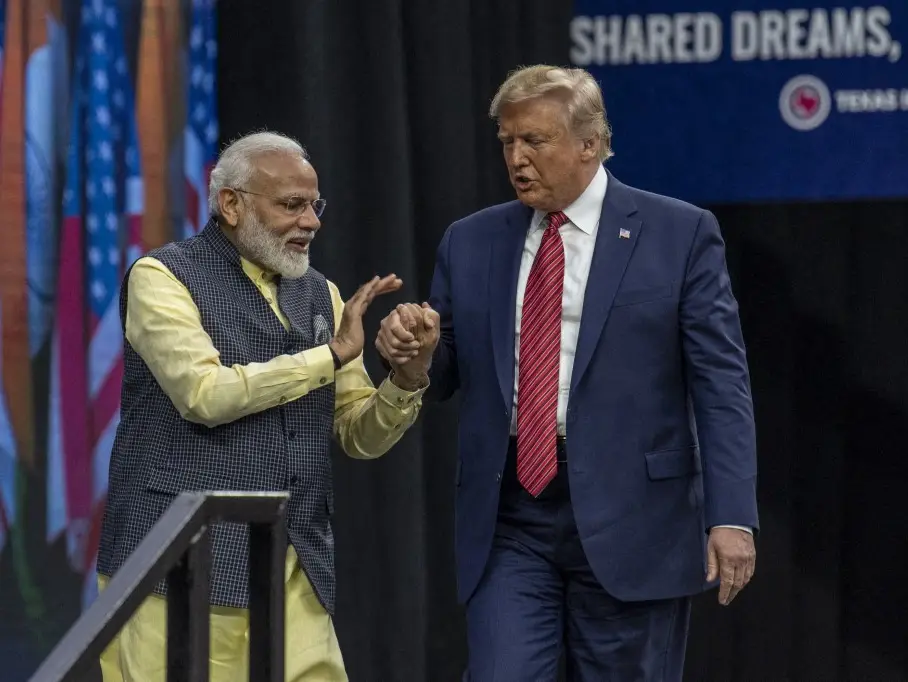
Who really blinked? That must be a question on many minds after President Donald Trump and Prime Minister Narendra Modi greeted and tweeted to announce what looked like the contours of a much-delayed Indo-US trade agreement. But don’t look for the answer just yet.
There are quite a few uncertainties looming over the deal, that the only thing that can be said with a degree of certainty is that both parties have agreed that it is better to do business with each other in a long-standing strategic relationship, rather than prolong a months-long standoff on tariffs and much else in geopolitics that cast a long shadow over ties between the world’s two biggest democracies. India, with the US as its largest trading partner, had much at stake.

Right now, it is a moment for sentimental appreciation. India’s stock market, which plunged on a marginal tweak-up in the Securities Transaction Tax (STT) in Sunday’s budget announcements, are up nearly 3 per cent in an overnight mood makeover. What really matters in the long run, however, would be a sector-wise list of winners and losers.
On the one hand, there is a case for seeing this as a TACO (Trump Always Chickens Out) moment in which the White House incumbent goes back on his early bombast, but claims victory after a climbdown. On the other hand, the troubles are not over for India. As a source close to the negotiators from the Indian side says: Eighteen is the new zero!
Trump has essentially rolled back his big “reciprocal tariff” hit from 25% to 18% apart from dropping his additional “punitive surcharge” of 25% linked to Russian oil purchases in the aftermath of the Ukraine conflict. But it is not quite the same as nil. As the source says, what we have is a “very limited agreement” restricted to the narrow Washington interest in goods that were already in the works but were stuck in a clash of attitudes. The bottom line: while the US has got away with zero duty on a few items, India may have to contend with the “new zero”.
Trending Stories
)
US vs China over South China Sea: Washington backs Philippines, Beijing hits back
)
Bigg Boss 20: Isha Rikhi evicted after three weeks in Salman Khan’s show
)
Musk plans to more than double xAI's chips to over 1.2 million Nvidia GPUs by year-end
)
After JU, clash erupts at SRFTI: BJP’s ‘Dimagi Naxal’ jibe sparks political firestorm after students protest RSS-linked event
)
‘Anti-social elements spreading false rumours’: LPU issues statement amid massive unrest over alleged rape
)
LPU students go on rampage, vandalise campus amid widespread protest: What's happening
)
Trump asked Xi to pressure Iran. China did not say yes — here’s what Beijing wants
)
US Treasury Secretary Scott Bessent hails global crackdown on Iranian banks and airlines
)
An OpenAI agent escaped its locked test cage again, by hiding questions in DNS lookups
)
'Our video was trimmed': LPU girls who featured in rape-denial video make U-turn
)
3 males killed, four others injured in shooting after fight at strip club in Detroit
)
'Victory for low-budget consumers': Raghav Chadha hails 30-day telecom recharge rules
)
Claude rebuilt the 1989 game 'Prince of Persia' by reusing the original's own code
)
Beyond metros: How Tier-2 and Tier-3 cities could drive India’s next AI wave
)
Tesla builds first Cybertruck with its own refined lithium: Elon Musk's $1 billion Texas bet pays off
)
IndiGo flight suffers tail strike in Bengaluru while landing; DGCA to probe incident
)
The US and China set up an AI 'red telephone', but skipped the rulebook
)
‘Terror suspects arrested near UK air base were looking to do big damage’: Trump
)
Russian envoy claims US tactics to contain India were revealed in ‘Freudian slip’
)
IND vs WI 1st ODI: Kohli breaks Sachin's most runs in one country record with unbeaten 139 as India thump West Indies by 8 wickets
)
Researchers rebuilt exactly how 700 AI agents hacked Hugging Face: a 900-link chain trick
)
‘Olympic inclusion is our major target’: WPA President Ishaun Singh on pool’s global ambitions
)
Nations League: Spain sink England at Wembley; Modric shines for Croatia
)
Why has Iran released no proof of life of Mojtaba Khamenei? Araghchi reveals...
)
'What kind of confession is this?': Pakistan PM Shehbaz Sharif’s 'terrorists would be roaming New York' remark goes viral, raises alarm online. Watch
)
South Korea demands apology from Ukraine over North Korean prisoners' transfer
)
Beyond BrahMos: India targets Rs 50,000 crore in defence exports with unmatched price edge
)
Sri Lankan Tamil migrant worker gets death sentence in Saudi Arabia, help sought from India
)
Muslim marriage cannot shield sex with minor wife from prosecution under POCSO: Delhi HC
)
'Can't help but draw painful parallels to Nirbhaya case': SC on latest incidents of rape cases in Delhi-NCR
)
99.9% more powerful - Scientists find boy who can recall memories from just 3 months of age
)
'FIRST LOOK from inside Noah’s Ark': Researchers share video from inside mysterious mound in Turkey
)
UNSC reform momentum grows: Russia, Portugal, Mauritius push for India's permanent seat bid
)
8 US marines injured in Iranian missile attack on vessel in Strait of Hormuz: Report
&im=FitAndFill=(700,400))
New OTT releases this week (September 28-October 4, 2026): Dupahiya 2, Pooja Meri Jaan, Ohh My Dog- 5 titles coming on Netflix, Prime Video and more
)
Afghanistan says 28 fighters killed in clash near Pakistan border, Islamabad denies
)
Ceuta migrant crisis: Protesters take to streets as Spain grapples with migrant challenge
)
LPU suspend classes, postpones exams as violence escalates over rape claims: What's happening
)
New York City wants a 'kill switch' on every AI, and will pay whistleblowers who report violations
What we are seeing, as note in stock movements, is a sigh of relief in export-oriented Indian sectors such as apparel, chemicals, textiles and engineering goods that were stopped on their tracks by the steep tariffs.
The limited agreement resembles a discount sale in an online marketplace -- more of an alluring advertising opportunity than a real bargain.
Trump’s social media boast that India has agreed to slash Russian oil purchases while buying more from the US and Venezuela is full of diplomatic pinpricks, given that it subjects India into a trade blackmail. Nevertheless, the rollback is a confirmation that the US gave way after India’s posturing signalling a step-up of relations with Moscow and the China-centric Shanghai Cooperation Organisation. India is yet to give up Russian oil purchases, though they are down. From all indications, Venezuela is just a boast factor for Trump, as the oil reserves in that country are of a poor quality and involve steep cost considerations for refiners.
There are more questions hanging in the air. What happens to US visa restrictions that have stymied India’s information technology exports, or, for that matter, rants by Trump’s far-right Republican supporters against immigration that borders on racism even against Indian Americans? Given that the Indian rupee has weakened in recent months against the US dollar, one wonders how much the competitiveness and profit margins of India’s merchandise exports eroded by 18% tariffs will be offset by the currency gain.
In the backdrop, we have everything from artificial intelligence (AI) and its future gains and the US-led ‘Pax Silica’ which Washington launched last month to secure supply chains for semiconductors and AI to counter China’s grip on critical minerals. India is yet to join the Western alliance and there is reason to believe Trump’s climbdown also factored in the need to include India in the alliance given its significant clout in the software revolution of which AI is only the next frontier.
Unlike the recently concluded India-European Union free trade agreement (FTA), the trade deal with the US is not a signed and sealed agreement yet. Geopolitical issues hang in the air, particularly on Washington’s wish to make India abandon its work in Iran’s Chabahar port. The extraordinary warmth Trump showed with Pakistan’s military chief Asim Munir and Islamabad’s establishment last year in the wake of India’s Operation Sindoor retaliation against the Pahalgam terror attack in Kashmir cannot be forgotten in a hurry.
Trump’s sweeping claim that India had agreed to reducing its tariffs and non-tariff barriers to zero and buying various US goods including energy products worth “more than $500 billion” are too vague to be accepted or dismissed at face value. We will have to wait and see. No time horizon has been cited.
What remains is the ground reality: Geopolitically and economically, and given the nature of emerging technologies and America’s priority to contain China, India remains important for whoever sits in the White House. Besides, it is difficult to imagine the US without Silicon Valley, whose technology pioneers are unlikely to stomach for long a president seen hostile to India.
But that is hardly a victory for the Modi government. It is more like some elbow room that needs to be utilised properly. Perhaps we can say the same about Trump whose Republicans face mid-term Congressional elections later this year. We are living in a diplomatically volatile world beset with technological uncertainties and inward-looking politics everywhere. The dust won’t settle so soon.
