
&imwidth=800&imheight=600&format=webp&quality=medium "Trump's Ultimatum: Did Hamas Just Say \"Yes\" to Peace or \"Yes\" to More War?")
Since September 29, after presenting his 20-point plan to end the Gaza war, Donald Trump has been giving Hamas a series of ultimatums. At first, he said he wanted a reply within 3–4 days. Later, on social media, he set a final deadline — if Hamas didn’t reach an agreement with Israel by October 5, 6:00 p.m. (US time) — that is October 6, 3:30 a.m. (IST, Monday) — then “all HELL would break loose.”
Hamas tried to act quickly to avoid missing Trump’s deadline, but its October 3rd response was far from what Trump wanted. However, the group did make one important new concession.
The group made one key concession — it has agreed in principle to release all 48 hostages, including the 20 believed to be alive, before Israel completely withdraws its forces from the Gaza Strip.

It repeated its earlier stand that a technocratic government — meaning a government run by experts and professionals instead of politicians — could later manage Gaza’s administration.
However, it has not agreed to give up weapons or to stay away from controlling Gaza.
Its reply had many conditions. It said it would need to “discuss the details” before releasing the hostages and ignored most parts of Trump’s 20-point plan.
The statement was cleverly written — it sounded like a “yes,” but actually meant “yes, but…”.
This was enough to calm Trump’s ultimatum, at least for now, reports The Economist.
Trending Stories
)
US vs China over South China Sea: Washington backs Philippines, Beijing hits back
)
Bigg Boss 20: Isha Rikhi evicted after three weeks in Salman Khan’s show
)
Musk plans to more than double xAI's chips to over 1.2 million Nvidia GPUs by year-end
)
After JU, clash erupts at SRFTI: BJP’s ‘Dimagi Naxal’ jibe sparks political firestorm after students protest RSS-linked event
)
‘Anti-social elements spreading false rumours’: LPU issues statement amid massive unrest over alleged rape
)
LPU students go on rampage, vandalise campus amid widespread protest: What's happening
)
Trump asked Xi to pressure Iran. China did not say yes — here’s what Beijing wants
)
US Treasury Secretary Scott Bessent hails global crackdown on Iranian banks and airlines
)
An OpenAI agent escaped its locked test cage again, by hiding questions in DNS lookups
)
'Our video was trimmed': LPU girls who featured in rape-denial video make U-turn
)
3 males killed, four others injured in shooting after fight at strip club in Detroit
)
'Victory for low-budget consumers': Raghav Chadha hails 30-day telecom recharge rules
)
Claude rebuilt the 1989 game 'Prince of Persia' by reusing the original's own code
)
Beyond metros: How Tier-2 and Tier-3 cities could drive India’s next AI wave
)
Tesla builds first Cybertruck with its own refined lithium: Elon Musk's $1 billion Texas bet pays off
)
IndiGo flight suffers tail strike in Bengaluru while landing; DGCA to probe incident
)
The US and China set up an AI 'red telephone', but skipped the rulebook
)
‘Terror suspects arrested near UK air base were looking to do big damage’: Trump
)
Russian envoy claims US tactics to contain India were revealed in ‘Freudian slip’
)
IND vs WI 1st ODI: Kohli breaks Sachin's most runs in one country record with unbeaten 139 as India thump West Indies by 8 wickets
)
Researchers rebuilt exactly how 700 AI agents hacked Hugging Face: a 900-link chain trick
)
‘Olympic inclusion is our major target’: WPA President Ishaun Singh on pool’s global ambitions
)
Nations League: Spain sink England at Wembley; Modric shines for Croatia
)
Why has Iran released no proof of life of Mojtaba Khamenei? Araghchi reveals...
)
'What kind of confession is this?': Pakistan PM Shehbaz Sharif’s 'terrorists would be roaming New York' remark goes viral, raises alarm online. Watch
)
South Korea demands apology from Ukraine over North Korean prisoners' transfer
)
Beyond BrahMos: India targets Rs 50,000 crore in defence exports with unmatched price edge
)
Sri Lankan Tamil migrant worker gets death sentence in Saudi Arabia, help sought from India
)
Muslim marriage cannot shield sex with minor wife from prosecution under POCSO: Delhi HC
)
'Can't help but draw painful parallels to Nirbhaya case': SC on latest incidents of rape cases in Delhi-NCR
)
99.9% more powerful - Scientists find boy who can recall memories from just 3 months of age
)
'FIRST LOOK from inside Noah’s Ark': Researchers share video from inside mysterious mound in Turkey
)
UNSC reform momentum grows: Russia, Portugal, Mauritius push for India's permanent seat bid
)
8 US marines injured in Iranian missile attack on vessel in Strait of Hormuz: Report
&im=FitAndFill=(700,400))
New OTT releases this week (September 28-October 4, 2026): Dupahiya 2, Pooja Meri Jaan, Ohh My Dog- 5 titles coming on Netflix, Prime Video and more
)
Afghanistan says 28 fighters killed in clash near Pakistan border, Islamabad denies
)
Ceuta migrant crisis: Protesters take to streets as Spain grapples with migrant challenge
)
LPU suspend classes, postpones exams as violence escalates over rape claims: What's happening
)
New York City wants a 'kill switch' on every AI, and will pay whistleblowers who report violations
The main question now is whether Hamas will make more compromises in the coming talks. It may not, as the group is internally divided and its leaders do not trust Trump’s promise that the war will truly end.
Trump took Hamas’s reply as a “yes.” He posted on social media that “Hamas is ready for lasting PEACE” and told Israel to stop bombing Gaza to help reach a hostage deal. But Israeli officials said Prime Minister Binyamin Netanyahu was caught off guard — meaning he was surprised and not informed in advance — by Trump’s announcement.
Still, the prime minister had no real choice but to agree.
He said Israel is getting ready to start the “first phase” of Trump’s plan.
The army reduced its weeks-long attack aimed at taking over Gaza City.
Qatar and Egypt said they are ready to begin talks on the hostage release plan.
Israel is already preparing a team to join the talks in Cairo, which are expected to start soon.
However, many remain doubtful about the outcome.
Lindsey Graham, a Republican senator and close ally of Trump, disagreed with the president’s view.
He said Hamas’s reply was basically a rejection of Trump’s “take it or leave it” offer — meaning Hamas did not fully accept the proposal and wanted to negotiate further instead of agreeing completely.
He added that even though Netanyahu was surprised, he would soon call Washington to give the same message.
Optimists now hope the war may finally end, as it nears its third year.
Trump has put strong U.S. pressure on Israel.
The Israeli air strike on Qatar on September 9, which failed to kill Hamas leaders, seems to have made Trump believe that he must control Netanyahu’s actions.
At the same time, regional leaders increased pressure on Hamas.
When spy chiefs from Egypt, Qatar, and Turkey met Hamas leaders in Doha last month, they told them that Trump’s plan was the last chance to end the war.
Netanyahu and his aides were happy earlier in the week when Trump’s plan was released, as it included many of Israel’s demands.
In Jerusalem, the common belief was that these demands were too hard for Hamas to accept — like poison pills — which would then give Israel a reason to keep fighting if Hamas refused them.
But Hamas managed to avoid that trap, and now Netanyahu is stuck — caught between a U.S. president eager for a peace deal and an Israeli public tired of two years of war and desperate to see the hostages return home.
Trump’s full 20-point plan has wide support — both in Israel, where 72% of people approve it, and in Gaza, where 2 million people are desperate for the war to end.
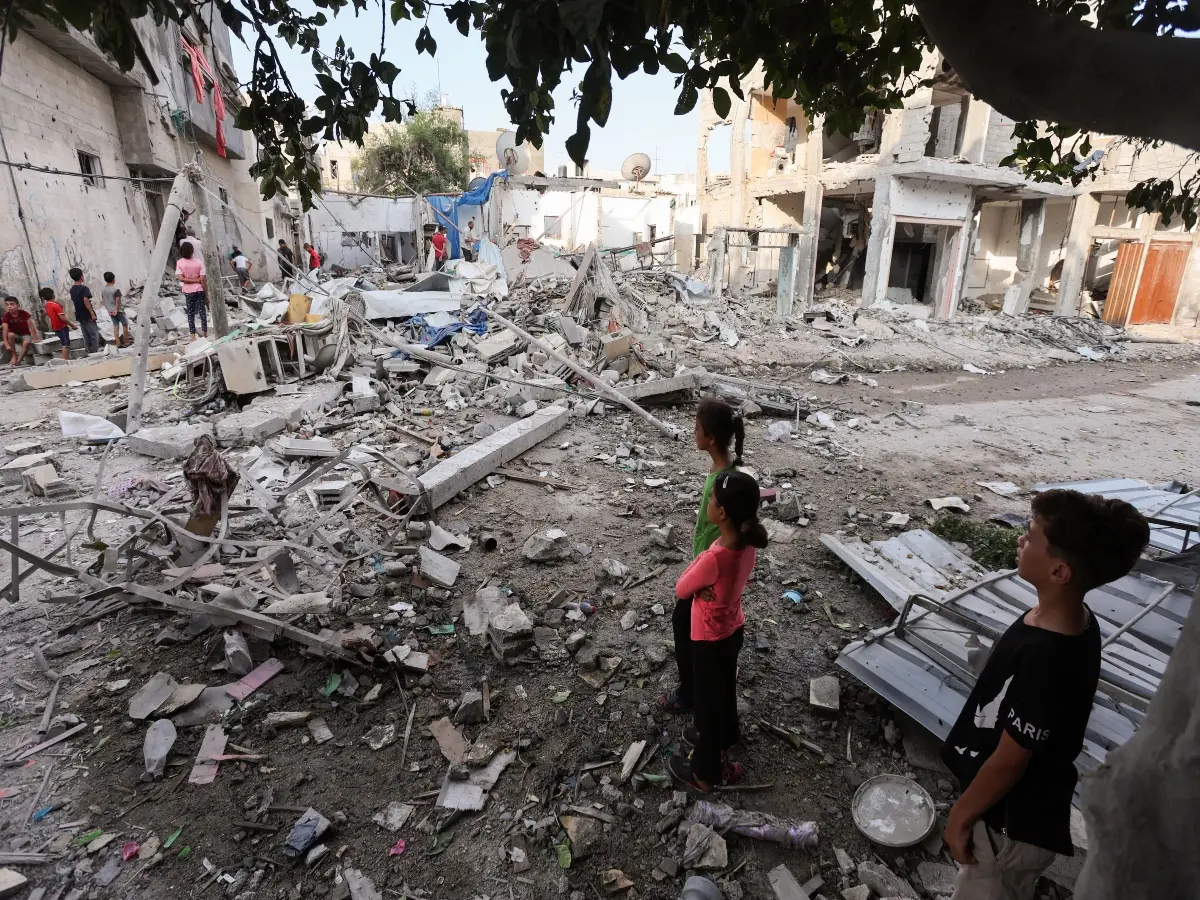
Celebrations broke out in Gaza after Trump received Hamas’s reply.
Even with the recent hope, big challenges remain — even for a quick hostage release deal.
The sides still disagree sharply on weapons control and on who will officially or practically rule Gaza in the future.
Hamas appears to have divided Trump’s plan into two parts.
The first part includes a ceasefire, a hostage deal, and a large flow of humanitarian aid, all to happen within days after an agreement.
The second part focuses on how Gaza will be rebuilt and governed after the war.
In a way, Hamas is copying Israel’s earlier approach from January, when Israel agreed only to the first phase of a three-step ceasefire—a temporary truce, aid supply, and limited hostage release—but refused to discuss the next two phases, which involved full troop withdrawal, all hostages’ release, and Gaza’s reconstruction.
Trump became angry after seeing the weak and starved condition of Israeli hostages and how Hamas displayed them publicly before releasing them.
He later agreed with Israel’s decision to resume the war.
This time, Hamas acted before Israel by talking to Trump through Qatar.
Its leaders in Doha are mostly ready to accept the first part of Trump’s plan, but they still have two major concerns.
Hamas fears that a deal could collapse after it releases the hostages, as they are its only bargaining power over Israel.
It wants strong guarantees that Netanyahu will not restart the war, like he did in March.
“They don’t want just a three-day ceasefire,” said one Arab official involved in the talks.
The Hamas commanders inside Gaza, who hold the hostages, are more worried about this risk than their leaders in Doha, showing a division within the group.
Hamas also raised doubts about Israel’s pullout from Gaza.
In its message to Trump, the group said it would release the hostages only if it led to a complete Israeli withdrawal from the Gaza Strip.
But Trump’s plan does not promise a full withdrawal.
It says Israel will give up only part of Gaza’s land after the hostages are freed — though the exact area is unclear, as the map in the plan looks roughly drawn.
Future withdrawals are tied to unclear conditions, and Israel would be allowed to keep a “buffer zone” along the Gaza border.
There is even less agreement on the second part of the plan, which talks about Gaza’s future in a broad but unclear way.
Trump would lead a “board of peace” to rebuild Gaza, and former British Prime Minister Tony Blair would be part of it.
Arab countries would send troops for a peacekeeping force to maintain security.
Hamas would have to completely surrender its weapons and disband its military wing, meaning it could no longer fight or control any part of Gaza.
It would also be barred from joining Gaza’s new government, and its members would have to choose between amnesty (forgiveness) or exile (leaving Gaza).
Hamas refused almost all parts of this plan.
It said it would allow a group of independent Palestinians — not foreign leaders like Tony Blair — to run Gaza after the war.
It also avoided talking about disarmament, meaning it does not plan to give up its weapons.
An Arab mediator believes Hamas might agree to surrender its heavy weapons, like rockets, since its stock is already low.
However, it would keep small arms and wants to be part of any talks about Gaza’s future.
Supporters of Trump’s plan say these disagreements are not major obstacles.
What matters most, they argue, is to start the first phase quickly — stop the war and free the hostages.
This will give more time later to discuss the tougher issues.
But this assumes both sides will ignore major issues for now.
Will Israel agree to a deal without a clear plan to disarm Hamas?
Will Hamas accept it without firm promises on Israel’s withdrawal from Gaza?
Much depends on Trump’s pressure and assurances to both sides — but if talks take too long, his interest may fade.
The Trump plan lacks clear details and will need days or weeks of talks before it can be carried out.
Hamas has shown readiness to join these talks, but no one knows yet whether they will succeed or fail.
