
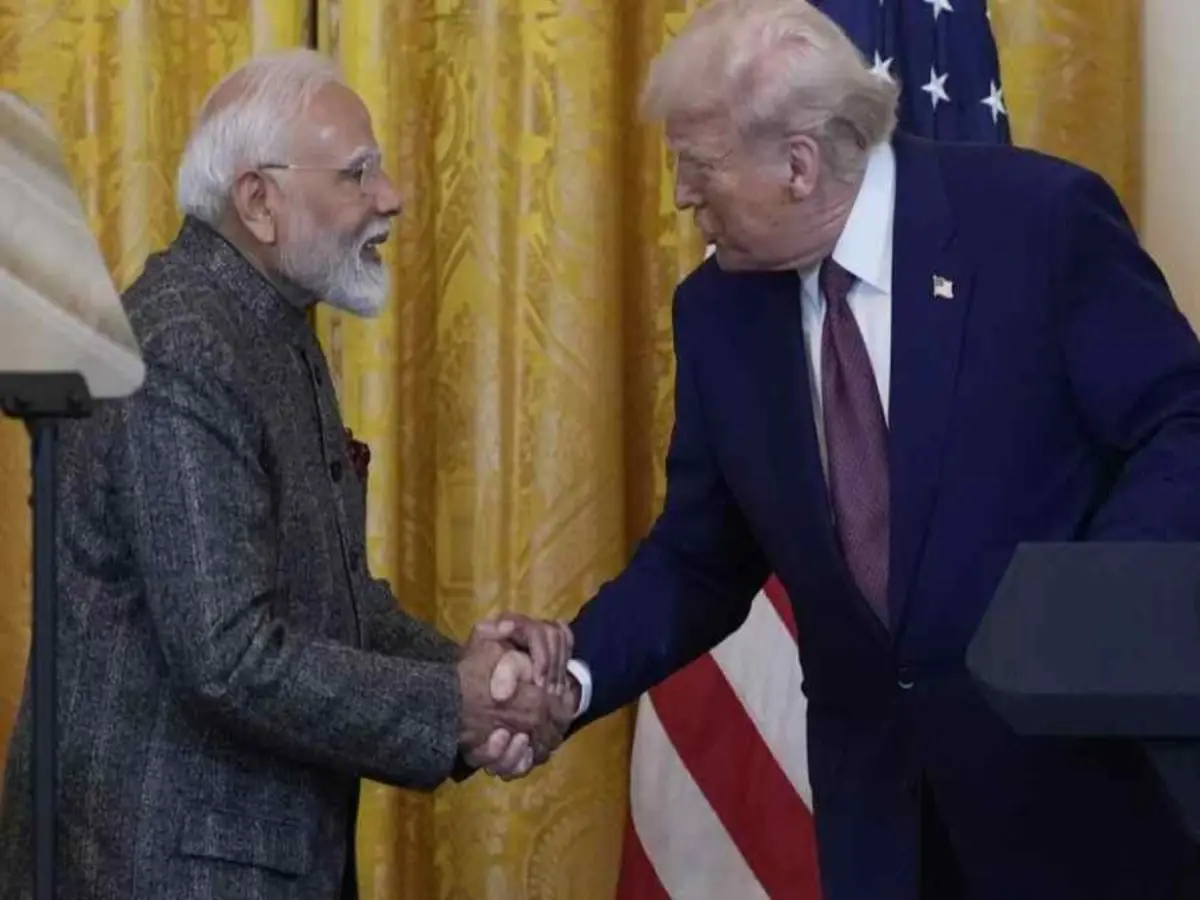
&imwidth=800&imheight=600&format=webp&quality=medium "Trade Tariffs, Tough Talk, & U-Turn! Trump Calls Modi ‘Great’ — Why It Matters and What’s Next”")
US President Donald Trump’s sudden reversal on India has become the talking point in global diplomacy. After weeks of tough talk, high tariffs, and social media criticism, Trump unexpectedly shifted his tone. He praised Prime Minister Narendra Modi as a “great Prime Minister” and called India-US ties “very special.” PM Modi, in a measured and statesmanlike response, reciprocated warmly and underlined the strength of the partnership.
This change is not just a passing remark. It carries deeper meaning. The US and India need each other for peace, prosperity, and balance in an uncertain world. The U-turn signals that even in times of strain, both democracies recognize the value of staying aligned.
Why Trump Changed His Tone

Trump’s hard line on India, marked by tariffs as high as 50 percent on Indian imports, was seen as punishment for New Delhi’s independent energy and trade policies. His criticism even extended to suggesting that India was drifting closer to Russia and China. But soon after, he walked back and stressed friendship.
Why this shift? The answer lies in strategic reality. Over the decades, successive governments on both sides of the Pacific have built a robust India-US partnership. India’s geographic position, economic strength, and democratic credentials make it indispensable for America’s long-term interests in Asia. India is part of the Indo-Pacific balance and a counterweight in an era of shifting alliances.
Economically too, India matters. It is the fastest-growing major economy and a huge consumer market. American companies such as Apple and Tesla see India as a vital investment hub. Equally, India’s pool of skilled professionals continues to strengthen US industries, from Silicon Valley to healthcare.
Trending Stories
)
US vs China over South China Sea: Washington backs Philippines, Beijing hits back
)
Bigg Boss 20: Isha Rikhi evicted after three weeks in Salman Khan’s show
)
Musk plans to more than double xAI's chips to over 1.2 million Nvidia GPUs by year-end
)
After JU, clash erupts at SRFTI: BJP’s ‘Dimagi Naxal’ jibe sparks political firestorm after students protest RSS-linked event
)
‘Anti-social elements spreading false rumours’: LPU issues statement amid massive unrest over alleged rape
)
LPU students go on rampage, vandalise campus amid widespread protest: What's happening
)
Trump asked Xi to pressure Iran. China did not say yes — here’s what Beijing wants
)
US Treasury Secretary Scott Bessent hails global crackdown on Iranian banks and airlines
)
An OpenAI agent escaped its locked test cage again, by hiding questions in DNS lookups
)
'Our video was trimmed': LPU girls who featured in rape-denial video make U-turn
)
3 males killed, four others injured in shooting after fight at strip club in Detroit
)
'Victory for low-budget consumers': Raghav Chadha hails 30-day telecom recharge rules
)
Claude rebuilt the 1989 game 'Prince of Persia' by reusing the original's own code
)
Beyond metros: How Tier-2 and Tier-3 cities could drive India’s next AI wave
)
Tesla builds first Cybertruck with its own refined lithium: Elon Musk's $1 billion Texas bet pays off
)
IndiGo flight suffers tail strike in Bengaluru while landing; DGCA to probe incident
)
The US and China set up an AI 'red telephone', but skipped the rulebook
)
‘Terror suspects arrested near UK air base were looking to do big damage’: Trump
)
Russian envoy claims US tactics to contain India were revealed in ‘Freudian slip’
)
IND vs WI 1st ODI: Kohli breaks Sachin's most runs in one country record with unbeaten 139 as India thump West Indies by 8 wickets
)
Researchers rebuilt exactly how 700 AI agents hacked Hugging Face: a 900-link chain trick
)
‘Olympic inclusion is our major target’: WPA President Ishaun Singh on pool’s global ambitions
)
Nations League: Spain sink England at Wembley; Modric shines for Croatia
)
Why has Iran released no proof of life of Mojtaba Khamenei? Araghchi reveals...
)
'What kind of confession is this?': Pakistan PM Shehbaz Sharif’s 'terrorists would be roaming New York' remark goes viral, raises alarm online. Watch
)
South Korea demands apology from Ukraine over North Korean prisoners' transfer
)
Beyond BrahMos: India targets Rs 50,000 crore in defence exports with unmatched price edge
)
Sri Lankan Tamil migrant worker gets death sentence in Saudi Arabia, help sought from India
)
Muslim marriage cannot shield sex with minor wife from prosecution under POCSO: Delhi HC
)
'Can't help but draw painful parallels to Nirbhaya case': SC on latest incidents of rape cases in Delhi-NCR
)
99.9% more powerful - Scientists find boy who can recall memories from just 3 months of age
)
'FIRST LOOK from inside Noah’s Ark': Researchers share video from inside mysterious mound in Turkey
)
UNSC reform momentum grows: Russia, Portugal, Mauritius push for India's permanent seat bid
)
8 US marines injured in Iranian missile attack on vessel in Strait of Hormuz: Report
&im=FitAndFill=(700,400))
New OTT releases this week (September 28-October 4, 2026): Dupahiya 2, Pooja Meri Jaan, Ohh My Dog- 5 titles coming on Netflix, Prime Video and more
)
Afghanistan says 28 fighters killed in clash near Pakistan border, Islamabad denies
)
Ceuta migrant crisis: Protesters take to streets as Spain grapples with migrant challenge
)
LPU suspend classes, postpones exams as violence escalates over rape claims: What's happening
)
New York City wants a 'kill switch' on every AI, and will pay whistleblowers who report violations
In this context, Trump’s U-turn was less about personal sentiment and more about recognizing ground realities. Alienating India could not only hurt US companies but also weaken America’s strategic influence in Asia.
India’s Mature Diplomacy
India, on its part, responded to the situation with balance and dignity. Throughout the tariff episode, New Delhi avoided sharp words or retaliation. Instead, it stuck to a calm, strategic communication style. PM Modi’s eventual response to Trump’s praise was measured: he highlighted mutual respect and reaffirmed the partnership.
This reflects India’s long-standing approach to foreign policy. Guided by the principle of Vasudhaiva Kutumbakam—the world is one family—India seeks global peace and cooperation, not confrontation. At the same time, it protects its sovereignty and makes independent choices, whether on energy, trade, or defense.
India’s focus on “Make in India” and “Make for World” highlights its dual ambition: self-reliance at home and contribution to global prosperity abroad. By avoiding any warlike rhetoric, India showed the world that it stands for constructive engagement, even under pressure.
Another dimension is the strength of the Indian diaspora in the US Millions of Indian-origin Americans contribute significantly to the US economy and society. They form a natural bridge between the two democracies and are an important factor in shaping US policies toward India.
Shared Need for Peace and Prosperity
The India-US relationship is not just transactional. It is strategic, people-driven, and rooted in shared democratic values. Both countries want an open, stable global order. They have cooperated on defense, technology, clean energy, and regional stability. Both stand against terrorism and support freedom of navigation in the Indo-Pacific.
Even when disagreements emerge—whether on trade or foreign policy—these are bumps on a larger road. The big picture remains the same: the US needs India as a trusted partner in Asia, and India needs the US as a reliable economic and technological ally. Together, they act as stabilizers in a world facing conflicts, recession risks, and geopolitical rivalries.
What Could Be Next
Trump’s U-turn is more than an adjustment of words. It is a recognition that India cannot be sidelined in any global strategy. The US may impose tariffs or raise concerns, but ultimately, cooperation with India is unavoidable. For India, the episode reaffirms the wisdom of patience and diplomatic maturity.
What could be next? The coming months may see new negotiations on trade, technology, and defense. US companies are expected to expand their presence in India, while strategic cooperation in the Indo-Pacific could deepen further. On the global stage, India is likely to leverage this renewed warmth to strengthen its voice at the United Nations, the G20, and other multilateral platforms.
Trump’s softer stand may also have a domestic angle. With elections approaching in the US, outreach to the influential Indian diaspora and projecting strong India ties could become part of his campaign narrative. On the other hand, India will continue to walk its independent path, balancing relations with multiple powers while safeguarding its sovereignty.
The reset shows that even in moments of friction, India and the US remain bound by shared interests and larger responsibilities. If both nations now build on this opening with vision and consistency, their partnership can not only secure prosperity for their people but also shape the future of global peace, stability, and economic growth. In an era of shifting powers, this may well be one of the defining alliances of the 21st century.