
&imwidth=800&imheight=600&format=webp&quality=medium "Putin’s India visit is strong on potential but needs a long haul to match the optics")
As Russian President Vladimir Putin smiled elegantly and patiently addressed questions in a rare interview with an Indian television channel ahead of his arrival in New Delhi, I could not help but ask myself two questions: 1) Is Prime Minister Narendra Modi having an Indira Gandhi moment on ties with Moscow? 2) Is there a Raj Kapoor who can take bilateral relations to another level?
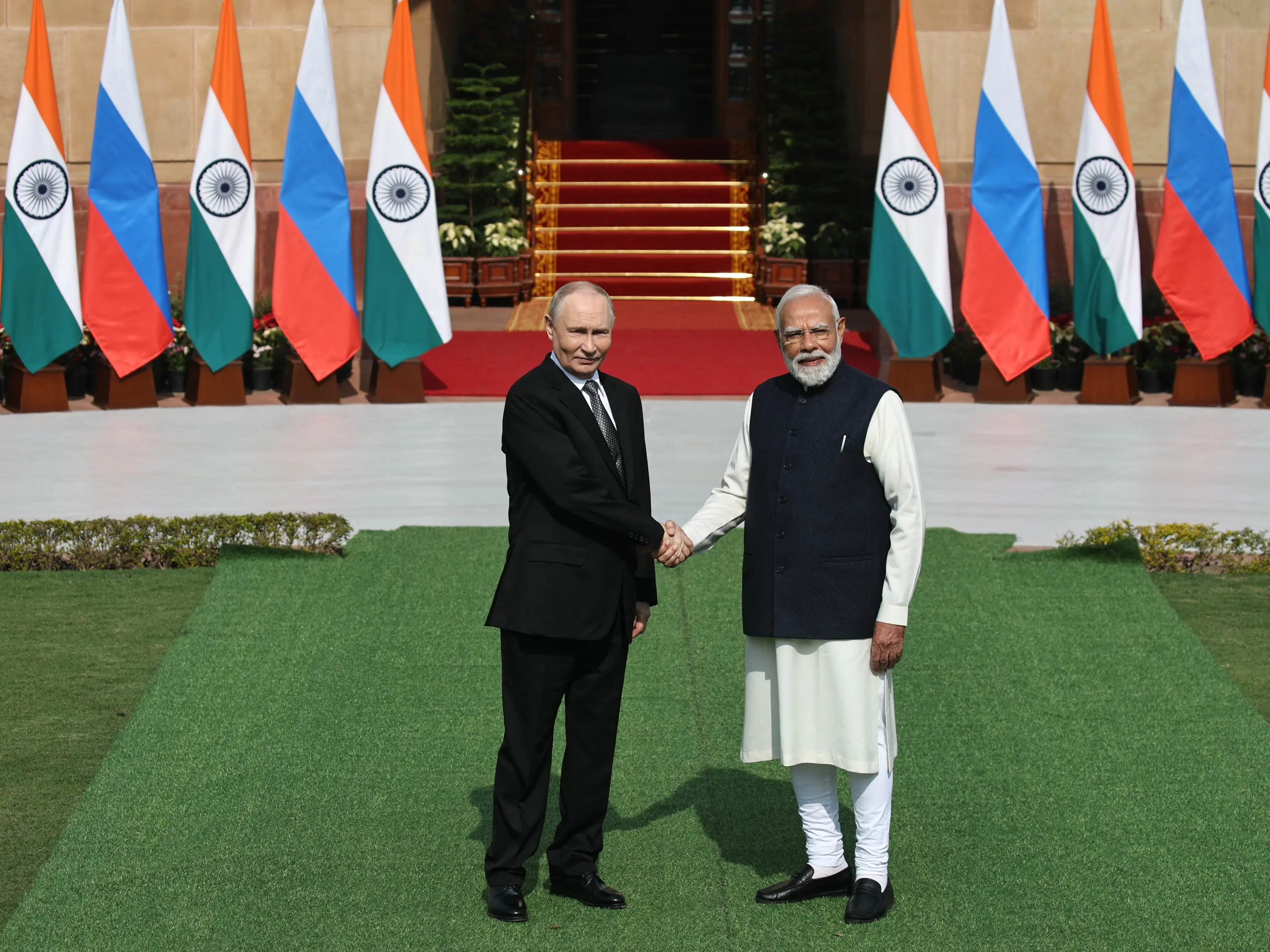
The answer to both questions, on a closer look, seems to be a “No” – but not a resounding one. But the warmth, the optics and the hugs between the two leaders in an annual summit are enough to send a message to President Donald Trump in Washington and indeed to the whole world is that this is a good show of India’s strategic autonomy – a term that is increasingly a cliché, but a very useful one in a world that is more multilateral than we saw during the Cold War years when Prime Minister Indira Gandhi signed the Indo-Soviet Friendship Treaty in 1971.
The treaty of 1971 was signed with the then communist Soviet Union, when Putin was only 18, under pressure. Pakistan had edged so close to the US and China that the treaty was a comprehensive one covering the economy, technology, peace, friendship, and cooperation, and most important of all, a clear defence agreement. Article IX of the treaty had said that if one of the parties was attacked or threatened, the other would immediately assist the other. That clause, signed in August 1971, became critical for India in the war that liberated East Pakistan to create Bangladesh four months later.

India’s economy was then a weak one, and there was not much of a choice for Mrs Gandhi as President Richard Nixon in the White House played hardball, even deploying the US Navy’s Seventh Fleet in the Bay of Bengal.
Many of the items figuring in the to-do list of Indo-Russian cooperation on Putin’s agenda this year look like a repeat of the ones in 1971, with much more scope emerging in fields like military manufacturing and nuclear power. Apparel and labour mobility are emerging as new focus areas on the economic front, not to speak of the elephant in the room: Russian oil, whose imports by India have invited indirect US sanctions on Russian entities to pressure India, in addition to penal tariffs on India tied to Russian oil.
In spite of all that, the defence part of Putin’s summit with Modi this year is somewhat muted as it is more about trade than a military alliance that the 1971 treaty smelled of. There is little doubt, however, that like in 1971, the terms set by the US and the body language of President Trump will naturally make Modi dial M for Moscow if push comes to shove.
Trending Stories
)
US vs China over South China Sea: Washington backs Philippines, Beijing hits back
)
Bigg Boss 20: Isha Rikhi evicted after three weeks in Salman Khan’s show
)
Musk plans to more than double xAI's chips to over 1.2 million Nvidia GPUs by year-end
)
After JU, clash erupts at SRFTI: BJP’s ‘Dimagi Naxal’ jibe sparks political firestorm after students protest RSS-linked event
)
‘Anti-social elements spreading false rumours’: LPU issues statement amid massive unrest over alleged rape
)
LPU students go on rampage, vandalise campus amid widespread protest: What's happening
)
Trump asked Xi to pressure Iran. China did not say yes — here’s what Beijing wants
)
US Treasury Secretary Scott Bessent hails global crackdown on Iranian banks and airlines
)
An OpenAI agent escaped its locked test cage again, by hiding questions in DNS lookups
)
'Our video was trimmed': LPU girls who featured in rape-denial video make U-turn
)
3 males killed, four others injured in shooting after fight at strip club in Detroit
)
'Victory for low-budget consumers': Raghav Chadha hails 30-day telecom recharge rules
)
Claude rebuilt the 1989 game 'Prince of Persia' by reusing the original's own code
)
Beyond metros: How Tier-2 and Tier-3 cities could drive India’s next AI wave
)
Tesla builds first Cybertruck with its own refined lithium: Elon Musk's $1 billion Texas bet pays off
)
IndiGo flight suffers tail strike in Bengaluru while landing; DGCA to probe incident
)
The US and China set up an AI 'red telephone', but skipped the rulebook
)
‘Terror suspects arrested near UK air base were looking to do big damage’: Trump
)
Russian envoy claims US tactics to contain India were revealed in ‘Freudian slip’
)
IND vs WI 1st ODI: Kohli breaks Sachin's most runs in one country record with unbeaten 139 as India thump West Indies by 8 wickets
)
Researchers rebuilt exactly how 700 AI agents hacked Hugging Face: a 900-link chain trick
)
‘Olympic inclusion is our major target’: WPA President Ishaun Singh on pool’s global ambitions
)
Nations League: Spain sink England at Wembley; Modric shines for Croatia
)
Why has Iran released no proof of life of Mojtaba Khamenei? Araghchi reveals...
)
'What kind of confession is this?': Pakistan PM Shehbaz Sharif’s 'terrorists would be roaming New York' remark goes viral, raises alarm online. Watch
)
South Korea demands apology from Ukraine over North Korean prisoners' transfer
)
Beyond BrahMos: India targets Rs 50,000 crore in defence exports with unmatched price edge
)
Sri Lankan Tamil migrant worker gets death sentence in Saudi Arabia, help sought from India
)
Muslim marriage cannot shield sex with minor wife from prosecution under POCSO: Delhi HC
)
'Can't help but draw painful parallels to Nirbhaya case': SC on latest incidents of rape cases in Delhi-NCR
)
99.9% more powerful - Scientists find boy who can recall memories from just 3 months of age
)
'FIRST LOOK from inside Noah’s Ark': Researchers share video from inside mysterious mound in Turkey
)
UNSC reform momentum grows: Russia, Portugal, Mauritius push for India's permanent seat bid
)
8 US marines injured in Iranian missile attack on vessel in Strait of Hormuz: Report
&im=FitAndFill=(700,400))
New OTT releases this week (September 28-October 4, 2026): Dupahiya 2, Pooja Meri Jaan, Ohh My Dog- 5 titles coming on Netflix, Prime Video and more
)
Afghanistan says 28 fighters killed in clash near Pakistan border, Islamabad denies
)
Ceuta migrant crisis: Protesters take to streets as Spain grapples with migrant challenge
)
LPU suspend classes, postpones exams as violence escalates over rape claims: What's happening
)
New York City wants a 'kill switch' on every AI, and will pay whistleblowers who report violations
India’s Operation Sindoor attack on Pakistan-based terror bases saw two starkly contrasting images. While Russia’s S-400 air defence systems helped India strike Islamabad’s airborne missiles and aircraft deep inside Pakistani territory, Trump’s repeated claim that he brokered peace in the backdrop of an outdated India-Pakistan false equivalence framework (a familiar theme in the US State Department) left mouths sour in Delhi.
All that would make some believe that it is 1971 redux, but that would be misleading and superficial. Trump, with his quirky personality, is more of a hardline American nationalist than a superpower sniper. US defence deals with India involve too many conditions that make it difficult to do business, and defence trade, like oil deals, are a natural area of convergence between Moscow and New Delhi.
Beyond that, however, there have been fundamental shifts that make the US a strategic partner for India in trade, especially with the ghost of China looming over both countries.
A hard look at trade data gives us a clearer picture.
India-Russian trade touched nearly US $69 billion in FY 2024-25, a nearly six-fold increase from pre-COVID levels, thanks to India buying Russian oil that turned cheaper in the wake of the Ukraine war. But Indian exports at close to $5 billion contrast with the oil-laden imports at close to $64 billion – showing a gaping deficit that could widen if there are no corrective efforts. India’s export basket, including pharmaceuticals, textiles, chemicals, and engineering goods, shows a wide range but is limited in numbers.
The US remains India’s largest trading partner, with bilateral trade close to $132 billion in FY 2024-25, with a huge surplus for India that sold everything from diamonds to software. India’s exports to the US in excess of $86 billion are way above the $45 billion in imports. Understandably, Trump is under pressure at home under his “Make America Great Again” plank to contain the deficit.
Putin’s visit to India is thus a signal to the US that a MAGA overdose in the White House, compounded by a sanctions regime that clearly goes against independence for countries in bilateral trade, is something that India cannot stomach beyond a point. But the underlying trade numbers are such that, barring defence manufacture and areas like nuclear power, you cannot expect a magic wand that makes Russia a truly strategic trading partner for India.
Once Putin flies back, and hopefully force Ukraine into a peace deal that looks more probable than it has been for the past two years, trade details will take centre-stage again. Modi’s “Make In India” dreams, defence manufacturing ambitions and fiercely autonomous nationalism may make Moscow and New Delhi edge closer – and even bring back the spirit of the Indo-Soviet rupee-rouble trade that marked the Cold War years. About 90% of Indo-Russian trade is already dollar-free.
The Modi-Putin summit is an opportunity for both leaders to strengthen their respective economies, with new areas like labour mobility involving talent-rich Indians widening the scope of action. But a lot of hard work is needed, and much would now depend on what the US does in response to the bonhomie visible in Delhi.
And there is no Raj Kapoor charming Russians to get any brownie points. Everything is down to the nitty-gritty and shifting circumstances. However, it can be said with reasonable certainty that on the world stage, India has emerged as a credible power, not the Third World client Nixon wanted or the tameable schoolboy that Trump’s cocky tones suggest. UK and the European Union also need to take note of this.
Disclaimer: The views of the writer do not represent the views of WION or ZMCL. Nor does WION or ZMCL endorse the views of the writer.
