A protest, a resignation, and a decade in service of India's youth

&imwidth=600&imheight=450&format=webp&quality=medium "A protest, a resignation, and a decade in service of India's youth")
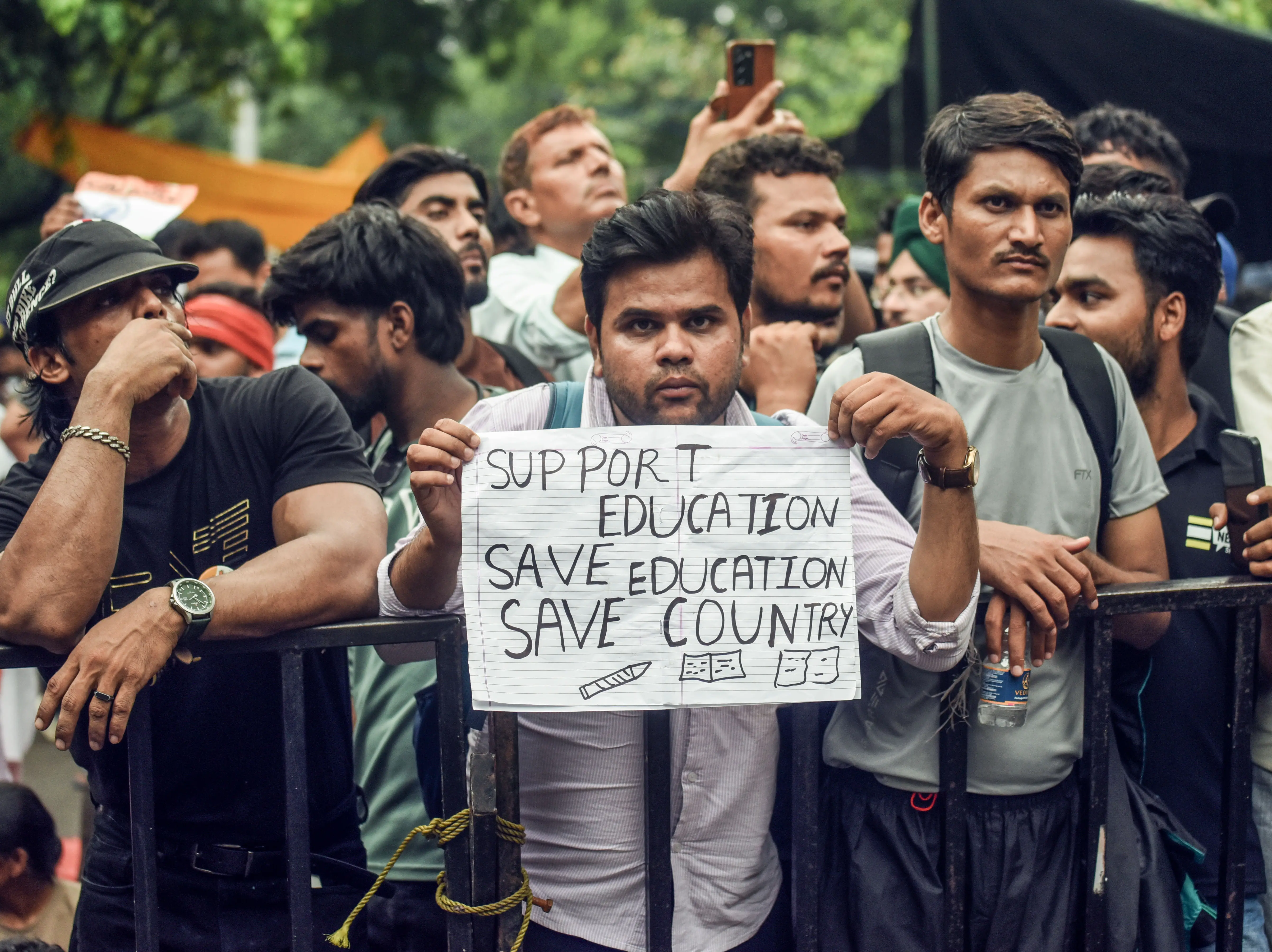
Cockroach Janta Party (CJP) supporters during the protest at Jantar Mantar. Photograph: (ANI)
The protesters who camped at Jantar Mantar were not wrong to be angry, and the government recognises that. What can be said, honestly, is this: across education, employment, etc the last 12 years represent the most sustained institutional investment in Indian youth since independence.
New Delhi has been quiet for a few days now after Dharmendra Pradhan resigned as Union Education Minister, acknowledging the gravity of the paper leak that had brought lakhs of young Indians onto the streets. The agitation was withdrawn once the government agreed to the remaining demands and a five-point charter for structural exam reform put forth by the agitators.
The CBI has since arrested several people, including coaching staff and an examination-linked doctor. Pralhad Joshi has taken charge as the new Education Minister, and Parliament has introduced the Public Examinations (Prevention of Unfair Means) Amendment Bill, 2026, raising the maximum prison term to ten years and the fine to Rs 10 crore, with fast-track courts.
The reform charter is substantial: an independent National Examination Integrity Authority, AI-based threat detection, blockchain-secured papers, biometric authentication, and a 24x7 security command centre. Investigations would be time-bound to ninety days, guilty institutions permanently debarred, and whistleblowers protected. A national exam calendar, independent audits, a student advisory council, mental health support, and an annual integrity report to Parliament complete the fifteen measures, a shift from damage control to structural accountability.
This is the right outcome, and it is worth saying so plainly. But it would be equally intellectually honest to acknowledge twelve years of sustained, deliberate investment in India's youth.
Education reform, not just examination reform
The National Education Policy (NEP) 2020 was the first genuine rewrite of India's education architecture in 34 years, replacing the 1986 framework with multiple entry-exit points, vocational integration from school, and a break from rote learning. The expansion since 2014 has been structural: IITs have grown from 16 to 23, IIMs from 13 to 21, and AIIMS from 7 to 23. Medical colleges have more than doubled, from 387 to 844. A government that is invested so heavily in opportunity cannot let the gatekeeping mechanism to it be compromised. That is why the Public Examinations Act was legislated, and why its enforcement, not its existence, is now rightly under evaluation.
Sport, culture, and dignity of youth ambition
Khelo India and the Target Olympic Podium Scheme (TOPS) have professionalised sport as a viable youth career rather than a hobby subsidised by chance. TOPS today supports over 230 elite, para and development athletes with stipends and specialised training. India's Olympic tally rose from two medals at Rio 2016 to seven at Tokyo 2020; its Paralympic count climbed to a record 29 at Paris 2024; and its Asian Games medals rose from 57 in 2014 to 107 at Hangzhou 2023.
The macroeconomic architecture of opportunity
Trending Stories
)
)
)
)
)
)
)
)
)
)
)
)
)
)
)
)
)
)
)
)
)
&im=FitAndFill=(700,400))
)
)
)
)
)
)
)
)
&im=FitAndFill=(700,400))
)
)
&im=FitAndFill=(700,400))
)
Consider access to opportunity more broadly. As of mid-2026, over 57 crore Mudra loans worth more than Rs 40 lakh crore have been disbursed since 2015 to first-generation YOUNG entrepreneurs, mostly without collateral. Startup India has helped build the world's third-largest startup ecosystem, with more than 125 unicorns founded by entrepreneurs who had no domestic capital pathway a decade ago. Meanwhile, the transformative Digital India mission has built more than infrastructure -- it has created a gig economy and formalised credit, identity, and access to banking for young Indians who had none of it just a decade ago.
Meeting its own high standard
None of this is offered as an alibi. The protesters who camped at Jantar Mantar were not wrong to be angry, and the government recognises that. What can be said, honestly, is this: across education, entrepreneurship, employment, digital access, and sport, the last twelve years represent the most sustained institutional investment in Indian youth since independence, measured not only in schemes launched but in jobs added and enterprises built.
Sarsanghchalak Mohan Bhagwat observed last week that youth today expect reasoning, not obedience, and that the new generation asks questions, and we must explain the reasoning to them, emphasising it is important for families to connect with the young through dialogue, not authority. Indeed, and for a government that has staked its legitimacy on being pro-youth, it has more to lose from a broken exam system than any criticism or protest, which is why it has always focused on dialogue and delivery.
Accountability delivered, not just promised, is not a favour to protesters. It is a government living up to its own stated standard. This month, the government met the standard it had set for itself.
