The worst is over when it comes to slowing GDP growth

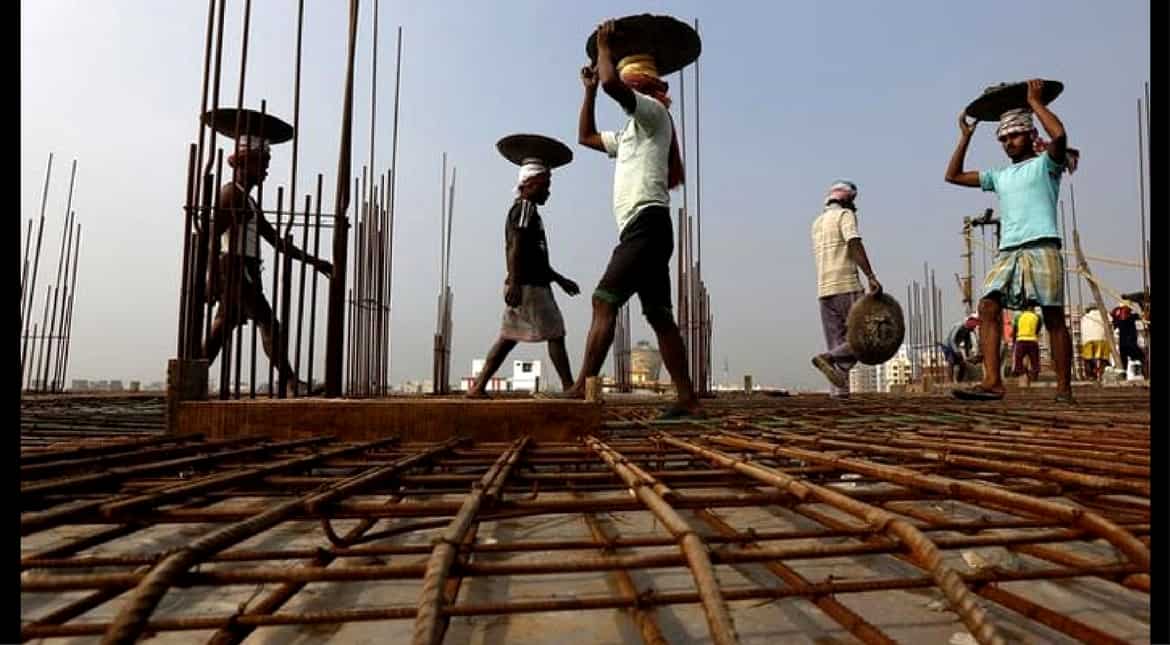
Slowing GDP
For those of us who have been watching this great nation take massive economic strides in the past three decades, a modest pull back is an opportunity to load up on some serious stocks.
Teary-eyed commentators have already beaten their chests hollow on how the twin curses of Demonetisation and implementation of the Goods & Services Tax have slowed India's economic engine to a mere 5.7 per cent expansion. The Opposition has already gone for the government's jugular for these two apparent self-goals and everyone on Dalal Street is anxious to know whether the ongoing bull market in stock prices will continue or not.

So, what really happened and what is in store for India's economy, arguably the finest that is there in the global space as of now. Well, some of the brightest are missing the fine print: the economy is in a temporary trough and just paused a bit in a bid to accelerate further. It's the proverbial arrow that is pulled back on the bow before it hits the Bulls Eye.
Often, when all the chips are down, it is Bollywood that saves the day: Therefore, "Picture abhi baaki hai, mere dost"! Such is the resilience of the Indian economy that it will ensure growth returns in leaps and bounds. And there are enough economic indicators that are pointing to it.
True, second quarter GDP slowed to 5.7 per cent as companies cleaned up inventories and refused to manufacture on a large scale as the newly minted GST came into effect on July 1st. Since tax rates were to change largely for the better, sensible manufacturers thought it best to pause their production units for a while. That is the reason why you see manufacturing slowing to just 1.2 per cent growth during April-June versus 5.3 per cent in January-March.
)
US vs China over South China Sea: Washington backs Philippines, Beijing hits back
)
Bigg Boss 20: Isha Rikhi evicted after three weeks in Salman Khan’s show
)
Musk plans to more than double xAI's chips to over 1.2 million Nvidia GPUs by year-end
)
After JU, clash erupts at SRFTI: BJP’s ‘Dimagi Naxal’ jibe sparks political firestorm after students protest RSS-linked event
)
‘Anti-social elements spreading false rumours’: LPU issues statement amid massive unrest over alleged rape
)
LPU students go on rampage, vandalise campus amid widespread protest: What's happening
)
Trump asked Xi to pressure Iran. China did not say yes — here’s what Beijing wants
)
US Treasury Secretary Scott Bessent hails global crackdown on Iranian banks and airlines
)
An OpenAI agent escaped its locked test cage again, by hiding questions in DNS lookups
)
'Our video was trimmed': LPU girls who featured in rape-denial video make U-turn
)
3 males killed, four others injured in shooting after fight at strip club in Detroit
)
'Victory for low-budget consumers': Raghav Chadha hails 30-day telecom recharge rules
)
Claude rebuilt the 1989 game 'Prince of Persia' by reusing the original's own code
)
Beyond metros: How Tier-2 and Tier-3 cities could drive India’s next AI wave
)
Tesla builds first Cybertruck with its own refined lithium: Elon Musk's $1 billion Texas bet pays off
)
IndiGo flight suffers tail strike in Bengaluru while landing; DGCA to probe incident
)
The US and China set up an AI 'red telephone', but skipped the rulebook
)
‘Terror suspects arrested near UK air base were looking to do big damage’: Trump
)
Russian envoy claims US tactics to contain India were revealed in ‘Freudian slip’
)
IND vs WI 1st ODI: Kohli breaks Sachin's most runs in one country record with unbeaten 139 as India thump West Indies by 8 wickets
)
Researchers rebuilt exactly how 700 AI agents hacked Hugging Face: a 900-link chain trick
)
‘Olympic inclusion is our major target’: WPA President Ishaun Singh on pool’s global ambitions
)
Nations League: Spain sink England at Wembley; Modric shines for Croatia
)
Why has Iran released no proof of life of Mojtaba Khamenei? Araghchi reveals...
)
'What kind of confession is this?': Pakistan PM Shehbaz Sharif’s 'terrorists would be roaming New York' remark goes viral, raises alarm online. Watch
)
South Korea demands apology from Ukraine over North Korean prisoners' transfer
)
Beyond BrahMos: India targets Rs 50,000 crore in defence exports with unmatched price edge
)
Sri Lankan Tamil migrant worker gets death sentence in Saudi Arabia, help sought from India
)
Muslim marriage cannot shield sex with minor wife from prosecution under POCSO: Delhi HC
)
'Can't help but draw painful parallels to Nirbhaya case': SC on latest incidents of rape cases in Delhi-NCR
)
99.9% more powerful - Scientists find boy who can recall memories from just 3 months of age
)
'FIRST LOOK from inside Noah’s Ark': Researchers share video from inside mysterious mound in Turkey
)
UNSC reform momentum grows: Russia, Portugal, Mauritius push for India's permanent seat bid
)
8 US marines injured in Iranian missile attack on vessel in Strait of Hormuz: Report
&im=FitAndFill=(700,400))
New OTT releases this week (September 28-October 4, 2026): Dupahiya 2, Pooja Meri Jaan, Ohh My Dog- 5 titles coming on Netflix, Prime Video and more
)
Afghanistan says 28 fighters killed in clash near Pakistan border, Islamabad denies
)
Ceuta migrant crisis: Protesters take to streets as Spain grapples with migrant challenge
)
LPU suspend classes, postpones exams as violence escalates over rape claims: What's happening
)
New York City wants a 'kill switch' on every AI, and will pay whistleblowers who report violations
There are two parts of the story: the reasons why GDP expansion slowed to its lowest since October 2014 are heavy interest burden on leading corporates owing to large borrowings; an appreciating rupee that has hit exports and, in turn, lowered capacity utilisation and banks that are under severe stress and are unable to lend due to ballooning non-performing assets.
These factors have more or less stalled investments in capacity expansion. Therefore, growth slowed on the industrial side. A booming agricultural production also ensured that food prices at the farm level fell, thereby, resulting in agricultural growth slowing as well in the months of April to June.
In any case, most economists had more or less written off two-quarters of GDP expansion post-November 2016, when the government introduced demonetisation by sucking out 86 per cent of the currency float.
Now, look at how high-frequency economic indicators, such as monthly sales of motorcycles, personal vehicles, medium and heavy vehicles, diesel and petrol consumption, steel and cement sales/production, coal and rail freight statistics etc have been performing during July and August. They are all trending HIGHER. Similarly, the manufacturing PMI index for August, one of the most important measures to track economic expansion, is at 51.2, indicating that the underlying GDP is alive, well and, in fact, growing.
And how does the economic landscape look from here till March 2018?
* My bet is that GDP will accelerate to an average 7.4 per cent in the next two quarters.
* Companies, stores, malls and mom-and-pop shops will restock goods. The good effects of the ongoing remonetisation are already visible in hotels, construction and transportation sectors.
* Consumption enters a higher trajectory as states implement salary increases recommended by the 7th Pay Commission. Therefore, disposable incomes rise.
* The lag effects of lower interest rates start reflecting on corporate balance sheets, consumption levels and on banks' non-performing assets.
* The government kick starts spending, thanks to higher tax collections and aggressive asset sales in the stock markets.
* The markets head higher as the government implements more reforms, further liberalises FDI and clamps down on black money.
* And finally, a normal monsoon, inflation targeting by the central bank, ongoing digitisation and financial inclusion will go a long way in improving GDP in the medium term.
Great nation-states and sustainable economies are not made or broken in one or two quarters. India's economic trajectory is up despite minor blips. For those of us who have been watching this great nation take massive economic strides in the past three decades, a modest pull back is an opportunity to load up on some serious stocks. And for those who have perennially waged a war on the state, may I say: you shall lose again. No one has won a bet by going short in India. No one will.