
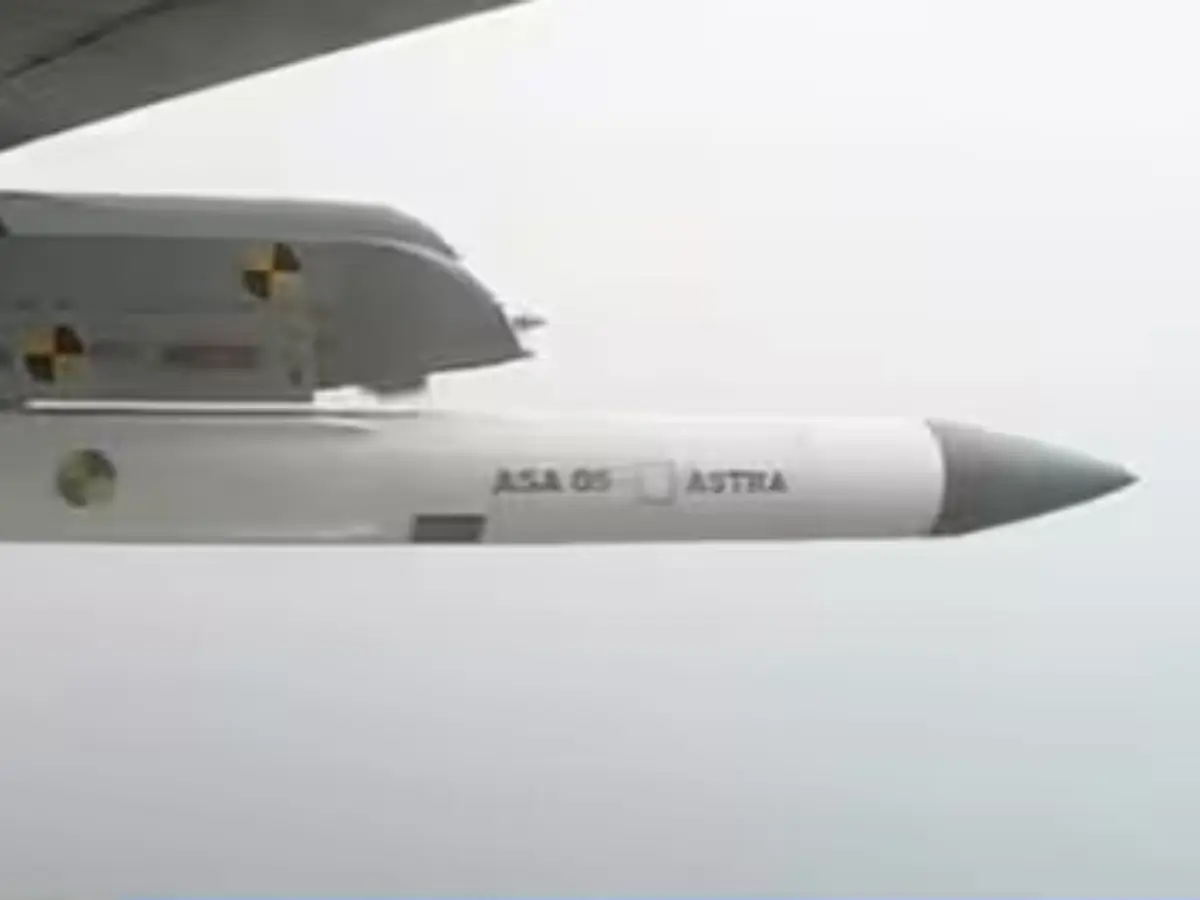
&imwidth=800&imheight=600&format=webp&quality=medium "The new Gandiva: How India's Astra MK3 brings Mahabharata magic to modern warfare")
When ancient warriors spoke of Gandiva, Lord Arjuna's divine bow from the Mahabharata, they praised its ability to strike enemies from impossible distances. Today, India's Defence Research and Development Organisation (DRDO) has borrowed this legendary name for its most advanced air-to-air missile - the Astra Mk3, nicknamed 'Gandiva'. But this is not just about mythology meeting modern warfare. This is about India taking a giant leap from being a weapons buyer to becoming a weapons maker that the world watches with respect.
The Journey from Dependence to Independence
For decades, the Indian Air Force relied heavily on foreign missiles to defend our skies. Russian R-77s, French MICAs, and Israeli Pythons formed the backbone of our air-to-air combat capability. But imagine if during a crisis, the supply chain got cut off or spare parts became unavailable? This uncomfortable reality pushed India to develop its own family of air-to-air missiles - the Astra series.

The story of Astra began in the early 1990s when DRDO scientists at Hyderabad's Defence Research and Development Laboratory started dreaming of an indigenous beyond-visual-range missile. What began as a small project with internal funding has now become one of India's most successful defence programs, with three generations of missiles that can compete with the best in the world.
What is a Beyond Visual Range Missile?
A Beyond Visual Range (BVR) missile is a smart weapon that can hunt down and destroy enemy aircraft from extremely long distances - often 50 to 300 kilometers away. The pilot firing it cannot see the target with naked eyes, but the missile uses its own radar to track and hit the enemy plane automatically.
Trending Stories
)
Colombia’s new president Abelardo de la Espriella vows to ‘defeat narco-terrorists’, signals hardline shift
)
The Royals enter the Doctor Who universe: King Charles and Queen Camilla beam into Commonwealth Games in TARDIS
)
US sanctions Iran’s crypto network after Strait of Hormuz attacks, offers $15m bounty for intel on IRGC finance
)
India avoids higher US tariff, secures lower 10% rate. Here's how
)
New speed limits, automatic challans: Big traffic change coming to Delhi-Meerut Expressway. All you need to know
)
RSS says Gen Z protests reflect genuine distress
)
Russia forms Ukrainian Volunteer Spetsnaz Brigade to fight Ukraine
)
Rockstar to unveil GTA 6 extended look ahead of November launch
)
Drug-resistant fungus that hides in hair and enters bloodstream reported in 23 US states
)
India officially names 27 places in Arunachal to counter China's renaming claims
)
Baba Vanga's 2026 prophecy: 2 predictions 'already came true', 3 terrifying ones remain. Details inside
)
Morale plummets on USS Abraham Lincoln: Are US sailors reaching a breaking point? | GRAVITAS
)
Reese Witherspoon's father hospitalised after poolside incident in Nashville: Report
)
Border row erupts in Europe after Ceuta crossings, Spain imposes border controls on Italy
&im=FitAndFill=(700,400))
National Handloom Day 2026: From Alia Bhatt to Samantha Ruth Prabhu; Actresses who celebrated India's textile heritage as brides
&im=FitAndFill=(700,400))
Why the Su-30MKI is one of the heaviest fighters ever built
)
Squadron Leader Bhawana Kanth scripts history as Indian Air Force gets its first woman ‘Top Gun’ pilot
&im=FitAndFill=(700,400))
New Friday OTT releases (August 7, 2026): Operation Safed Sagar, Vadhandhi, Main Vaapis Aaunga- 6 movies and TV shows on Netflix, Prime Video and more
)
Uttarakhand young innovator builds India's own flying vehicle, conducts first test flight: WATCH
)
IAF officer held for sharing sensitive information in 'honey trap' case, booked under Official Secrets Act
)
Chilling video shows students take cover as teen opens fire at Thai school
)
Trump calls White House ballroom ruling a 'national disgrace' as court says Congress approval needed
)
Shakib Al Hasan ready to return to Bangladesh—under one condition
&im=FitAndFill=(700,400))
Why the Su-30MKI doesn't need external fuel tanks to fly vast distances
)
Unitree Robotics targets $9 billion valuation in landmark IPO backed by DeepSeek and Tencent
)
India names 27 sites in Arunachal Pradesh
)
'Security can't be bought with Pakistan, Turkey deal': Iran tells Saudi Arabia
)
‘Fake news’: MEA rejects report claiming India sought defence pact with Israel after Pakistan, Saudi Arabia, Turkey deal
)
Technology transfer deal boosts India's defence manufacturing ambitions
)
Trump says Iranian school bombing photos could be AI-generated - 'I don’t think...'
)
Jugal Hansraj reunites with Shekhar Kapur after 40 years for Masoom: The Next Generation
&im=FitAndFill=(700,400))
How many soldiers operate one S-400 battery?
)
Bharat Bhhagya Viddhaata OTT: When will Kangana Ranaut's film stream online?
Astra Mk1: The Reliable Workhorse
The first member of the Astra family, the Mk1, is already serving with the Indian Air Force and Navy. This 3.6-meter-long missile weighs 154 kg and can hit targets at ranges over 100 km. Think of it as a smart, self-guided arrow that can chase down enemy aircraft even when they try to escape.
What makes the Astra Mk1 special is its "fire and forget" capability. Once launched from a fighter jet like the Sukhoi Su-30MKI or the indigenous Tejas, the missile uses its own radar to hunt down the target. The missile uses mid-course inertial guidance with terminal active radar homing, meaning it can course-correct itself during flight and doesn't need constant guidance from the launching aircraft.
The Mk1 has been tested extensively and was cleared for full production in 2024. The Ministry of Defence has already signed a contract worth ₹2,971 crore with Bharat Dynamics Limited to produce over 350 missiles, with each missile costing around ₹7-8 crore. This might sound expensive, but it's actually much cheaper than importing equivalent foreign missiles.
Astra Mk2: The Range Extender
While the Mk1 was still in development, DRDO scientists were already working on its bigger brother - the Astra Mk2. This missile addresses one key limitation of the Mk1: range. The Mk2 uses a dual-pulse rocket motor to extend its range to 160 km, making it significantly more threatening to enemy aircraft.
The dual-pulse technology is like having a car with two fuel tanks that can be used at different times. The first pulse fires during launch, giving the missile initial velocity, while the second pulse can be ignited later during flight to maintain speed and extend range. This technology dramatically increases what military experts call the "no-escape zone" - the area where an enemy aircraft cannot outrun or outmaneuver the missile.
The Mk2 is slightly bigger than the Mk1, with a diameter of 190mm compared to 178mm, and weighs about 175 kg. Despite being heavier, it outperforms the Chinese PL-15E export variant, which weighs 200kg but has a shorter range of 145km.
The IAF has already released footage of an Astra Mk2 being launched from a Su-30MKI during trials, and the missile is expected to enter service soon. This will give India a significant advantage in air combat, as most enemy aircraft will be within striking distance before they can even detect our fighters.
Astra Mk3 'Gandiva': The Game Changer
Now comes the star of the show - the Astra Mk3, which truly lives up to its mythological name. This missile represents a quantum leap in Indian missile technology and puts India in the elite club of nations that can produce ramjet-powered air-to-air missiles.
Unlike its predecessors that use rocket motors, the Gandiva is powered by a Solid Fuel Ducted Ramjet (SFDR) engine. This is like the difference between a regular car and a jet engine-powered vehicle. The ramjet sucks in air from the atmosphere and mixes it with fuel to create thrust, allowing the missile to fly farther and faster than conventional rockets.
The numbers are impressive: the Gandiva can strike targets at over 300 kilometers - that's like shooting from Delhi and hitting a target in Chandigarh. It can fly at speeds of up to Mach 4.5, which is more than four times the speed of sound. At such speeds, even the most advanced enemy aircraft have very little time to react or take evasive action.
But range and speed are just part of the story. The Gandiva is being designed to counter specific threats like China's J-20 stealth fighter and their long-range PL-15 missile. The missile's extended range means that Indian fighters can potentially shoot down enemy aircraft before they can even fire their own weapons.
The Brain Behind the Brawn
What makes the Astra Mk3 truly special is its "brain" - the guidance system. The current developmental version uses an Active Electronically Scanned Array (AESA) seeker based on Gallium Arsenide technology. But for the production version, DRDO plans to upgrade to an even more advanced seeker using Gallium Nitride (GaN) technology.
Why is this important? Think of the seeker as the missile's eyes and brain combined. The GaN technology offers better performance in high temperatures, uses less power, and most importantly, is much more resistant to electronic jamming. In modern warfare, enemies try to confuse missiles using electronic countermeasures, but the GaN seeker can see through these tricks and stay locked onto its target.
This technological upgrade is made possible by India's growing capabilities in semiconductor technology under the "Aatmanirbhar Bharat" initiative. We're not just building missiles; we're building the entire technological ecosystem needed to support them.
Testing and Timeline
The Astra Mk3 has already achieved significant milestones. In December 2024, DRDO successfully tested the SFDR propulsion system at the Integrated Test Range in Odisha. Currently, the missile is undergoing captive carriage trials, where it's mounted on a Sukhoi Su-30MKI fighter jet to test its integration with the aircraft's systems.
The next phase involves live-fire trials, where the missile will be actually launched at targets to prove its effectiveness. DRDO is targeting full-scale production by 2030-2031, which means the Gandiva could be protecting Indian skies within this decade.
Flying on Indian Wings: Astra's Aircraft Integration
But having advanced missiles is only half the battle - they need to work seamlessly with our aircraft. The Astra missile family isn't just about the weapons themselves - it's about creating a complete combat ecosystem for Indian fighter aircraft. The Astra Mk1 has already proven its worth, successfully test-fired from the indigenous Tejas fighter in March 2025, hitting targets at over 100 kilometers.
The integration story is particularly exciting for the Tejas program. The new Tejas Mk1A variant, currently being delivered to the IAF, comes standard with Astra missile capability. In May 2025, aviation enthusiasts spotted a Tejas Mk1A prototype flying with two Astra Mk1 missiles and ASRAAM missiles, showcasing India's growing self-reliance in both aircraft and weapons.
This isn't just about one aircraft. The Astra series is designed to arm the entire IAF fleet - from the heavy-duty Su-30MKI to the lightweight Tejas, and potentially the Rafale fighters. This universal compatibility means that whether it's a homegrown Tejas or an imported Sukhoi, Indian pilots will have the same advanced missile technology at their disposal.
Strategic Implications
The Astra series represents more than just new weapons; it represents a fundamental shift in how India approaches defence. Instead of depending on foreign suppliers, we're building our own capabilities. This has several advantages:
Economic Benefits: The money spent on these missiles stays in India, creating jobs and building industrial capacity. The technology developed for Astra can be used in other projects, creating a multiplier effect.
Strategic Independence: We don't have to worry about spare parts, technology transfer restrictions, or political pressure from supplier countries. During conflicts, we can produce more missiles as needed.
Export Potential: Countries like Malaysia, Vietnam, and Indonesia have shown interest in the Astra missiles. Brazil is considering the Astra Mk1 for its Gripen fighters. This can bring in foreign exchange and establish India as a reliable defence partner.
Technological Advancement: The technologies developed for Astra - from advanced seekers to ramjet engines - have applications in other defence and civilian projects.
The Road Ahead
The Astra series will eventually replace all foreign air-to-air missiles in Indian service. The Mk1 is already being integrated with the entire fighter fleet except the Mirage 2000. The Mk2 will provide extended range capability, while the Mk3 will give India a decisive edge in long-range air combat.
But challenges remain. Miniaturizing ramjet technology is complex, and ensuring reliability in combat conditions requires extensive testing. The cost of development is high, and the timeline is ambitious.
However, the progress so far gives reason for optimism. From a country that couldn't produce basic components three decades ago, India has developed missiles that can compete with the best in the world. The Astra program shows that with sustained effort, proper funding, and clear vision, India can achieve technological independence in critical areas.
Conclusion
The journey from the first Astra to the advanced Gandiva mirrors India's own transformation from a technology importer to a technology creator. Just as the mythological Gandiva gave Arjuna the power to protect dharma, the modern Gandiva will give the Indian Air Force the power to protect our skies.
When the Astra Mk3 enters service in the early 2030s, it will not just be another weapon in India's arsenal. It will be a symbol of how far we've come and a promise of where we're going. In a world where technological superiority often determines military outcomes, the Astra series ensures that India will not just be a participant in the game - we'll be setting the rules.
The sky is no longer the limit for Indian defence technology. It's just the beginning.
