PM Modi's power meet with Putin & Pezeshkian, all eyes on BRICS Summit | Gravitas

&imwidth=600&imheight=450&format=webp&quality=medium "PM Modi's power meet with Putin & Pezeshkian, all eyes on BRICS Summit | Gravitas")
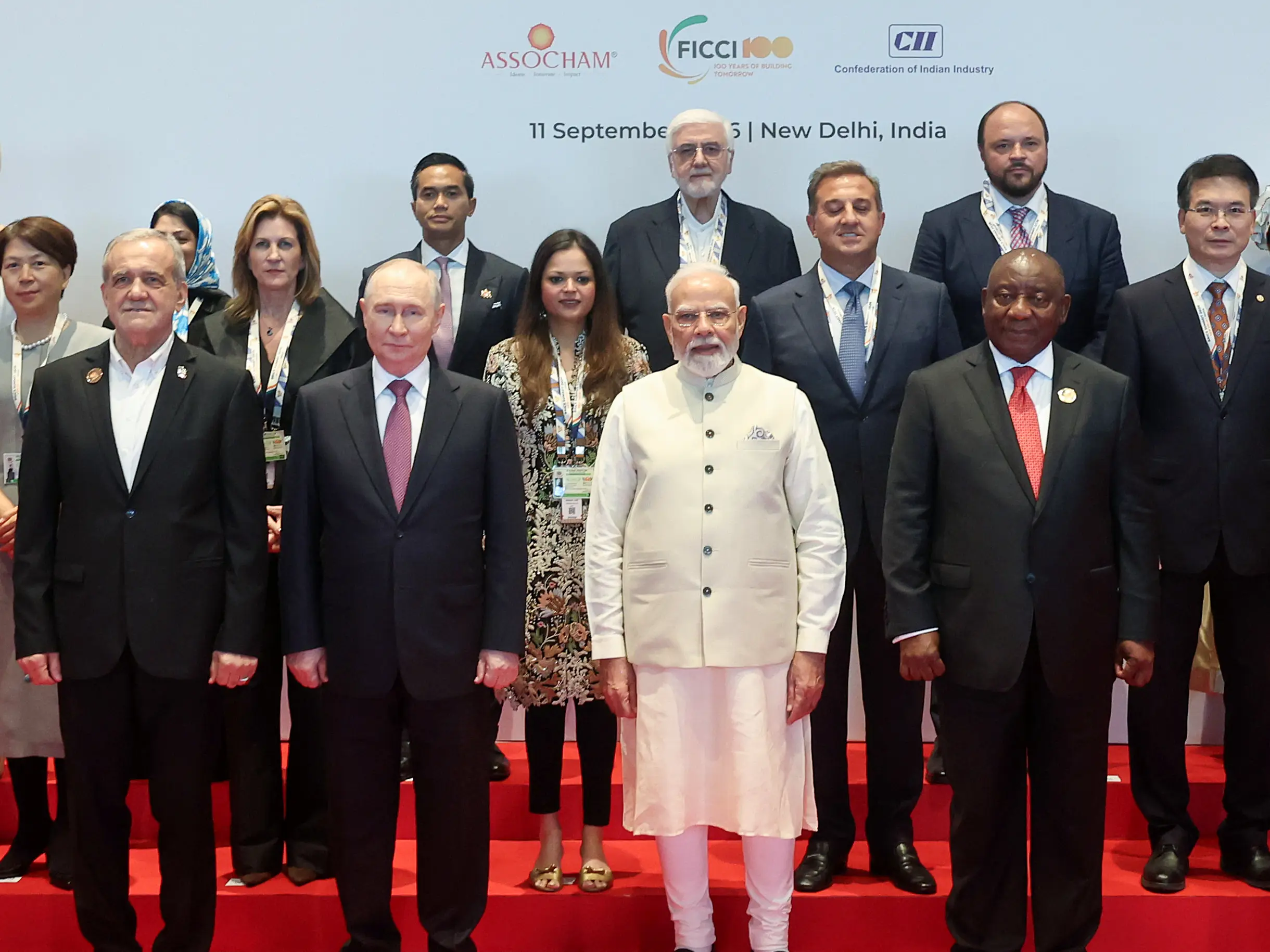
Prime Minister Narendra Modi in a group photograph with Russian President Vladimir Putin, Iranian President Masoud Pezeshkian, South African President Cyril Ramaphosa and other dignitaries at the BRICS Business Forum 2026, in New Delhi on Friday. Photograph: (ANI)
Prime Minister Narendra Modi used the BRICS summit to champion diplomacy and a multipolar world while strengthening India's strategic and economic ties with Russia and Iran amid global conflicts, US tariffs and sanctions.
As the world grapples with a litany of wars and America's hegemonic designs, India's approach has stood out with its consistent thrust on diplomacy and a multipolar world.
Prime Minister Narendra Modi set the tone for the BRICS summit by highlighting the expanse and economic power of the bloc. BRICS now comprises 11 members and 10 partner countries, representing half of the world's population, 40 per cent of the world's GDP and more than 25 per cent of global trade.
Addressing the BRICS Business Forum, Modi said the GDP of BRICS nations has grown at nearly twice the pace of the rest of the world despite adverse circumstances.
He urged the forum to prepare a report on removing the top 10 trade barriers and support 100 startups from BRICS countries. Citing India's accomplishments, Modi issued a call for other nations to "innovate with India".
The safety of seafarers was also high on Modi's agenda. He stressed that global trade can progress only when sea lanes and supply routes remain open and seafarers are safe.
The day also witnessed key high-profile bilateral meetings. Modi held talks with Iranian President Masoud Pezeshkian amid the ongoing crisis around the Strait of Hormuz, whose virtual closure has triggered an energy crisis affecting several countries, including India.
Trending Stories
&imwidth=280&imheight=210&format=webp&quality=medium)
&imwidth=280&imheight=210&format=webp&quality=medium)
&imwidth=280&imheight=210&format=webp&quality=medium)
&imwidth=280&imheight=210&format=webp&quality=medium)
&imwidth=280&imheight=210&format=webp&quality=medium)
&imwidth=280&imheight=210&format=webp&quality=medium)
&imwidth=280&imheight=210&format=webp&quality=medium)
&imwidth=280&imheight=210&format=webp&quality=medium)
&imwidth=280&imheight=210&format=webp&quality=medium)
&imwidth=280&imheight=210&format=webp&quality=medium)
&imwidth=280&imheight=210&format=webp&quality=medium)
&imwidth=280&imheight=210&format=webp&quality=medium)
&imwidth=280&imheight=210&format=webp&quality=medium)
&imwidth=280&imheight=210&format=webp&quality=medium)
&imwidth=280&imheight=210&format=webp&quality=medium)
&imwidth=280&imheight=210&format=webp&quality=medium)
&imwidth=280&imheight=210&format=webp&quality=medium)
&imwidth=280&imheight=210&format=webp&quality=medium)
&imwidth=280&imheight=210&format=webp&quality=medium)
&imwidth=280&imheight=210&format=webp&quality=medium)
&imwidth=280&imheight=210&format=webp&quality=medium)
&imwidth=280&imheight=210&format=webp&quality=medium)
&imwidth=280&imheight=210&format=webp&quality=medium)
&imwidth=280&imheight=210&format=webp&quality=medium)
&imwidth=280&imheight=210&format=webp&quality=medium)
&imwidth=280&imheight=210&format=webp&quality=medium)
&im=FitAndFill=(700,400)&imwidth=280&imheight=210&format=webp&quality=medium)
&im=FitAndFill=(700,400)&imwidth=280&imheight=210&format=webp&quality=medium)
&imwidth=280&imheight=210&format=webp&quality=medium)
&imwidth=280&imheight=210&format=webp&quality=medium)
&imwidth=280&imheight=210&format=webp&quality=medium)
&imwidth=280&imheight=210&format=webp&quality=medium)
&imwidth=280&imheight=210&format=webp&quality=medium)
&imwidth=280&imheight=210&format=webp&quality=medium)
Earlier in the day, Modi held a bilateral meeting with Russian President Vladimir Putin. The bonhomie between the two leaders was once again on display.
On arriving at New Delhi's Bharat Mandapam, the two leaders shared a warm hug and shook hands as they reviewed progress across multiple domains, including the economy, defence, energy, space, skill mobility and people-to-people exchanges.
The meeting assumes significance as India is considering a Russian proposal to buy five more S-400 air defence systems following the success of Operation Sindoor. There are also reports that Moscow is offering Su-57 fifth-generation fighter jets to India.
The two leaders also exchanged views on the situation in West Asia and the Black Sea, where multiple Indian seafarers have lost their lives amid the ongoing Iran and Russia-Ukraine wars.
While agreeing to strengthen the strategic partnership between the two countries, Modi reiterated the importance of diplomacy in resolving conflicts and expressed India's willingness to assist in peace efforts.
According to sources, other issues that may have come up for discussion included achieving a bilateral trade target of $100 billion by 2030, broadening India's access to the Russian market and strengthening civil nuclear cooperation.
Modi also gifted Putin a Russian translation of the ancient Tamil classic Thirukkural. Russian author Leo Tolstoy was captivated by the treatise for its emphasis on non-violence and compassion. The work also offers lessons on diplomacy, leadership and governance.
Also Read: 'We are still sending terrorists to where they belong', says Trump at 9/11 memorial event
Following the meeting, Modi and Putin travelled together in the same car. They later visited Russia's International Industrial Exhibition, Innoprom India, which seeks to further expand trade and industrial ties between the two countries.
Amid Trump's global tariffs and the United States' strengthening of sanctions against Russia and Iran, a key question is how BRICS is responding to the changing global trade order.
The BRICS finance ministers and central bank governors collectively voiced concern over the unilateral imposition of tariffs and non-tariff measures that distort trade.
They also encouraged discussions on promoting the use of local currencies among BRICS countries for trade and investments.
Addressing the BRICS Business Forum, Iranian President Masoud Pezeshkian also voiced support for this approach.
This is already taking place between India and Russia. Estimates suggest that around 96 per cent of their bilateral trade is now settled in rupees and roubles.
Meanwhile, Union Finance Minister Nirmala Sitharaman met Russian First Deputy Prime Minister Denis Manturov to strengthen the India-Russia payments system.
All eyes will now be on the next two days to see how BRICS seeks to put forward an alternative vision for the world, as peaceful coexistence remains a casualty of ongoing conflicts.