Heeramandi review: Sanjay Leela Bhansali delivers a riveting story in a familiar set up

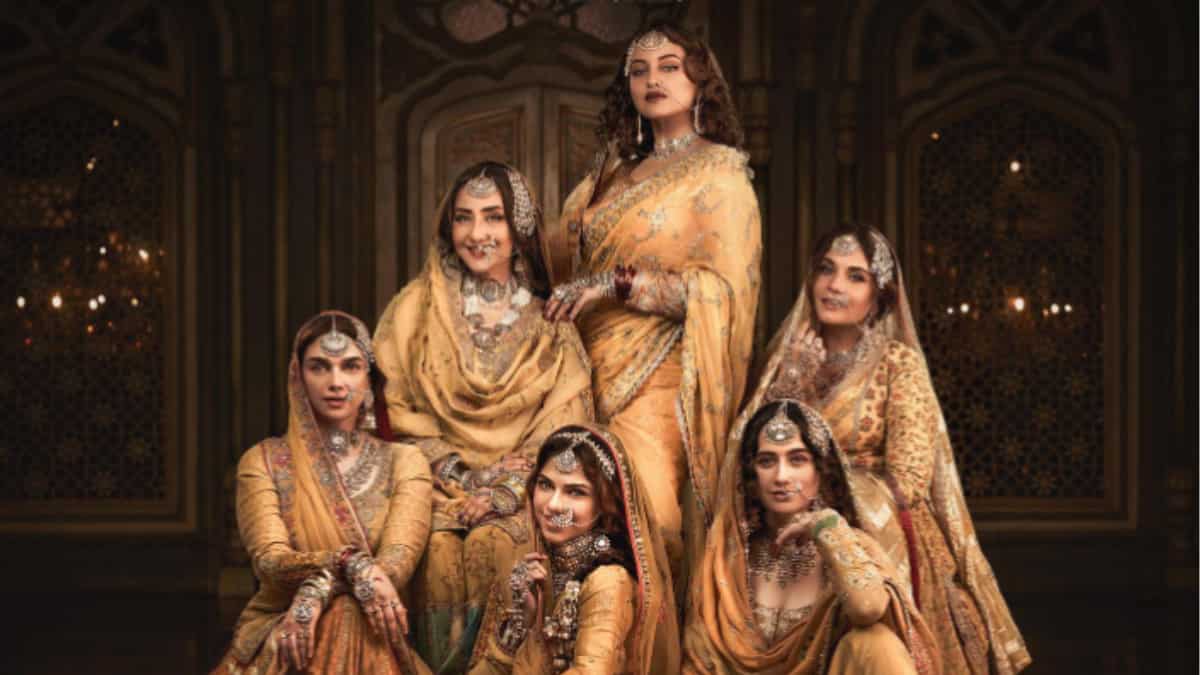
'Heeramandi' first look
Heeramandi Review: There is a sense of familiarity when you start watching Sanjay Leela Bhansali's latest project, the Netflix web series Heeramandi: The Diamond Bazaar. The grandeur, the drama, the larger-than-life portrayal of the characters - stuff that we usually associate Bhansali to - and a universe that only Bhansali can create, no one else. The filmmaker's pet project (he's had the idea with him for 18 years) features a gamut of stars and is based on Moin Beg's novel with a very detailed screenplay by Bhansali. While it focusses on a bunch of nautch girls in the red light district of Lahore in pre-independent India, the 8-episode drama delves into much more - concentrating on breaking barriers of prejudice, presumptions, power and greed and gaining independence in every sense of the term.
The plot of Heeramandi
The six women who arethe leading charactersof the show are different from each other and have distinct personalities, yet are connected due to their common background. Mallikajaan (Manisha Koirala) is the madame/matriarch of a regal brothel Shahi Mahal which is at the heart of Heeramandi. Set in the 1940s, it is an era where Nawabs fund these brothels, with each having a nautch girl reserved for their entertainment daily even as their wives lead lonely lives in their palaces. Mallikajaan wields power in Heeramandi and Shahid Mahal. Her two daughters - Bibbojaan( Aditi Rao Hydari) and Alamzeb (Sharmin Sehgal) love their mother but are not interested in taking her legacy forward. Bibbojaan is secretly part of the independence struggle, supplying crucial information about the British to the 'rebels' while Alamzeb, a poetess, wants to leave Shahi Mahal and marry the man she is deeply in love with.
Mallika is also a foster mother of sorts to Lajjo (Richa Chadha) - a tragic figure, always intoxicated and in grief due to unrequited love. Mallika's younger sister Waheedan (Sanjeeda) hates her and blames her for ruining her life and taking away what she feels is rightfully hers. And while Mallika navigates all these women and runs a thriving brothel, her biggest threat comes from Fareedan (Sonakshi Sinha) who is eyeing to take control of the Shahi Mahal and the position of power.
As the politics and tussle for power rages on in the bylanes of Heeramandi, there is also a growing unrest in the country with most rejecting the British rule and its oppression. While the women initially are clashing with each other over the greater control of Heeramandi, they ultimately realise that their whole existence is in danger as British intend to wipe out Heeramandi completely.

Before Heeramandi, a look at the powerful women in Sanjay Leela Bhansali's films
Intricate story line
Heeramandi is set at a time when noblemen would send their sons to these brothels to learn etiquette, to appreciate art before they step out in the real world. It is a time when the nautch girls walked around the streets with great pride over their beauty, their talent and their ability to wrap the most powerful men around their fingers. Bhansali's compelling screenplay weaves an intricate tale of power, greed, lust and love where these women may not have the privilege to marry the nawabs and have a family of their own, yet wield control over them with their beauty and charm. For them, the women in the brothels are sisters, mothers, nieces and confidants - they are the family.
Bhansali's screenplay is detailed with each character getting a back story. There are multiple plots, one of a mother avenging her infant baby's disappearance, one of an aspiring poetess unwillingly falling for a rebel, of a daughter wanting to avenge the death of her mother, of a lover who never got back the love she desired, of a rebel whose first and only love is freedom of her beloved country, of a sister who has waited too long to get what belongs to her but has failed multiple number of times. Each character has tragic stories that the maker beautifully weaves into the main plot.
&imwidth=180&imheight=135&format=webp&quality=medium)
US midterms 2026: What polls and prediction markets indicate about Congress
&imwidth=180&imheight=135&format=webp&quality=medium)
Ilhan Omar breaks silence over alleged marriage to her brother; Trump thinks it's 'really good answer'
&imwidth=180&imheight=135&format=webp&quality=medium)
From Agni-V to Project Kusha: How are India’s indigenous missile systems and defence shield reshaping modern warfare
&imwidth=180&imheight=135&format=webp&quality=medium)
Will Rohit and Kohli play ODI World Cup 2027? BCCI president Manhas says board 'not in a position to comment'
&imwidth=180&imheight=135&format=webp&quality=medium)
‘I caution the president...’: Trump’s ex-press secretary warns after Zacharia’s exit
&imwidth=180&imheight=135&format=webp&quality=medium)
Diljit Dosanjh's Oct 30 Delhi show hits roadblock, Delhi Police denies permission
&imwidth=180&imheight=135&format=webp&quality=medium)
'It's a crime not to see this scene': Tehran puts Trump 'behind bars'
&imwidth=180&imheight=135&format=webp&quality=medium)
Kolkata airport: CISF detects ₹1.13 crore in US dollars hidden in bags of 2 Bangkok-bound passengers
&imwidth=180&imheight=135&format=webp&quality=medium)
China's dancing robot turns violent bodyguard, lifts cars and fights intruders - Watch
&imwidth=180&imheight=135&format=webp&quality=medium)
Rafale Marine fighter begins flight trials in Goa ahead of Indian Navy induction
&imwidth=180&imheight=135&format=webp&quality=medium)
Priyanka Chopra celebrates Dussehra 2026 with Nick Jonas and daughter Malti Marie | See pics
&imwidth=180&imheight=135&format=webp&quality=medium)
Feds obtain DNA evidence that could prove Ilhan Omar married her brother: Report
&imwidth=180&imheight=135&format=webp&quality=medium)
US to get 850 F-35 stealth fighter jets under 10-year Pentagon-Lockheed deal
&imwidth=180&imheight=135&format=webp&quality=medium)
Meta slapped with $25 billion fine in New Mexico over Facebook data practices, company plans appeal
&im=FitAndFill=(700,400)&imwidth=180&imheight=135&format=webp&quality=medium)
New OTT releases this week (October 19-25, 2026): Gajab Raat to Chaar Yaar-8 titles to watch during Dussehra week on Netflix, Prime Video and more
&imwidth=180&imheight=135&format=webp&quality=medium)
16-foot doomsday fish in Chile triggers fears that the next earthquake is coming
&imwidth=180&imheight=135&format=webp&quality=medium)
Viral video shows cross falling on Colombia priest, no official confirmation | WATCH
&imwidth=180&imheight=135&format=webp&quality=medium)
US midterms 2026: Trump's approval rating hits record low as Democrats gain ground
&imwidth=180&imheight=135&format=webp&quality=medium)
Why websites around the world are suddenly going offline? What you need to know about PHP
&imwidth=180&imheight=135&format=webp&quality=medium)
Ranbir Kapoor apologises for Dussehra speech slip, clarifies remark at Ramayana event
&imwidth=180&imheight=135&format=webp&quality=medium)
Australia police arrest former national 100m champ Jake Doran for alleged child abuse
&imwidth=180&imheight=135&format=webp&quality=medium)
'Father of all bombs' vs 'mother of all bombs': Iran threatens US with new weapon as Trump hints at MOAB strike
&imwidth=180&imheight=135&format=webp&quality=medium)
Are the US and Israel preparing for another major attack on Iran? Here's what report claims
&imwidth=180&imheight=135&format=webp&quality=medium)
'You are a dummy, you are a stupid person': Trump loses temper with CNN, ABC reporters after questions about Russia sanctions
&imwidth=180&imheight=135&format=webp&quality=medium)
WATCH: Woman IPS officer fires several rounds of AK-47, ignites debate online
&imwidth=180&imheight=135&format=webp&quality=medium)
'Gyanu must go': CJP's Saurav Das, Ashutosh Ranka after release, despite Jantar Mantar protest undertaking
&imwidth=180&imheight=135&format=webp&quality=medium)
EU probes Booking.com under Digital Services Act
&imwidth=180&imheight=135&format=webp&quality=medium)
US-Iran war: Bibi, Trump gamble on new Iran war to save themselves in polls
&imwidth=180&imheight=135&format=webp&quality=medium)
Pakistan signs another defence pact even as Makkah Alliance shows no teeth. This time, it's with Qatar, Indonesia, Turkey
Familiar premise
Since it is a Bhansali project, the world he creates is magical and opulent. The usual tropes of the maker are all there, the women are often showing grief with their hair all dishevelled and open, they are always looking ethereal irrespective of the emotions they are going through, they live in grand kothas and perform at gigantic courtyards which have fountains that never go dry. On so many occasions, I got a sense of deja vu watching Heeramandi.
Heeramandi: The real 'regal' story of tawaifs who inspired Sanjay Leela Bhansali's series
The women have been similarly dressed as how Bhansali's women have been dressed in Bajrao Mastani, Gangubai Kathiawadi and even Padmaavat. Some of the sets, the long shots the crowded lanes of Heeramandi, Shahi Mahal - look like a residual of Gangubai world. The tropes are familiar and sometimes feel a little jaded because the focus shifts from the story.
The performances in Heeramandi
To its credit, the show has some terrific performances from its leading ladies. Sonakshi Sinha has found her footing in the digital space after years of doing cringe-masala potboilers. Sinha as the calculative, sharp and slightly conniving Fareedan is a such delight to watch on screen. Sinha had delivered a strikingly different performance in last year's critically acclaimed Dahaad. Her performance in Heeramandi shows her versatility as an actor and she doesn't disappoint. Complementing her is Manisha Koirala who adopts a deep baritone to play the menacing, controlling Mallika Jaan for whom power is above all kinds of familial bonding. Koirala and Bhansali collaborate after two long decades. Their last outing Khamoshi was a poignant coming-of-age story.
In Heeramandi, Koirala is the leader of the pack - in all sense of the term and takes the detailed story forward with her credible performance. Sanjeeda Sheikh and Richa Chadha (in limited screen time) create an impact with their tragic characters.
The weakest link in the story is Sharmin Sehgal, who is the youngest of the lot and her inexperience shows. Her performance leaves no impact, even though her character Alambeg has a solid storyline. Amid powerful performers like Koirala, Sinha, Chadha, and even Aditi Rao Hydari, Sharmin's performance fails to create the desired impact.
The men - Fardeen Khan, Shekhar Suman, Taha Shah, and Adhyayan Suman - are there to only enable the story of the six women. They come and go in the series and have limited screen time. Taha Shah - with his performance as Taj stands out and delivers and his earnest performance is also the longest in terms of screen time. The other actor who stands out is Indresh Malik as Ustaad Ji, the effeminate pimp who shares a close relationship with the women and their link to the outside world.
What does not work
While the story is compelling and keeps you hooked, the maker hurries through the ending. Till about 6 episodes the story meanders around the women and their internal politics and suddenly in the last two episodes the story very hastily shifts focus to the independence struggle. Sure some characters are shown to be involved in the freedom movement right from the beginning of the show, but the transformation of the rest of the characters in the last two episodes seems very abrupt and slightly out of context. It ultimately makes the entire story feel very hollow. Had Bhansali stuck the story of revenge and greed - Heeramandi would have perhaps had a lasting impact. Instead, it muddles too many things into one plot and tries to be woke - especially in the last scene- and ultimately defeats the purpose the story of the women shunned by society.
Heeramandi: The Diamond Bazaaris still an engaging watch. It has good music (by Bhansali himself), great visuals and compelling performances by most of its actors. It requires your patience as Bhansali takes time to unravel each of the characters and their individual stories but creates a stunning world that is hard to overlook. Sit back, be patient and enjoy the magical world that Bhansali takes you in. Heeramandi: The Diamond Bazaar is streaming on Netflix.

