

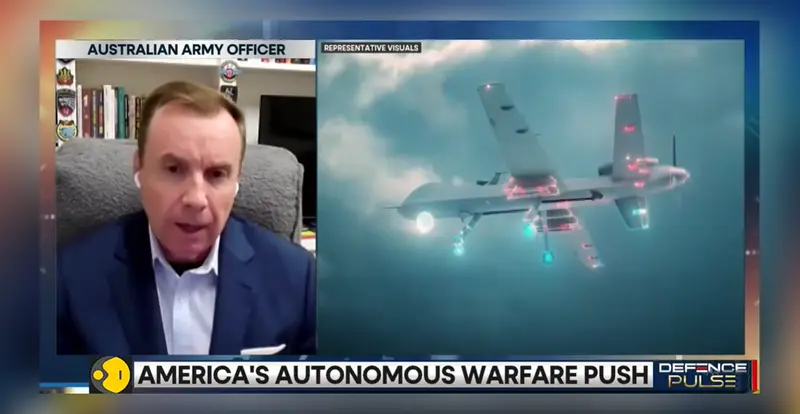
The US Army now has a new autonomous warfare command. It's called the Futures and Autonomous Systems Command (FASCOM). It marks a major push towards robotic warfare, but retired Australian Army Major General Mick Ryan believes the transformation also exposes serious shortcomings in America's preparedness against drone attacks.
The US Army's newly announced FASCOM aims to accelerate autonomous warfare capabilities, bringing together technological development, experimentation, training and procurement.
Iran War Exposes US Military's Drone Defence Failures
Speaking exclusively on WION's Defence Pulse, I asked General Ryanwhether FASCOM represented an acknowledgment of American military shortcomings during the Iran conflict, he said it was partly a response to the failure to counter Iranian Shahed drones.
"They were caught short with drone defences," he said, adding that the threat was "entirely predictable." He was particularly critical of Western militaries for failing to absorb lessons from Ukraine. "I think this was a gross failure of humility in the U.S. as well as Western military organisations," he said.
Trending Stories
&im=FitAndFill=(700,400)&imwidth=180&imheight=135&format=webp&quality=medium)
‘0-100km/h in 1 second Tesla Roadster’: Why tyre grip becomes a problem when cars accelerate this fast
&imwidth=180&imheight=135&format=webp&quality=medium)
Up to 1 million satellites in orbit? the space race raising questions about who controls space
&imwidth=180&imheight=135&format=webp&quality=medium)
US sanctions Cuban state-owned bank BICSA over alleged financial links to Iran
&imwidth=180&imheight=135&format=webp&quality=medium)
Majid Majidi's new film Midday Meal takes top prize at Asia's biggest film festival
&imwidth=180&imheight=135&format=webp&quality=medium)
Broke Your iPhone Duo? Here’s how much screen repair could cost
&imwidth=180&imheight=135&format=webp&quality=medium)
Russian woman and Bihar boy's love story goes viral after she reaches India to marry him
&imwidth=180&imheight=135&format=webp&quality=medium)
Arijit Singh 9-city India stadium tour to start from January: Check venue and ticket prices
&imwidth=180&imheight=135&format=webp&quality=medium)
Ramayana International trailer out: First glimpse of Kunal Kapoor as Indra Dev in Ranbir Kapoor and Yash starrer
&imwidth=180&imheight=135&format=webp&quality=medium)
Billy Joel's health update: Why the singer can't drive or perform right now?
&imwidth=180&imheight=135&format=webp&quality=medium)
Turkey Floods: Heavy rains flood homes and submerge vehicles in Istanbul
&imwidth=180&imheight=135&format=webp&quality=medium)
Katie Zacharia, White House Press Secretary admits she never passed bar exam amid credentials controversy
&imwidth=180&imheight=135&format=webp&quality=medium)
Ukraine blinded: Musk deflects blame on Trump, Putin sharpens attack | Gravitas
&imwidth=180&imheight=135&format=webp&quality=medium)
Oregon school shooting: 16-year-old identified as suspect after at least four killed, including three children
&imwidth=180&imheight=135&format=webp&quality=medium)
Who is Abu Dhabi royal Mahrah Al Nahyan, found unconscious on London street with toddler after cocaine use
&imwidth=180&imheight=135&format=webp&quality=medium)
US-Iran War: Trump eyes mother of all bombs; Iran in crosshairs

Not Khan but Pal: Why did Imran Khan choose his mother's surname over his father's? Family tree explained
&imwidth=180&imheight=135&format=webp&quality=medium)
Russia-Ukraine War: Putin vows retaliation against Ukraine
&imwidth=180&imheight=135&format=webp&quality=medium)
'Turns out the future does have flying cars': Musk's Tesla unveils 'flying' sports car with SpaceX technology | Watch
&imwidth=180&imheight=135&format=webp&quality=medium)
Australian woman charged for adding snail poison to lover's curry at work
&imwidth=180&imheight=135&format=webp&quality=medium)
Central Park in Delhi shut on October 16, 17 amid CJP's protest call
&im=FitAndFill=(700,400)&imwidth=180&imheight=135&format=webp&quality=medium)
Inside the Peshawar school tragedy: 34 dead, building's condition under scrutiny and owner arrested. Here's what all happened
&im=FitAndFill=(700,400)&imwidth=180&imheight=135&format=webp&quality=medium)
‘No traffic jams for Tesla owners’: How Elon Musk’s new flying car is different from regular cars?
&imwidth=180&imheight=135&format=webp&quality=medium)
‘My president, I mean my husband’: Trump's new press secretary Katie Zacharia's first briefing goes off the rails in 14 minutes
&im=FitAndFill=(700,400)&imwidth=180&imheight=135&format=webp&quality=medium)
World's 7 most innovative countries in 2026 REVEALED: Did India make the list? | In Pics
&imwidth=180&imheight=135&format=webp&quality=medium)
Trump says Zelensky 'not a good guy' amid fresh Russia-Ukraine tensions | Watch video
&imwidth=180&imheight=135&format=webp&quality=medium)
Earthquake measuring 7 magnitude strikes Russia’s Kamchatka Peninsula
&imwidth=180&imheight=135&format=webp&quality=medium)
Was Trump in danger at Alaska rally? Viral video shows Secret Service agents reacting
&imwidth=180&imheight=135&format=webp&quality=medium)
'Will stand with Pakistan in case of war with US': Rajasthan BJP chief's remark sparks row
&imwidth=180&imheight=135&format=webp&quality=medium)
US midterms 2026: FBI investigates suspicious mailings containing 'unknown substance' sent to election offices
&imwidth=180&imheight=135&format=webp&quality=medium)
Abhishek Sharma sets all-time record for most T20I sixes in a year
&im=FitAndFill=(700,400)&imwidth=180&imheight=135&format=webp&quality=medium)
Inside Tesla's Roadster: 10 features of Elon Musk's 'flying car' that push the limits of electric vehicles | In Pics
&imwidth=180&imheight=135&format=webp&quality=medium)
India’s naval priorities: Ex-Navy Chief calls for third aircraft carrier, more warships and submarines
&imwidth=180&imheight=135&format=webp&quality=medium)
Netanyahu defies Trump, blocks Gaza military base for Board of Peace | Gravitas
&imwidth=180&imheight=135&format=webp&quality=medium)
Saudi Arabia executes Two Bangladesh nationals over immoral act
&imwidth=180&imheight=135&format=webp&quality=medium)
Nine former FBI employees fired over investigation into Trump's classified records sue Kash Patel, DOJ over alleged unlawful dismissal
&im=FitAndFill=(700,400)&imwidth=180&imheight=135&format=webp&quality=medium)
Tesla Roadster's thrusters vs rocket engines: What's the difference?
&imwidth=180&imheight=135&format=webp&quality=medium)
Mumbai: CJP brings Tricolour protest to Azad Maidan after weeks of demonstrations
&imwidth=180&imheight=135&format=webp&quality=medium)
'Ukraine must get all it needs to protect civilians and infrastructure': Macron
&imwidth=180&imheight=135&format=webp&quality=medium)
Portland stabbing: Multiple people reportedly stabbed hours after deadly Bend school shooting
Gen. Ryan argued that military transformation must extend beyond acquiring autonomous weapons to changing battlefield tactics, training and institutional structures.
What India and Australia Must Learn
With China rapidly developing autonomous military capabilities, Gen. Ryan suggested India and Australia should closely examine America's new command structure.
"I think countries like Australia and India will hopefully have liaison officers embedded in the U.S. Army," he said. He also recommended that both countries establish similar commands to accelerate drone warfare capabilities across their armed forces. Such structures, Ryan argued, could help military organisations adapt more rapidly to emerging technologies and battlefield requirements.
Tanks, Drones and the Future Battlefield
Gen.Ryan also warned that traditional armoured warfare faces unprecedented challenges from persistent drone surveillance. Drawing on Ukraine's experience, he explained that forces may need prolonged suppression of enemy drones before deploying armoured vehicles, even in small numbers.
Modern tanks and armoured vehicles, he noted, produce substantial physical, thermal and electromagnetic signatures, making concealment increasingly difficult.
On counter-drone warfare, he rejected the idea of a single technological solution, advocating layered defences combining sensors, electronic warfare, interceptor drones and conventional weapons.
His assessment carries particular importance for India as it expands indigenous drone development and evaluates how autonomous systems should be integrated into military formations.

