Mountains, jungles or cities: Indian Army veteran reveals toughest battlefield

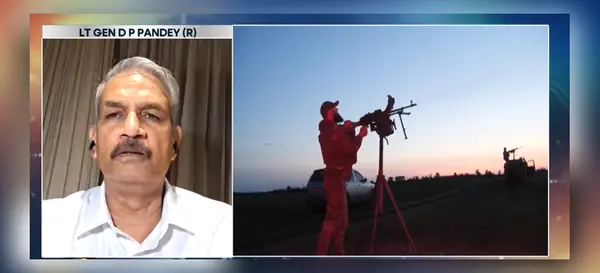
Lt Gen D.P. Pandey (Retd.), former Commander of the Indian Army’s Chinar Corps Photograph: (Credit: WION screenshot)
An Indian Army veteran breaks down the stark challenges of combat, comparing mountains, dense jungles, and urban cities to reveal which battlefield poses the greatest test of survival.
Mountains can deprive soldiers of oxygen and mobility. Deserts offer little concealment. Jungles restrict visibility and cities can turn every building into a potential threat. Despite drones, artificial intelligence and increasingly sophisticated sensors, terrain remains one of the most powerful forces shaping how wars are fought.
Lt Gen D.P. Pandey (Retd.), former Commander of the Indian Army’s Chinar Corps, has served across several such environments. Speaking to WION’s Defence Pulse, he identified urban warfare as particularly challenging. “I find urban terrain to be slightly more challenging because issues of differentiation between the civilian and the enemy become an immensely challenging problem.”
Cities create a three-dimensional battlefield. Threats can emerge from buildings, streets and underground networks. Dense civilian populations further complicate target identification and the use of firepower. High-rise buildings add another dimension as troops may have to clear, secure and subsequently hold individual blocks.
Jungles create a different problem. Dense foliage restricts visibility and can limit surveillance. Pandey said drones, thermal imagers and night-vision systems can significantly improve a soldier’s awareness without eliminating the fundamental challenges imposed by terrain. “Technology is an enabler. It empowers. Technology is not a replacement for basic soldiering skills.”
Trending Stories
)
)
)
)
)
)
)
)
)
)
)
)
)
)
)
)
)
)
)
)
)
)
)
)
&im=FitAndFill=(700,400))
)
)
)
)
)
)
)
)
&im=FitAndFill=(700,400))
)
)
)
)
Even detecting movement beyond foliage can transform a soldier’s situational awareness. Drones can exploit openings in vegetation to provide a top-down view while thermal imaging can indicate the presence of people who may otherwise remain unseen.
Pandey stressed that technology becomes most valuable when it is layered on top of strong fundamental military training. “If you don’t have basic soldiering skills, even the technology will fail to assist you.”
Recent conflicts have demonstrated how less technologically advanced forces can exploit difficult geography, concealment and unconventional tactics against militaries possessing superior surveillance and firepower.
For Pandey, battlefield effectiveness therefore rests on a combination of human resolve, soldiering skills and technological advantage.
Mountains, jungles and cities may change the conditions of combat but technology cannot eliminate terrain. It can help soldiers see farther, communicate better and fight more effectively. Ultimately, it is training and adaptation that allow them to master the ground beneath their feet.

