
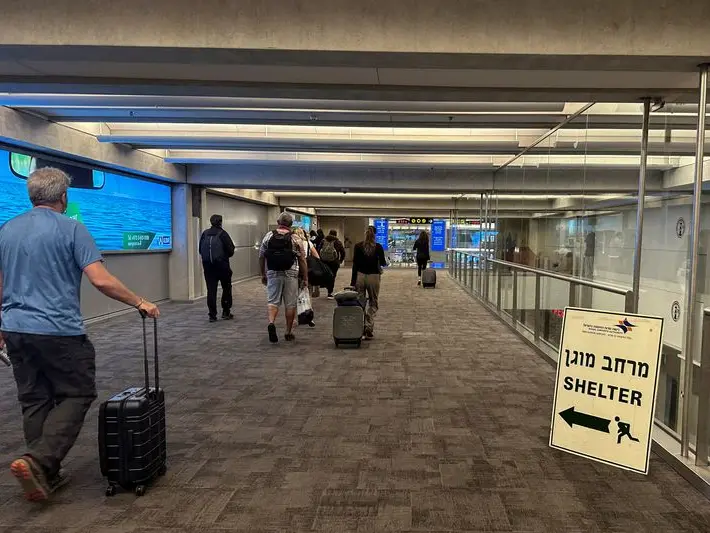
&imwidth=800&imheight=600&format=webp&quality=medium "Airlines reroute flights over Iran–Israel tensions: Who’s paying the price and who’s profiting?")
As conflict intensifies across West Asia, global airlines are cancelling or rerouting flights over Iranian and Israeli airspace. What began as precautionary action has now disrupted major passenger routes, supply chains, and flight schedules — even as defence firms cash in on soaring global insecurity.
The trigger? Israeli airstrikes on Iranian military facilities earlier this week, followed by retaliatory warnings from Tehran and partial airspace closures. The developments have not only heightened regional risk but are also fuelling a fresh wave of military spending.
Airlines avoid the ‘militarised skies’

Global aviation is once again on high alert.
Dozens of international carriers — including Lufthansa, Emirates, Singapore Airlines, and Air India — have altered their flight paths to avoid Iranian, Iraqi, and Israeli airspace. As per Reuters, some long-haul flights have been diverted mid-air, while others are detouring via Central Asia or Saudi Arabia, adding up to three hours in travel time.
The Times of India reported that Air India rerouted 16 services in just 48 hours, citing operational safety. Meanwhile, Israeli flag carrier El Al temporarily suspended flights from Tel Aviv. Analysts say the move echoes past aviation disasters, including Malaysia Airlines Flight MH17 in 2014 and Ukraine International Airlines Flight 752, mistakenly shot down over Tehran in 2020.
Trending Stories
)
Nigeria: Protesters take to the streets, police fire shots
)
US-Iran war: Tehran draws red lines — seven demands before any peace talks
)
Russia-Europe tensions: Polish PM warns Russian attacks could test NATO's unity
&im=FitAndFill=(700,400))
‘Not the US or China’: These are the countries leading the world in arable land
)
Trump says he'll build an 'AI Force' and appoint a czar, for 'high IQ' people only
)
EXCLUSIVE | Singer Hanita Bhambri on her Toxic debut, working with Vishal Mishra and more
)
Sikh bus driver assaulted, bus stolen and rammed into cars in England; video surfaces
)
Mark Carney mimics Trump in hilarious moment over C$70 billion clean-energy investment; room erupts in laughter
&im=FitAndFill=(700,400))
Before Extraordinary Minami Minami, these popular K-dramas got Japanese versions
)
'Were you here to sell chickpeas?': Wasim Akram criticises Babar Azam's captaincy
)
Aravana prasadam shortage at Sabarimala temple in Kerala triggers protests, TDB questioned
)
‘End of my career...’: NSA Doval recalls tense Sikkim mission when China captured Indian intelligence team
)
Report: Iran rebuilding Taleghan 2, nuclear site tied to past weapons research, hit twice by Israel
)
Trump defends AI amid growing alarm, announces new 'AI force' and promises an 'AI czar'
)
Iran sets 7 conditions to end war with US: What are Tehran’s demands?
)
Trump announces ‘AI Force’ as debate grows over AI risks and regulation
)
China may have gained access to US's classified F-35 jets; parts meant for repairs diverted to Hong Kong, sparking Pentagon inquiry
)
Man breaks open wall hiding hundreds of books since 15 years
)
Gaza under attack: Health chief's son killed in IDF strikes
)
S Jaishankar, former Army chief among high-profile names issued Delhi SIR notices
)
Arvind Kejriwal, family members, Delhi CM Rekha Gupta get SIR notices
)
AI actress Tilly Norwood glitches mid-interview, switches from English to Chinese | Watch
)
Saudi vs Houthis: Houthis claim missiles & drones used in attack on key Saudi sites
)
Ed Sheeran addresses Macklemore's removal, Gaza conflict during Philadelphia concert: 'I cannot hide how I feel'
)
‘Will go to any extent’: Pakistan vows to defend Saudi Arabia amid Houthi attacks
66 years of the Indus Waters Treaty: How India and Pakistan settled a bitter river dispute
)
The Verdict | When precision fails: US commits war crime in Minab school strike, UN finds
)
9 women found dead near Johannesburg: South Africans rally, demand 'enough' to femicide
)
Kampala-Ankara rift deepens: Uganda suspends military ties, seeks Fred Lumbuye's extradition
)
Several petrol pumps, other businesses to refuse UPI payments above Rs 2,000 from Oct 16: Is it legal?
)
US-Iran war: Tehran sets seven conditions to re-engage in talks with US
)
Reacher star Alan Ritchson opens up about alleged blackmail, suicide attempt during difficult period
)
West Indies Squad for India Series: Hetmyer included for T20Is, Holder rested
)
China now makes advanced memory chips without the machines it was banned from buying
&im=FitAndFill=(700,400))
How many F-35s does Britain, Japan and Israel have?
)
Harry Brook targets long reign at top of T20I rankings after Sri Lanka sweep
)
Russia's deadly Ukraine strikes kill 2 in Sumy, hit Dnipro mall
)
Russia holds first parliamentary elections since the beginning of the Ukraine war
&im=FitAndFill=(700,400))
Meet top 5 Indian batters with fastest T20I centuries
)
Raphinha hat-trick powers Barcelona to 3-1 win over Sevilla in La Liga
)
Aviation security firm Osprey Flight Solutions warned in a recent advisory that the growing risk of “misidentification in militarised skies” is becoming harder to mitigate as regional tensions rise.
The real-world impact: Cost, chaos and cargo delays
West Asian airspace lies at the heart of one of the world’s busiest flight corridors, linking Asia with Europe. Its closure has hit airlines where it hurts — the balance sheet. According to industry data cited by Reuters, rerouting flights around Iran and Israel adds US $5,000 to $10,000 per flight in fuel and overflight charges.
Fuel costs alone make up nearly 30 per cent of an airline’s total operating expenditure. Extended flight times also mean additional crew hours, passenger delays and overburdened airport schedules. Freight operators are feeling the shockwaves too. Cargo delays have rippled through hubs like Dubai, Doha, Istanbul and Delhi — critical links in Asia–Europe logistics.
Insurance firms, in turn, have hiked aviation war-risk premiums for carriers flying near active conflict zones.
A 2024 precedent offers insight: when Pakistani airspace remained closed for five months, Indian carriers reported losses totalling nearly US $600 million, according to Cirium data cited by Reuters.
Defence industry surges on war anxiety
While airlines scramble to contain losses, the defence industry is soaring.
As reported by Reuters, European defence manufacturers are in the middle of what analysts describe as a “supercycle”. The Stoxx Europe Aerospace & Defence index has posted over 40 per cent annual returns since 2022, fuelled by rising investor confidence and state procurement.
Meanwhile, the European Investment Bank has expanded its defence lending programme threefold — from €1 billion to €3 billion — with funds funnelled into high-tech small and mid-sized arms manufacturers across the EU.
On the policy front, countries like the UK, Germany, and Australia have ramped up defence budgets. According to Bloomberg, defence allocations are nearing 5 per cent of GDP in some cases, with billions going into radar systems, unmanned submarines, long-range strike capabilities, and AI-powered surveillance.
Adding to this, defence-focused exchange-traded funds (ETFs) in Europe have attracted US $6.2 billion in capital inflows so far in 2025 — nearly six times the inflows recorded during the same period last year, Bloomberg reports.
Why defence thrives when skies close and what does all this mean?
For every flight rerouted, there’s a supply chain recalibrated. As nations militarise skies, sea lanes, and cyberspace, private firms in the defence sector are capitalising on government urgency. War-risk insurance, drone production, missile detection, and satellite imaging are booming — all funded by state defence budgets swollen by geopolitical insecurity.
Meanwhile, the public — flyers and freight — pays for the fallout.
What lies ahead?
With Iran warning of “unprecedented consequences” if Israel continues military strikes — as quoted by Reuters — and the Israeli military maintaining “maximum readiness”, regional de-escalation looks unlikely in the short term.
Airspace closures may persist for weeks, perhaps months. Airlines face spiralling costs. Cargo firms brace for more uncertainty. But one sector is already winning — the global defence industry, whose stocks and influence continue to climb, flight by flight.
(With inputs from the agencies)