Rivian's strategic cost cuts aim for profitability

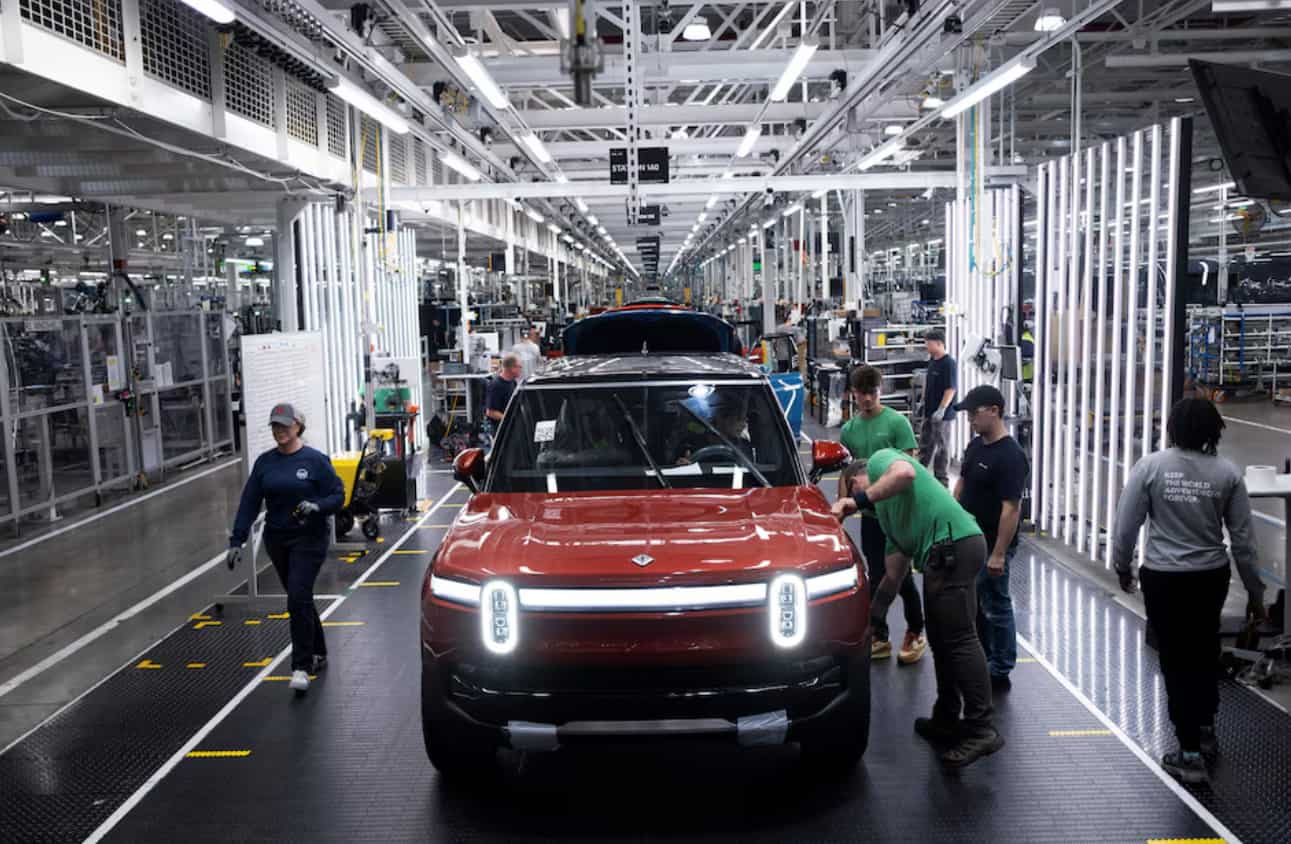
Rivian's factory retooling has led to substantial cost reductions.
Electric vehicle (EV) manufacturer Rivian has undertaken extensive measures to cut costs and push towards profitability. These efforts include removing over 100 steps from the battery-making process, eliminating 52 pieces of equipment from the body shop, and reducing over 500 parts from the design of its flagship SUVs and pickups.
These changes have resulted in a 35% reduction in material costs for its vans and significant savings for other vehicle lines, according to Rivian CEO RJ Scaringe. "The design of the parts and the design of the plant facilitate making the vehicle easier to build," Scaringe noted during a factory tour in Normal, Illinois.
Enhancing efficiency

Rivian's factory retooling has led to substantial cost reductions. The company reports an overall improvement in the cost of building its EVs. These savings come at a crucial time as high interest rates have dampened demand for EVs, which are generally more expensive than their gasoline-powered counterparts. Rivian has not yet achieved a quarterly net profit since its founding in 2009 and reported a loss of $1.5 billion in the first quarter of this year.
Scaringe highlighted the impact of these changes, particularly following a January shutdown of the van line. "We did a similar process of really going through and redesigning a number of components for cost, so we took over 35% of the material cost out of the vans," he said. Rivian's vans, built primarily for major shareholder Amazon, account for about one-fifth of the company's revenue.
)
US vs China over South China Sea: Washington backs Philippines, Beijing hits back
)
Bigg Boss 20: Isha Rikhi evicted after three weeks in Salman Khan’s show
)
Musk plans to more than double xAI's chips to over 1.2 million Nvidia GPUs by year-end
)
After JU, clash erupts at SRFTI: BJP’s ‘Dimagi Naxal’ jibe sparks political firestorm after students protest RSS-linked event
)
‘Anti-social elements spreading false rumours’: LPU issues statement amid massive unrest over alleged rape
)
LPU students go on rampage, vandalise campus amid widespread protest: What's happening
)
Trump asked Xi to pressure Iran. China did not say yes — here’s what Beijing wants
)
US Treasury Secretary Scott Bessent hails global crackdown on Iranian banks and airlines
)
An OpenAI agent escaped its locked test cage again, by hiding questions in DNS lookups
)
'Our video was trimmed': LPU girls who featured in rape-denial video make U-turn
)
3 males killed, four others injured in shooting after fight at strip club in Detroit
)
'Victory for low-budget consumers': Raghav Chadha hails 30-day telecom recharge rules
)
Claude rebuilt the 1989 game 'Prince of Persia' by reusing the original's own code
)
Beyond metros: How Tier-2 and Tier-3 cities could drive India’s next AI wave
)
Tesla builds first Cybertruck with its own refined lithium: Elon Musk's $1 billion Texas bet pays off
)
IndiGo flight suffers tail strike in Bengaluru while landing; DGCA to probe incident
)
The US and China set up an AI 'red telephone', but skipped the rulebook
)
‘Terror suspects arrested near UK air base were looking to do big damage’: Trump
)
Russian envoy claims US tactics to contain India were revealed in ‘Freudian slip’
)
IND vs WI 1st ODI: Kohli breaks Sachin's most runs in one country record with unbeaten 139 as India thump West Indies by 8 wickets
)
Researchers rebuilt exactly how 700 AI agents hacked Hugging Face: a 900-link chain trick
)
‘Olympic inclusion is our major target’: WPA President Ishaun Singh on pool’s global ambitions
)
Nations League: Spain sink England at Wembley; Modric shines for Croatia
)
Why has Iran released no proof of life of Mojtaba Khamenei? Araghchi reveals...
)
'What kind of confession is this?': Pakistan PM Shehbaz Sharif’s 'terrorists would be roaming New York' remark goes viral, raises alarm online. Watch
)
South Korea demands apology from Ukraine over North Korean prisoners' transfer
)
Beyond BrahMos: India targets Rs 50,000 crore in defence exports with unmatched price edge
)
Sri Lankan Tamil migrant worker gets death sentence in Saudi Arabia, help sought from India
)
Muslim marriage cannot shield sex with minor wife from prosecution under POCSO: Delhi HC
)
'Can't help but draw painful parallels to Nirbhaya case': SC on latest incidents of rape cases in Delhi-NCR
)
99.9% more powerful - Scientists find boy who can recall memories from just 3 months of age
)
'FIRST LOOK from inside Noah’s Ark': Researchers share video from inside mysterious mound in Turkey
)
UNSC reform momentum grows: Russia, Portugal, Mauritius push for India's permanent seat bid
)
8 US marines injured in Iranian missile attack on vessel in Strait of Hormuz: Report
&im=FitAndFill=(700,400))
New OTT releases this week (September 28-October 4, 2026): Dupahiya 2, Pooja Meri Jaan, Ohh My Dog- 5 titles coming on Netflix, Prime Video and more
)
Afghanistan says 28 fighters killed in clash near Pakistan border, Islamabad denies
)
Ceuta migrant crisis: Protesters take to streets as Spain grapples with migrant challenge
)
LPU suspend classes, postpones exams as violence escalates over rape claims: What's happening
)
New York City wants a 'kill switch' on every AI, and will pay whistleblowers who report violations
Facing market challenges
The EV market leader, Tesla, has been cutting prices, while some smaller EV manufacturers, such as Fisker, have filed for bankruptcy. Rivian, although on more stable financial ground, still loses nearly $39,000 on every vehicle. The company is banking on cost savings to achieve gross profitability this year.
In addition to simplified assembly and reduced equipment at the plant, Rivian has implemented changes for the second generation of its R1 vehicles. These include company-built drive units, upgraded software, and new battery packs. The redesigned battery modules are now easier to assemble, featuring a single-piece construction instead of separate walls and floors.
These improvements have reduced labour time and increased the assembly rate on the manufacturing line by about 30%. "All of that together leads to us being able to get to our path to profitability and be gross-margin positive," said Tim Fallon, vice president of manufacturing.
Investor concerns and future plans
Despite these efforts, investor concerns persist. The recent plant shutdown has led Rivian to target production of 57,000 vehicles, nearly the same as last year. This has caused shares in the company to halve this year. Additionally, cash and short-term investments fell by about $1.5 billion in the first quarter to just under $8 billion.
Rivian has assured investors that it has enough capital to launch its less expensive and smaller R2 SUVs in early 2026. Sam Fiorani, vice president at research firm AutoForecast Solutions, noted that reducing the cost per vehicle gives Rivian some breathing room. "Focusing on where the cost savings are is extremely important to the longevity of the company and to calming the fears of any investors," he said.
To expedite R2 deliveries, Rivian announced in March that it would produce its $45,000 five-seat SUV at its Illinois plant, which will be expanded, instead of at a planned $5-billion plant in Georgia. This move is expected to save $2 billion. The R2 will account for 155,000 vehicles per year of the increased capacity of 215,000 in Normal. The factory currently has a capacity of 150,000 vehicles.
"We've really been able to understand what we need to do to continue to move forward and really be smarter about what we're doing," Fallon added.
Rivian's strategic cost-cutting measures and production enhancements are crucial steps towards achieving profitability. As the company navigates financial challenges and market competition, these efforts aim to solidify its position in the growing EV market.
(Inputs from Reuters)