&imwidth=800&imheight=600&format=webp&quality=medium "Trump and Putin China visits: Key contrasts in tone, strategy & symbolism and the unexpected similarities")
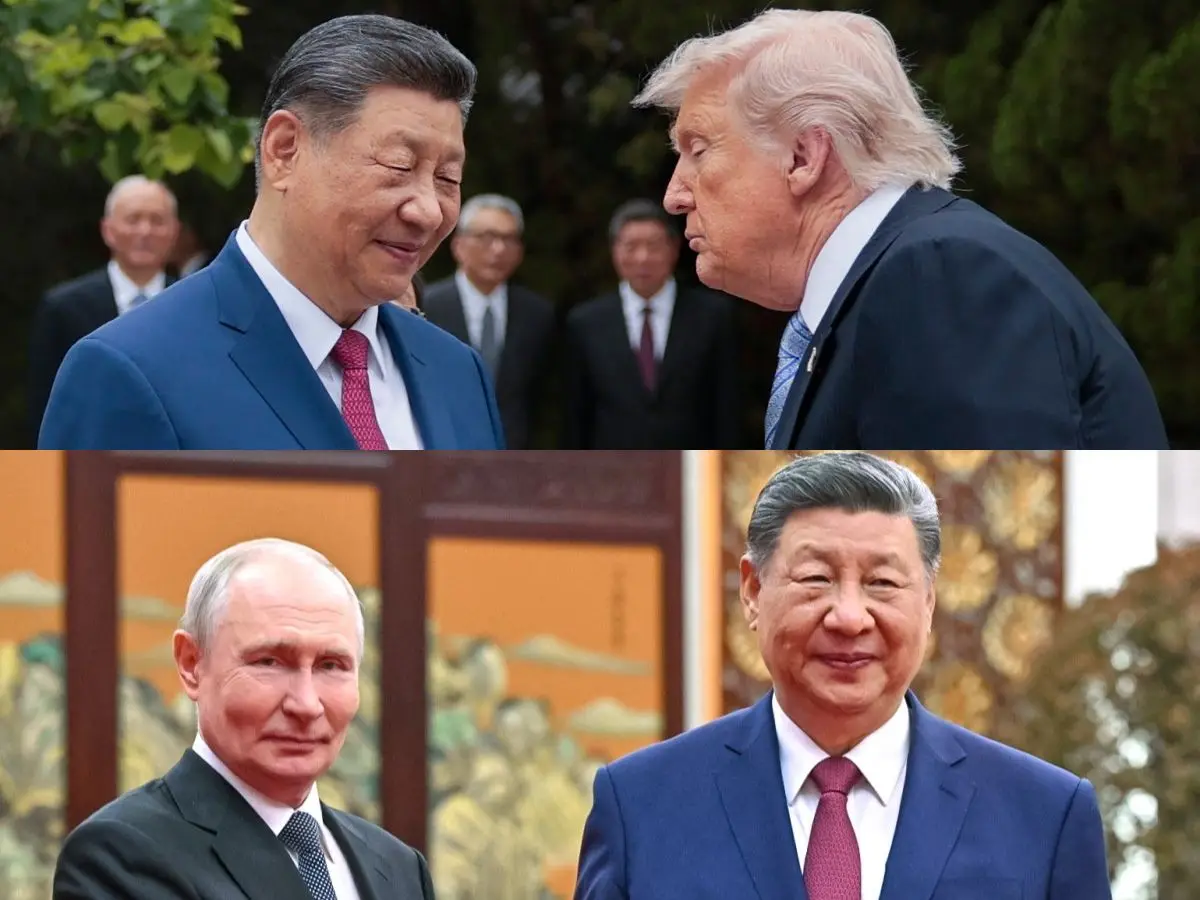
China has increasingly functioned as a central stage for global diplomacy, hosting high-profile engagements involving the United States and Russia at different points in recent past. Visits linked to US President Donald Trump and Russian President Vladimir Putin have been widely analysed for what they reveal about shifting global alignments and China’s positioning as a key diplomatic power under Xi Jinping. While each leader’s engagement with Beijing has taken place in distinct geopolitical moments, analysts consistently note that China uses such summits to project stability, economic leverage and strategic influence.
Contrasting Diplomatic Tone and Messaging
The tone of engagement has sharply differed between the two leaders. The differences between the two visits began with their length: The US president stayed in China for three days, while Putin’s visit lasted two. Trump’s interactions with China were largely shaped by trade tensions, Taiwan, tariff disputes and public positioning around economic competition. His visits and meetings often reflected a transactional approach, with emphasis on bilateral trade imbalances and negotiations.

By contrast, Putin’s engagements with China have been framed more in terms of long-term strategic alignment, energy cooperation and shared geopolitical interests. The tone has generally been described as steadier and more continuity-driven, particularly in the context of Western sanctions and Russia’s pivot towards Asia.
Strategy and Symbolism in Global Context
Trending Stories
)
ISRO stages comeback with GSLV-F17/EOS-05 success; targets six more launches
)
Man pushes Russian humanoid robot. Watch what happens next
)
Nigerian Navy discovers 99,000 litres of suspected stolen, illegally refined products as it intensifies anti-crude oil theft operations
)
Husband uses secret camera to record wife’s affair, wins divorce case, ends up in jail for spying
)
China detains 52 Singaporeans over alleged pyramid schemes; Beijing denies arrest
&im=FitAndFill=(700,400))
Why US tanks weigh over 20 tons more than Russian tanks
)
Indian agencies uncover hawala, shell firms and fake trade used to hide illicit money, FATF says
)
Killing the Himalayas slowly: Human urine is melting a glacier on Mount Everest
)
US Open 2026: Auger-Aliassime out but Swiatek, Osaka, and Gauff advance into third round
&im=FitAndFill=(700,400))
New Friday OTT releases (September 4, 2026): GDN, Dhamaal 4, Jagamae Sangeetham- Watch 6 new movies and TV shows on Netflix, Prime Video and more
)
Kenya vs Tata Chemicals: Why President William Ruto ordered company to stop operations
&im=FitAndFill=(700,400))
How fast can the Sukhoi Su-30 fighter jet really fly?
)
Netherlands shifts 86 tonnes of gold reserve to UK citing geopolitical risks
)
‘I wouldn’t call it a war,’ says JD Vance on ongoing conflict with Iran
)
Nobel laureate Machado says Venezuela’s ‘illegitimate’ regime has no right to strike US oil deal
)
Breaking | Vance takes the podium: First White House briefing since Leavitt's exit
)
Volkswagen to cut 50,000 more jobs, 100,000 roles to be eliminated by 2030
)
Suvendu Adhikari threatens to cut school aid over refusal to sing full Vande Mataram
)
The Verdict: Peace for Iran, pressure on Afghanistan: Pakistan’s contradictory diplomacy
&im=FitAndFill=(700,400))
Krishna Janmashtami 2026: From Dhaniya Panjiri to Makhana Kheer- 5 best sweet dishes perfect for celebrating Lord Krishna’s birth
)
Bangladesh batter Towhid Hridoy creates history with 350 not out in South Africa
&im=FitAndFill=(700,400))
Why US tanks can spin their heavy turrets much faster than Russian tanks
)
Manipur violence: 25 houses torched in Manipur’s Kangpokpi a day after 10 homes were burnt along Imphal-Tamenglong road
)
Lollapalooza India 2027: From Olivia Dean to KATSEYE, check full lineup, dates and tickets
&im=FitAndFill=(700,400))
Why Russian fighter jets use bulky, low-pressure tyres compared to US jets
)
NATO troops gather in Arctic, Russia threatens nuclear retaliation
)
South Korea plans for military deployment in Strait of Hormuz amid US pressure
)
Iran's army conducts drone & missile attack on US bases
)
Inside Iran's shadow fleet: How Tehran dodges the US blockade at sea
)
At least 2 killed in Minneapolis shooting, suspect also dead
)
Iran attacks US bases in Kuwait & UAE, supersecret missile project in focus | Gravitas
)
Who is Aditi Paudel? 17-year-old becomes Japan's first literacy ambassador
)
Happy Krishna Janmashtami 2026 wishes: 30+ messages, quotes, greetings, and WhatsApp status ideas to share
The strategic framing of the visits also diverges significantly. Trump’s China-era diplomacy was closely tied to economic pressure and renegotiation of trade terms, often under the broader narrative of ‘America First’. Putin’s approach has focused more on consolidating multipolarity, strengthening non-Western alliances, and deepening institutional cooperation through platforms such as BRICS and regional groupings.
According to the Associated Press, while the United States and China continue efforts to stabilise strained trade relations, Moscow and Beijing have reaffirmed their partnership as strategically essential. Vladimir Putin described the ‘driving force’ of the bilateral relationship as the energy sector, with particular emphasis on oil and gas cooperation. The remarks show the growing role of energy ties in sustaining economic links between Russia and China amid shifting global trade dynamics and broader geopolitical realignments.
ALSO READ: 'No cosmetic permitted as injection under law': India drug regulator CDSCO issues strict warning
Symbolically, China has used both sets of engagements to reinforce its image as an indispensable global power capable of hosting and balancing competing superpowers on its diplomatic stage. China and Russia signed more than 40 cooperation agreements spanning trade, technology and media exchanges, reinforcing the breadth of their bilateral engagement. The two sides also issued a joint declaration describing Russia and China as “important centers of power in a multipolar world,” underscoring their shared geopolitical framing. By contrast, Donald Trump and Xi Jinping did not sign a joint declaration or publicly oversee any agreements during the visit. Details of several accords were announced only after the US president had left Beijing, including Washington’s statement that China had agreed to purchase U.S. agricultural products worth an annualised $17 billion and acquire 200 Boeing aircraft.
Unexpected Points of Convergence
Despite clear contrasts, some similarities emerge. Both leaders were received at Beijing’s Tiananmen Square with full ceremonial honours, including a military guard of honour, a marching band and children waving national flags. They also held closed-door discussions with Xi Jinping at the Great Hall of the People, located adjacent to the square. Separately, Donald Trump was given a private tour of the Temple of Heaven and walked through the imperial gardens of Zhongnanhai during his visit. Putin, instead, spent much of his time with Xi.
Both leaders’ engagements with China underscore the country’s centrality in global trade and security architecture. In both cases, interactions reflect a recognition that China cannot be bypassed in discussions on economic stability and geopolitical strategy.
Additionally, both Trump-era and Putin-era engagements highlight a broader shift away from unipolar dominance towards a more contested, multipolar global order, where China plays an increasingly pivotal role.