Another FTX in making? Does Higgsfield AI has 1 customer care guy for 300,000 paying customers?

&imwidth=600&imheight=450&format=webp&quality=medium "Another FTX in making? Does Higgsfield AI has 1 customer care guy for 300,000 paying customers?")
The new FTX? Higgsfield AI has 1 customer care guy for 300,000 paying customers sitting on Discord
Higgsfield AI reached a $5.4 billion valuation and a $300 million annual run rate with roughly 300,000 paying customers. Users report that billing disputes are resolved not through a support desk but by tracking down a single Discord moderator, that refunds often follow only after complaining publicly, and that questions about accountability are deleted from the company's Discord server.
Higgsfield AI is valued at $5.4 billion. It reported a $300 million annual revenue run rate by early February. It raised $80 million in January from Accel, GFT Ventures and Menlo Ventures and $400 million more in August. It has roughly 15 million users, about 300,000 of whom pay, and it generates some 4.5 million video clips a day, enough volume to make it the largest customer of OpenAI's Sora 2 model by spend.
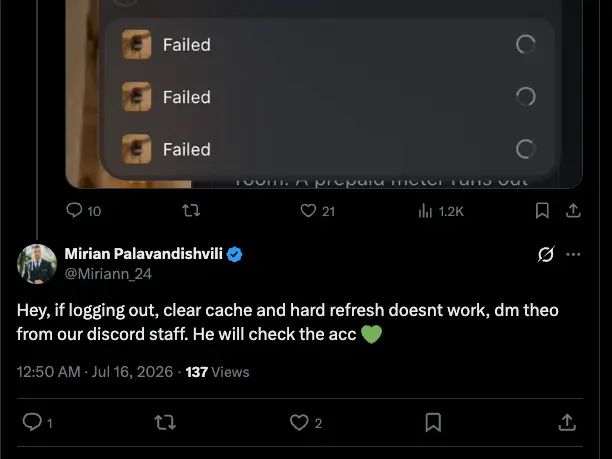
According to its own customers, the way to resolve a billing dispute with it is to find one particular moderator on Discord and hope he is online. Even the company's Community manager on X goes on commenting to ask a guy on discord to solve the issue.
How Support Actually Works
Reporting on complaints logged against the company describes the mechanism plainly: billing issues often require direct contact with a specific Discord moderator, commonly known as 'THEO' which means resolution speed depends on one person's availability rather than on any standard support process.
Users describe the consequences. Cancellation requests denied or stalled, with some told their cancellation "couldn't be verified" after they had requested it. Credits deducted after a subscription had already been cancelled. And a recurring pattern in which credits deducted in error are refunded, but only after the customer raises it publicly.
That last detail is the one worth pausing on. If a company reliably corrects errors once they are visible to other customers, and unreliably otherwise, then public complaint has become part of the support process rather than a failure of it.
Trending Stories
&imwidth=280&imheight=210&format=webp&quality=medium)
&imwidth=280&imheight=210&format=webp&quality=medium)
&imwidth=280&imheight=210&format=webp&quality=medium)
&imwidth=280&imheight=210&format=webp&quality=medium)
&imwidth=280&imheight=210&format=webp&quality=medium)
&imwidth=280&imheight=210&format=webp&quality=medium)
&imwidth=280&imheight=210&format=webp&quality=medium)
&imwidth=280&imheight=210&format=webp&quality=medium)
&imwidth=280&imheight=210&format=webp&quality=medium)
&imwidth=280&imheight=210&format=webp&quality=medium)
&imwidth=280&imheight=210&format=webp&quality=medium)
&imwidth=280&imheight=210&format=webp&quality=medium)
&imwidth=280&imheight=210&format=webp&quality=medium)
&imwidth=280&imheight=210&format=webp&quality=medium)
&imwidth=280&imheight=210&format=webp&quality=medium)
&imwidth=280&imheight=210&format=webp&quality=medium)
&imwidth=280&imheight=210&format=webp&quality=medium)
&imwidth=280&imheight=210&format=webp&quality=medium)
&imwidth=280&imheight=210&format=webp&quality=medium)
&im=FitAndFill=(700,400)&imwidth=280&imheight=210&format=webp&quality=medium)
&imwidth=280&imheight=210&format=webp&quality=medium)
&imwidth=280&imheight=210&format=webp&quality=medium)
&imwidth=280&imheight=210&format=webp&quality=medium)
&imwidth=280&imheight=210&format=webp&quality=medium)
&imwidth=280&imheight=210&format=webp&quality=medium)
&imwidth=280&imheight=210&format=webp&quality=medium)
&imwidth=280&imheight=210&format=webp&quality=medium)
&imwidth=280&imheight=210&format=webp&quality=medium)
&imwidth=280&imheight=210&format=webp&quality=medium)
&imwidth=280&imheight=210&format=webp&quality=medium)
&imwidth=280&imheight=210&format=webp&quality=medium)
&imwidth=280&imheight=210&format=webp&quality=medium)
&im=FitAndFill=(700,400)&imwidth=280&imheight=210&format=webp&quality=medium)
&imwidth=280&imheight=210&format=webp&quality=medium)
&imwidth=280&imheight=210&format=webp&quality=medium)
&imwidth=280&imheight=210&format=webp&quality=medium)
&imwidth=280&imheight=210&format=webp&quality=medium)
The Documented Cases
Individual accounts on review platforms describe what happens when the informal route does not work.
One customer had their account restricted following a fraud-prevention review in March. They submitted the documentation the company requested in late May, and received no response for 16 days. After escalating formally in June, three different agents replied over two days, each promising action. Days later an automated message stated that a solution had been shared. No solution had been communicated, and the account remained blocked.
Another described the support chat as extremely disrespectful and unprofessional, with their messages dismissed rather than addressed. Another put it more simply: "I didn't expect any response from Higgsfield after I ran into an issue and emailed them about it."
Higgsfield's Trustpilot rating stands at around 3.2 out of 5 across more than 1,200 reviews. It also carries an open complaints record with the Better Business Bureau.
The Deletions
Several users report that questions about accountability posted on the company's Discord server are removed.
That is consistent with a pattern documented in the company's own marketing practice, where it has been described as publishing deliberately provocative content to attract attention and subsequently deleting the posts. The company's X account was suspended in February for what the platform described as inauthentic behaviour.
Deleting customer complaints and deleting marketing posts are different acts, but they share a logic: the visible record is treated as something to be managed rather than answered. For customers whose only reliable escalation route is public visibility, removing that visibility closes the one door that worked.
The Refund Terms Behind It
The support bottleneck matters more because of how narrow the formal remedy is.
Higgsfield's refund policy provides for refunds only within seven days of purchase, only if no credits have been used, and minus a six per cent service fee. Renewals are excluded entirely. Subscription credits do not roll over between billing cycles.
A customer who discovers a problem in week three has no contractual remedy. Their options are the moderator, a public complaint, or a chargeback with their bank.
What The Company Says
Higgsfield has not disputed that it has had problems, and in some respects has been notably direct about it.
The company refunded $1.35 million to users affected by slowdowns, attributing those partly to some 40,000 fraudulent bot accounts it shut down over December and January. It has cited high infrastructure demand and bot activity during peak periods as the cause of degraded performance.
Chief executive Alex Mashrabov, formerly head of generative AI at Snap, has acknowledged the wider criticism: "Rapid scaling brings real challenges. We acknowledge that our internal processes and external communications haven't always kept pace with our core values, and we have made mistakes."
Cofounder Yerzat Dulat has separately suggested that negative discussion has been amplified by competitors, naming firms including Runway and Midjourney. That claim has not been independently verified.
The Question It Raises
The charitable reading of all this is that Higgsfield grew faster than any company could staff for. Fifteen million users in roughly two years is genuinely extraordinary, and Mashrabov's statement about processes failing to keep pace is a reasonable description of what happens when growth outruns operations.
The difficulty with that reading is the money. This is not a startup without the means to hire. It closed an $80 million round in January, from three established venture firms, at a $1.3 billion valuation, against $300 million in annualised revenue. Support headcount at that point is a choice about where to allocate resources, not a constraint.
Three hundred thousand people are paying this company. What they appear to have bought, when something goes wrong, is a queue for one person's attention on a chat server — and the possibility that the question itself is removed before it is answered.
)
