&imwidth=800&imheight=600&format=webp&quality=medium "Putin visits India: All the times Russia stood by India, and India backed Russia, since the Soviet era")
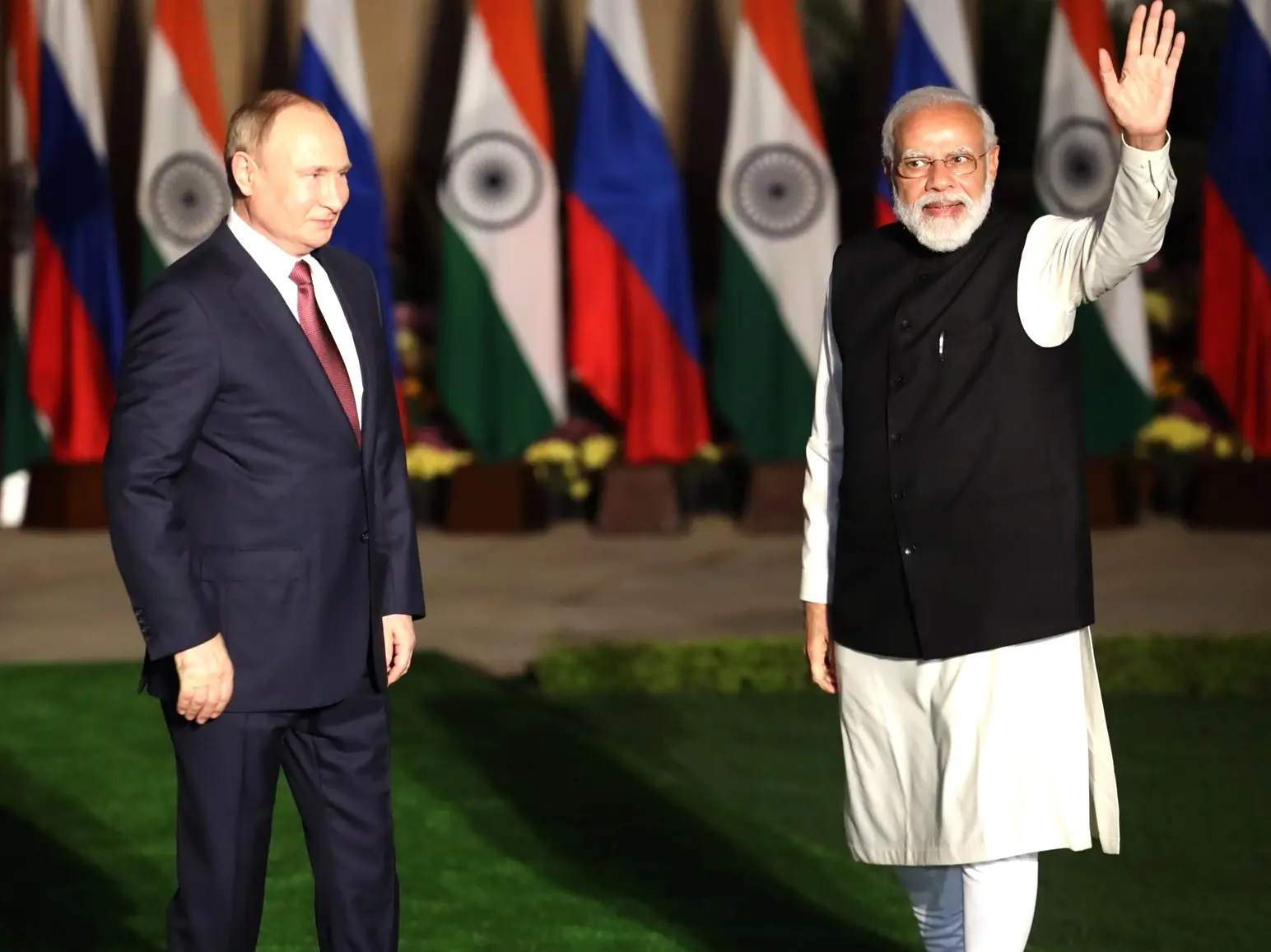
India–Russia relations go back to the era of the Soviet Union and remain one of the most stable partnerships anywhere in the world. The strong India–Russia bond results from mutual need, shared worldview, demonstrations of support during periods of crisis, and global pressure faced by both India and Russia. Russia stood by India from the early days of its independence. While being non-aligned during the Cold War, India took care not to join any effort to isolate the Soviet Union. Since the dissolution of the Soviet Union, India and Russia remained strong partners in political, economic, defence, and security affairs. Here are the major instances when Russia – and before that the USSR – stood by India, and when India reciprocated to sustain this deep, time-tested, special and privileged strategic partnership.
India's Cold War neutrality and the Non-Aligned Movement during the Soviet era
It would not be an exaggeration to say that the Non-Aligned Movement grew partly as a result of pressures on India to side with either the US-led Western or Soviet-led communist blocs during the Cold War era. As India pursued a non-aligned, independent foreign policy, the Soviet Union emerged as one of its most reliable partners, giving large-scale economic assistance to a nation still finding its feet on the global stage. Soviet engineers and planners helped India build the foundations of its heavy-industry ecosystem. This assistance was at the core of steel plants such as Bhilai, as well as numerous factories and technology hubs. India–USSR cooperation at this time would herald the next decades of strong ties.

Soviet Union did not join China in the 1962 Sino-Indian War
The Soviet Union, which led the communist bloc during the Cold War alongside China, attempted to balance ties during the Sino-Indian War of 1962. At a crucial juncture, the USSR tilted towards India, refusing to support China despite ideological alignment. The Soviet Union chose military and diplomatic neutrality, benefiting India during this vulnerable period.
Soviet Union’s stance on the 1971 Bangladesh Liberation War and Indo-Pak War
Trending Stories
As India and Pakistan approached conflict during the Bangladesh Liberation War, the Indo-Soviet Treaty of Peace, Friendship and Cooperation was signed in August 1971. This landmark agreement guaranteed political and strategic support, with the USSR vetoing multiple anti-India resolutions at the UN Security Council. In contrast, the United States deployed the aircraft carrier USS Enterprise to the Bay of Bengal in a show of support for Pakistan. The Soviet Union dispatched elements of its Pacific Fleet, including nuclear-armed submarines, to counter the US and UK naval task forces. This cemented India–Soviet cooperation as one of the most trusted relationships of the Cold War era.
Soviet Union's support for India’s nuclear programme in the 1970s and 1980s
India conducted its first peaceful nuclear test in 1974, leading Western nations to impose sanctions and curtail nuclear cooperation. The Soviet Union stepped in to provide India with heavy water, fuel-cycle assistance, and technical collaboration to help India sustain its nuclear research programme. This was done quietly, without fanfare, but was crucial for India’s energy security and strategic autonomy in the years ahead.
Numerous Soviet vetoes on Kashmir and other political issues
The Soviet Union used its veto power in the UN Security Council throughout the Cold War to block resolutions that threatened India’s sovereignty, particularly on the Kashmir issue. This consistently frustrated Pakistan's efforts to internationalise the matter. With Soviet support, India was able to maintain control of the narrative and resist external pressure on one of its longest-standing foreign-policy challenges.
Longstanding space and technology cooperation
In both manpower and material, the Soviet Union offered scientific and technical assistance to India for its entry into outer space, enabling its growth as one of the major space powers. The USSR launched India’s first satellite, Aryabhata, in 1975. It also trained Indian astronaut Rakesh Sharma, making him the first Indian in space in 1984. Additionally, the Soviet Union provided critical rocket-engine and early cryogenic technology support when Western nations restricted access. India owes much of the foundation of its space programme to Soviet, and later Russian, assistance.
India–Soviet defence and military partnership (1950s–1991)
India's defence ties with Russia date back to the Soviet era. Nearly 70–85 per cent of India’s military equipment by the end of the Cold War – including MiG-21 fighter aircraft, T-72 tanks, submarines, and missile systems – came from the USSR. Much of this was supplied at concessional “friendship prices,” often supported through rupee–rouble trade arrangements. India also benefited from technology-transfer agreements that were not offered by many Western defence suppliers.
Post-Soviet era: How Russia stood by India during the 1998 Pokhran-II nuclear tests
India conducted the Pokhran-II nuclear tests in 1998 and immediately faced US-led Western sanctions. However, Russia refused to join the collective punitive measures, continuing defence, nuclear, and technological cooperation with India. This ensured continuity in India’s strategic programme at a time of intense global pressure.
Russia’s stance during the 1999 Kargil War
During the Kargil conflict with Pakistan, Russian President Boris Yeltsin publicly stated that Pakistan had initiated the aggression, taking an unambiguous position in India’s favour. This diplomatic support provided India with significant international legitimacy during the conflict.
The landmark Strategic Partnership agreement of 2000 and its expansion in 2010
As Russia stabilised after the dissolution of the Soviet Union, its ties with India grew stronger. The relationship was cemented in 2000 with the Declaration on Strategic Partnership. Annual summits were formalised, with long-term defence, nuclear, and energy cooperation frameworks established. In 2010, this relationship was elevated to the “Special and Privileged Strategic Partnership,” providing both depth and continuity despite global headwinds.
India's neutral stance on Russian military operations in Crimea and Ukraine
Following Russia’s annexation of Crimea in 2014, India refused to criticise Moscow or join Western sanctions. After Russia’s 2022 invasion of Ukraine, India continued to balance its stance despite being a strategic partner of the US and several Western nations. India abstained from nearly all anti-Russia resolutions at the UN. Prime Minister Narendra Modi stated that “this is not the era of war.” While Western nations sought to curb Russian energy exports, India continued purchasing Russian crude oil and fertilisers even in the face of US pressure and tariff measures.
The S-400 deal despite US sanctions pressure
Since 2018, India has purchased the S-400 air-defence system from Russia. The acquisition took place despite the threat of American sanctions under CAATSA (Countering America’s Adversaries Through Sanctions Act). Russia delivered the S-400 Triumf system largely on schedule, even as it was engaged in military operations in Ukraine.
Russia’s role in easing tensions during the 2020 India–China border crisis
When India and China clashed at the Galwan Valley in 2020, Russia quietly facilitated back-channel diplomacy to help defuse the situation. High-level meetings were held in Moscow, easing tensions between the two Asian powers.
India's strong stance on the purchase of Russian oil in the face of US punishment
After the Ukraine war in 2022, India emerged as Russia's single largest buyer of seaborne crude oil. Russian oil accounted for only about 1 percent of India’s crude imports in 2021, but as Western nations attempted to reduce Russian energy revenues, India’s imports surged to roughly 35–40 per cent between 2023 and 2024. This came at significant diplomatic risk and punishment by the US through tariffs. A rupee–rouble payment mechanism was established using national financial systems to bypass Western sanctions.
Even as Russia was engaged in a prolonged conflict in Ukraine, it largely maintained its defence delivery schedules to India, including S-400 regiments and the commencement of AK-203 rifle production. Among the most important areas of cooperation remains the BrahMos missile system, jointly developed by India and Russia. Russia continued to be involved in India’s nuclear power programme, with more units at Kudankulam in the pipeline.