
&imwidth=800&imheight=600&format=webp&quality=medium "Putin lands in Delhi today: From ‘poop suitcase’ to ‘flying Kremlin’ - INSIDE his extraordinary security")
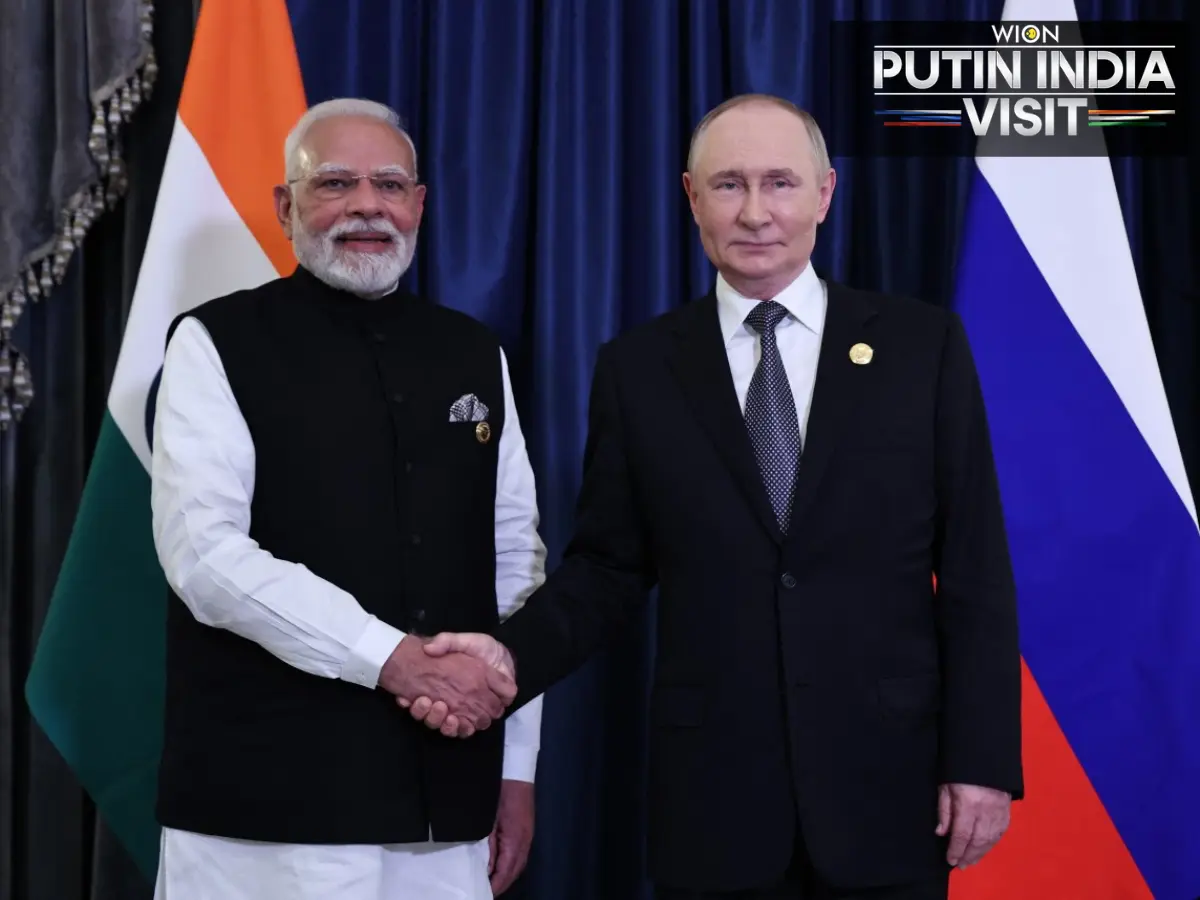
Russian President Vladimir Putin will touch down in New Delhi on Thursday evening (December 4) following an invitation from Indian Prime Minister Narendra Modi. Shortly after his arrival, the two leaders are expected to hold a private dinner meeting.
The formal engagements begin on Friday (December 5), starting with a ceremonial reception at Rashtrapati Bhavan, followed by a visit to Raj Ghat to honour Mahatma Gandhi. His visit is tightly scheduled, featuring the annual India-Russia summit at Hyderabad House, a programme at Bharat Mandapam, and a state dinner hosted by President Droupadi Murmu.
Putin's tight security net

Massive security measures have been taken for Russian President Vladimir Putin. From elite officers from Russia’s Presidential Security Service, India’s National Security Guard (NSG), specialised snipers, anti-drone systems, and AI-powered surveillance, New Delhi is under one of its most extensive security covers in recent years for Putin. One of Russia’s most opaque security bodies Federal Protective Service (FSO) is responsible for security arrangements. Here's a look at it:
According to reporting cited by Azerbaijani outlet Modern.az, Putin’s security personnel come from the elite Presidential Security Service (SBP), a unit within the FSO known for rigorous selection criteria. Recruits must be under 35, at least 180 cm tall, physically strong, combat-trained, psychologically stable, and multilingual. Their personal and family histories are scrutinised, and once selected, they are legally barred from ever revealing operational details about the president. The guards seen near Putin are only the surface layer of a far larger setup. Hidden personnel including snipers, intelligence teams, drone units, communication specialists and evacuation strategists are deployed.
Trending Stories
)
Why asking questions could be more important than memorising answers
)
BRICS Summit 2026: Iran's Pezeshkian praises PM Modi at BRICS
)
Osama Bin Laden ‘planned’ to target India, CIA reveals dozens of declassified documents
)
PM Modi and China's Xi offered to help resolve Russia-Ukraine war: Kremlin
)
BRICS Summit 2026: Global leaders of BRICS nations attend main open session
)
'Iran won't surrender': Pezeshkian sends blunt message to US while attending BRICS Summit in India
)
Why dehydration is the hidden cause of travel fatigue on long flights
)
Top 5 places to visit in Goa beyond its famous beaches
)
'He is popular...': Malaysian PM Anwar Ibrahim's praise for PM Modi during bilateral meeting | WATCH
)
BRICS Summit 2026: 30+ countries seek BRICS membership
)
Frustrated man demolishes his kitchen after thousands flock to see Mother Mary his wife spotted on the wall
)
BRICS Summit 2026: PM Modi, Xi reach key consensus on ties, China to assume BRICS chairmanship in 2027
)
BRICS Summit 2026: Consensus on joint declaration, diplomatic win for India
)
Trump says Canada eager to reach a deal, it could come ‘fairly soon’ if Ottawa treats US farmers better
)
‘Partners, not rivals’: Xi outlines four point plan for stronger India-China ties
&im=FitAndFill=(700,400))
Why Chinese PL-15 air-to-air missiles use dual-pulse motors compared to European interceptors
)
Could staying indoors all day affect your health?
)
BRICS Summit 2026: PM Modi addresses Day 2 of 18th BRICS summit
)
Who is the smiling man beside Modi, Putin and Xi at BRICS Summit 2026?
)
800 million years old - Scientists discover 'fingerprints' of supercontinent Gondwana in ancient rocks
)
Why going digital does not always mean becoming more efficient
&im=FitAndFill=(700,400))
Why do air defence missiles explode near their target instead of hitting it?
)
From severe mobility problems to recovery: Madhuri the elephant’s journey of wildlife care
)
BRICS Summit day 1: New Delhi declaration adopted with full consensus, big diplomatic win for India
)
Did Iran President Pezeshkian touch feet of Hindu spiritual leader at Delhi event as shown in viral video?
)
9-year-old Chennai prodigy clears Cambridge IGCSE grade 10 exams
)
Why does your body need time to adjust after a long journey?
)
BRICS Summit 2026: PM Modi to hold bilateral with leaders of seven countries
)
Ramanathaswamy temple takes centre stage as PM Modi welcomes world leaders at BRICS
)
Houthis launch cross-border strike on Saudi Arabia as Yemen war escalates
)
BRICS Summit 2026: Chinese president Xi Jinping departs from New Delhi after attending BRICS summit
)
Why does your skin need protection from UV rays?
)
How does the loss of forests affect the way wildlife lives and moves?
)
IND vs AFG, 1st T20I: When and where to watch live streaming in India?
)
Why do wild animals need quiet places to survive?
)
Bigg Boss 20: Qazi Touqeer gets a special ‘rockstar’ moment from Salman Khan
)
Humans may lose control of AI: Anthropic CEO calls for slowdown, Altman, Musk back him
One of the most unusual and widely reported aspects of his travel security is the handling of his biological waste. Reports first made public by Paris Match journalists Regis Gente and Mikhail Rubin, and later echoed by The Independent (2022), describe how Putin’s stool is collected, sealed and transported back to Russia to prevent foreign intelligence from analysing it for clues about his health. Former BBC journalist Farida Rustamova has also backed such claims, citing sources who said Putin sometimes uses a private or portable toilet during trips abroad, a practice believed to date back to the start of his presidency.
Former FSO officer Gleb Karakulov revealed that Putin’s lifestyle as “closed and deeply isolated,” noting that he avoids smartphones, travels occasionally by secure train, and maintains strict protocols to minimise digital and physical traceability. Apart from this, food security is another tightly controlled area. Putin travels with his own military-trained chefs, food testers and kitchen staff. As described in the Kremlin-backed documentary Our Service, the culinary team is present wherever Putin goes.
Before his arrival, foreign hotel kitchens are cleared of all local food supplies and replaced with items sourced and tested inside Russia.
When abroad, Putin typically travels in an Aurus Senat limousine, a Russian-built armoured vehicle resistant to bullets, explosions and chemical threats. The car includes emergency oxygen supply, a protected communications system, and the ability to continue driving even with punctured tyres. His aircraft, the Ilyushin IL-96-300PU, sometimes dubbed the “Flying Kremlin”, contains encrypted communications, missile defence systems, a medical unit and a secure command centre capable of authorising nuclear operations. Two backup aircraft often accompany it. Bodyguards reportedly undergo a two-week quarantine before foreign trips to reduce risk of illness.

