

&imwidth=800&imheight=600&format=webp&quality=medium "Oil spikes, airlines stumble, AI stocks soar: The sectors gaining and losing most from the Iran war")
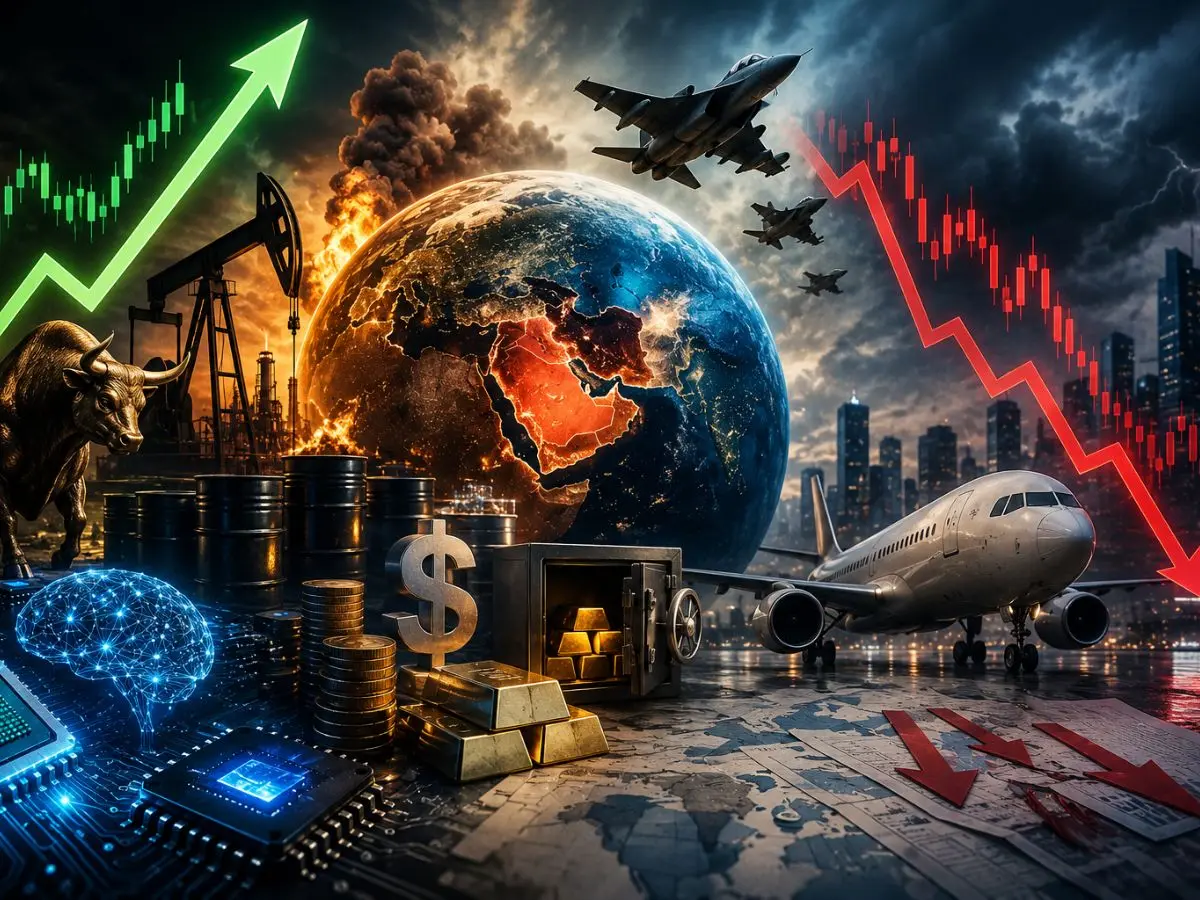
The Iran conflict is rapidly redrawing the global investment landscape, creating distinct market winners and losers as investors reposition around energy shocks, geopolitical risk and defensive assets. An analysis of global markets shows oil producers, defence-linked sectors, AI-driven technology stocks and the US dollar benefiting from the crisis, while airlines, energy-importing economies and vulnerable currencies face mounting pressure.
Oil prices have risen sharply amid fears of supply disruptions across the Middle East, with investors closely monitoring shipping activity through the Strait of Hormuz, one of the world’s most important routes for crude exports. Reuters reported that oil prices have climbed by roughly 40 per cent since the conflict escalated, dramatically altering expectations around inflation, interest rates and global growth. In physical markets, crude has remained well above $100 a barrel and, at one stage in early April, briefly traded at nearly twice its pre-war level. The surge has strengthened oil-exporting economies and energy companies, while sharply increasing operating costs for sectors heavily dependent on fuel, particularly aviation and logistics. Although a record 400-million-barrel release from strategic petroleum reserves by major economies, along with alternative sourcing by traders, has softened some supply pressures, strain across the global energy system continues to intensify.
Reuters also noted that airlines have come under pressure from both higher fuel costs and disruptions to regional airspace. Earlier this month, Air India temporarily suspended select international routes due to rising aviation turbine fuel (ATF) prices and airspace restrictions, while increasing international fuel surcharges by $10 to $50 per passenger. IndiGo also introduced a fresh fuel surcharge as escalating oil prices pushed operating costs higher. Several carriers have been forced to reroute or suspend flights across parts of the Gulf region, adding operational strain at a time when fuel prices are already climbing.
AI and defence stocks emerge among strongest gainers
Trending Stories
&imwidth=180&imheight=135&format=webp&quality=medium)
'My name has always been Ilhan Omar': Congresswoman hits back at Trump, calls him a 'creep'
&imwidth=180&imheight=135&format=webp&quality=medium)
Gravitas | US attack could trigger WW III: Russian planes in Tehran, Israeli jets, US warships in action
&imwidth=180&imheight=135&format=webp&quality=medium)
Viral video shows cross falling on Colombia priest, no official confirmation | WATCH
&imwidth=180&imheight=135&format=webp&quality=medium)
'This is humiliation': Vijay Deverakonda under fire over controversial marriage proposal remark on Koffee With Karan 9
&imwidth=180&imheight=135&format=webp&quality=medium)
US Navy, Marine Corps boards defy Trump's transgender military ban, vote to retain troops
&imwidth=180&imheight=135&format=webp&quality=medium)
Will the US attack Iran this weekend? Trump's envoy says, 'absolutely'
&im=FitAndFill=(700,400)&imwidth=180&imheight=135&format=webp&quality=medium)
Why do army tanks have different types of armour?
&imwidth=180&imheight=135&format=webp&quality=medium)
India-China face-off continues near Arunachal’s Taksing, reveals ITBP chief in first official confirmation of tensions
&imwidth=180&imheight=135&format=webp&quality=medium)
Nairobi building collapse: Several feared trapped after 16-storey structure crumbles; rescue operation underway
&imwidth=180&imheight=135&format=webp&quality=medium)
Pakistan airline PIA unveils new crew uniforms, faces online criticism
&imwidth=180&imheight=135&format=webp&quality=medium)
Did Neha Bora call for Bangladesh-like GenZ protest, 'anarchy' in India? WION Fact-checks viral claim
&imwidth=180&imheight=135&format=webp&quality=medium)
'Completely insane, never happened': Trump's son-in-law denies allegations of secret dealings with Saudi, UAE
&imwidth=180&imheight=135&format=webp&quality=medium)
India’s 2022 CWG silver medallist Sabbhineni Meghana announces international retirement
&imwidth=180&imheight=135&format=webp&quality=medium)
Horrific video shows the moment 18-year-old fell to her death from Mexico amusement park ride
&imwidth=180&imheight=135&format=webp&quality=medium)
IND-W vs ZIM-W, 1st ODI: Rawal, Charani star in India’s nine-wicket win over Zimbabwe
&imwidth=180&imheight=135&format=webp&quality=medium)
Microsoft AI diagnoses complex medical cases more than twice as accurately as doctors, study finds
&imwidth=180&imheight=135&format=webp&quality=medium)
Google Fitbit Air’s new health guardian feature tracks trends: How it works
&imwidth=180&imheight=135&format=webp&quality=medium)
US midterms 2026: Trump revises Canada tariffs as Susan Collins faces tight re-election race in Maine
&imwidth=180&imheight=135&format=webp&quality=medium)
US midterms 2026: Viral video claims Lindsey Graham paid underage men for sex; clip released weeks before his sister's Senate race
&imwidth=180&imheight=135&format=webp&quality=medium)
AI deepfakes are spreading online: Why is removing them so difficult?
&imwidth=180&imheight=135&format=webp&quality=medium)
China's dancing robot turns violent bodyguard, lifts cars and fights intruders - Watch
&imwidth=180&imheight=135&format=webp&quality=medium)
Global cybersecurity alert: PHP flaws trigger website shutdowns as hack attempts surge into millions
&imwidth=180&imheight=135&format=webp&quality=medium)
'You’re a horrible little reporter, aren’t you?': Trump snaps at NBC reporter questioning his support for Ramaswamy's campaign ad
&imwidth=180&imheight=135&format=webp&quality=medium)
Apple’s first touchscreen MacBook Pro may cost Rs 4 lakh in India: What to expect on October 28
&imwidth=180&imheight=135&format=webp&quality=medium)
US charges two former FBI officials with lying to Congress about Hunter Biden probes. 'Politically motivated' Trump grievance or something else?
&im=FitAndFill=(700,400)&imwidth=180&imheight=135&format=webp&quality=medium)
New Friday OTT releases (October 23, 2026): Gajab Raat, Dorothy, Chaar Yaar- Watch these 6 new movies and TV shows on Netflix, Prime Video and more
&imwidth=180&imheight=135&format=webp&quality=medium)
US midterms 2026: Trump administration sues to block Alaska Senate election certification if Republican Dan Sullivan loses. What's happening?
&imwidth=180&imheight=135&format=webp&quality=medium)
Anthropic security chief issues grim cyberattack warning: ‘It’s going to get a lot worse’
&imwidth=180&imheight=135&format=webp&quality=medium)
Tu Hai Meri Kiran film review: Sonakshi Sinha and Zaheer Iqbal's thriller gets tangled in its own twists
&imwidth=180&imheight=135&format=webp&quality=medium)
First Lady Melania Trump secures ceasefire between Russia, Ukraine in Oleshky: White House
&imwidth=180&imheight=135&format=webp&quality=medium)
One man, 8 months of work, and a river dirty again: Why Bittu Tabahi may quit
&imwidth=180&imheight=135&format=webp&quality=medium)
Jenna Ortega plans TV break after Wednesday: ‘I want to leave time for new things’
&imwidth=180&imheight=135&format=webp&quality=medium)
Five killed, several injured after explosion in Bihar's Siwan as firecrackers catch fire
&imwidth=180&imheight=135&format=webp&quality=medium)
Iran targeting US diplomats? Intelligence warns of 'advanced' assassination plots: Report
&imwidth=180&imheight=135&format=webp&quality=medium)
Emmanuel Macron calls Paris suburb shooting a 'racist terrorist attack' after one killed, several injured
Despite the broader geopolitical uncertainty, investors have continued pouring capital into artificial intelligence-linked companies, particularly large US technology firms. Reportedly, AI-related stocks have remained resilient even as wider market volatility increased, reinforcing their position as a dominant force in global equity markets.
South Korea’s SK Hynix crossed the $1 trillion market valuation mark for the first time on Wednesday, joining memory chip rivals Samsung Electronics and Micron Technology as surging investor demand for AI-linked semiconductor stocks continued to drive gains across the global chip sector, Reuters reported.
Defence and cybersecurity firms have also attracted stronger investor interest amid rising security concerns and expectations of increased military spending globally. At the same time, traditional safe-haven assets including the US dollar and gold have strengthened as investors seek protection from geopolitical instability. The report suggests markets are increasingly splitting into sectors that benefit from prolonged instability and those exposed to inflation, fuel dependency and weakening trade conditions.
Fashion and luxury sector
The global luxury sector is entering a phase of stabilisation rather than contraction, according to Kearney’s 2026 Global Luxury Industry Outlook, which projects market growth of 2–4 per cent this year, lower than broader industry forecasts of 3–5 per cent. The report says luxury brands are navigating slower demand, changing consumer behaviour and persistent economic uncertainty, with growth expected to diverge sharply across regions, product segments and buyer demographics.
Emerging economies and airlines face growing strain
The economic pressure is particularly visible in energy-importing regions across Asia and parts of Europe, where rising oil costs threaten to intensify inflation and weaken currencies. Reuters highlighted that Asian currencies and bond markets have faced renewed stress as investors move capital towards safer assets.
Meanwhile, the conflict is reinforcing a wider global market divide. Oil exporters, AI-driven technology firms and safe-haven assets continue attracting flows, while sectors dependent on cheap energy and stable trade routes face mounting uncertainty. The result is an increasingly polarised market environment shaped as much by geopolitics as by economic fundamentals.

