

&imwidth=800&imheight=600&format=webp&quality=medium "Germany’s far-right AfD projected to score its biggest win in key state election, may fall short of majority")
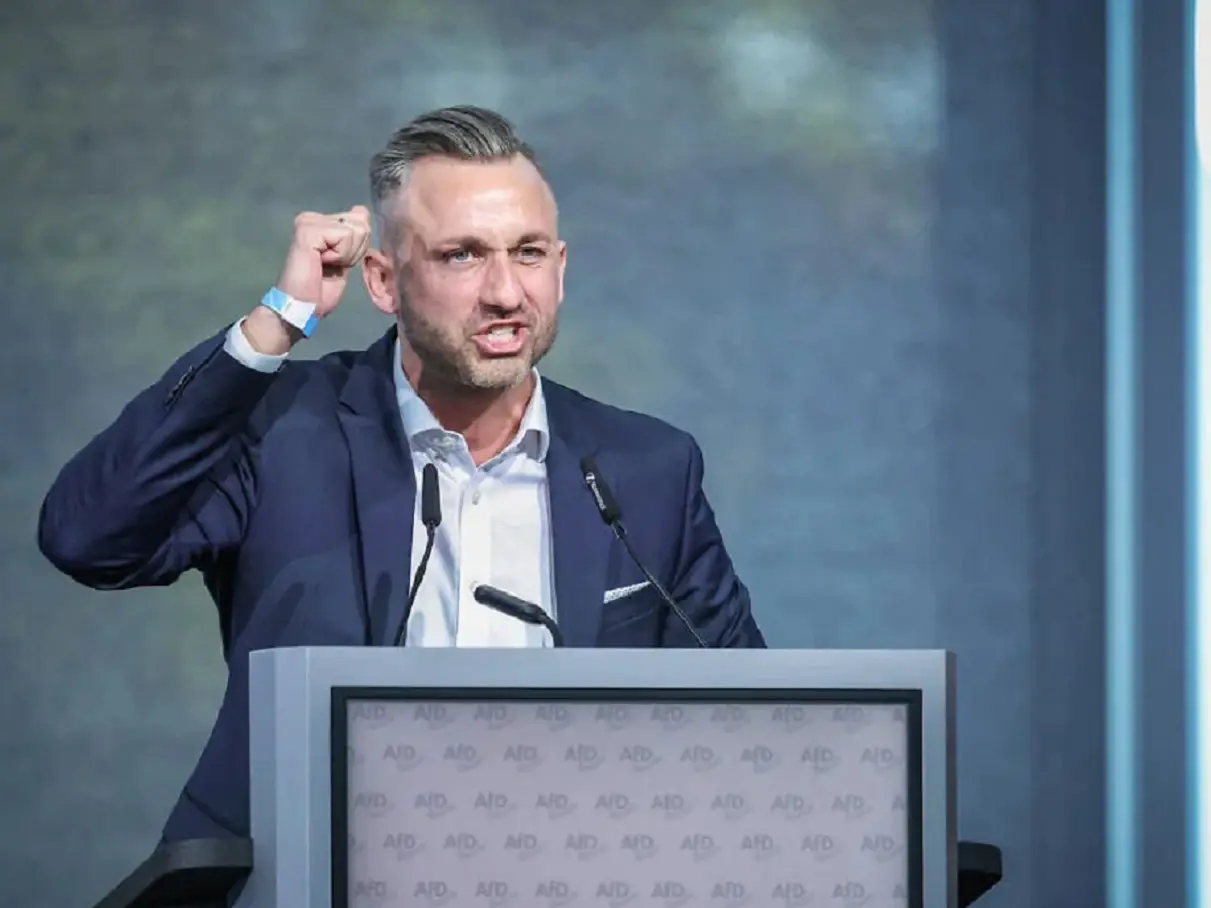
The far-right, anti-immigration, populist Alternative für Deutschland (AfD) has emerged as the winner in a crucial state election in Germany on Sunday, with projections saying it will win more than 44 per cent of the vote in the eastern region of Saxony-Anhalt.
As per the exit polls, AfD is more than doubling its support and securing a historic result. The AfD seems to on the brink of becoming the first far-right party to gain power in Germany at the state level since the Second World War.
Initial exit polls showed the party would secure 44.4% of the vote, more than predicted.
The Christian Democrats (CDU) of Chancellor Friedrich Merz were trailing far behind with around 18.4%—a huge dip from the 37. 1 per cent in 2021. The far-left Die Linke was third with 9.3%, with the Social Democrats on 8.4% and the Greens on 8.7%.
The smaller BSW reached the 5% hurdle needed to re-enter parliament, against expectations. The party, an offshoot of Die Linke, has agreed to cooperate with the AfD on issues such as energy price reform.
Trending Stories
&imwidth=180&imheight=135&format=webp&quality=medium)
Viral video shows cross falling on Colombia priest, no official confirmation | WATCH
&imwidth=180&imheight=135&format=webp&quality=medium)
France reports first human case of livestock virus Shamonda, patient dies; what we know so far
&imwidth=180&imheight=135&format=webp&quality=medium)
Trump called Musk to lift Starlink restrictions affecting Ukraine's military operation: Report
&imwidth=180&imheight=135&format=webp&quality=medium)
Two BrahMos missiles on Tejas, triple the range and 100% indigenisation, says former BrahMos CEO
&imwidth=180&imheight=135&format=webp&quality=medium)
Ilhan Omar breaks silence over alleged marriage to her brother; Trump thinks it's 'really good answer'
&imwidth=180&imheight=135&format=webp&quality=medium)
India-China face-off continues near Arunachal’s Taksing, reveals ITBP chief in first official confirmation of tensions
&imwidth=180&imheight=135&format=webp&quality=medium)
Netanyahu dials PM Modi, invites him and Capt Smit Machchhar to light torch on Israel’s Independence Day
&imwidth=180&imheight=135&format=webp&quality=medium)
WATCH: Trump demands Ilhan Omar removal from Congress for 'using fake name to be sworn in'. So what is her real name?
&imwidth=180&imheight=135&format=webp&quality=medium)
Iran to invade neighbours soon, Israeli jets in action, American troops ready to strike any moment
&imwidth=180&imheight=135&format=webp&quality=medium)
Christa Pike's failed execution: Tennessee team struggled to insert IV lines, lawyer says
&imwidth=180&imheight=135&format=webp&quality=medium)
US midterms 2026: US Supreme Court allows New Hampshire to restrict student IDs for voting
&imwidth=180&imheight=135&format=webp&quality=medium)
A secret code, a midnight escape and 300 deaths: The Russian officer who turned on Putin
&imwidth=180&imheight=135&format=webp&quality=medium)
Trump ordered to answer questions under oath in BBC defamation lawsuit by December 11
&imwidth=180&imheight=135&format=webp&quality=medium)
Putin says Russia is ready to resume Ukraine-US peace talks but rejects 'short ceasefire' amid deadly attacks
&imwidth=180&imheight=135&format=webp&quality=medium)
From Agni-V to Project Kusha: How are India’s indigenous missile systems and defence shield reshaping modern warfare
&imwidth=180&imheight=135&format=webp&quality=medium)
'It's a crime not to see this scene': Tehran puts Trump 'behind bars'
&imwidth=180&imheight=135&format=webp&quality=medium)
What is the ‘heat ray’ weapon? Pete Hegseth reportedly authorises DHS to test it at US-Mexico border
&imwidth=180&imheight=135&format=webp&quality=medium)
SA vs AUS 2nd Test: Temba Bavuma reveals 'Tendulkar inspiration' behind career-best 179
&imwidth=180&imheight=135&format=webp&quality=medium)
China's dancing robot turns violent bodyguard, lifts cars and fights intruders - Watch
&imwidth=180&imheight=135&format=webp&quality=medium)
Tom Skerritt, best known for Top Gun and Alien, dies at 93; tributes pour in
&imwidth=180&imheight=135&format=webp&quality=medium)
Watch: India rejects ‘imprecise and unsupported’ references in UN migrant rights report
&imwidth=180&imheight=135&format=webp&quality=medium)
US to get 850 F-35 stealth fighter jets under 10-year Pentagon-Lockheed deal
&imwidth=180&imheight=135&format=webp&quality=medium)
GRAVITAS | Putin fires nuclear-capable hypersonic missiles, Zelensky ready to surrender 25% territory
&im=FitAndFill=(700,400)&imwidth=180&imheight=135&format=webp&quality=medium)
New Friday OTT releases (October 23, 2026): Gajab Raat, Dorothy, Chaar Yaar- Watch these 6 new movies and TV shows on Netflix, Prime Video and more
&imwidth=180&imheight=135&format=webp&quality=medium)
'That was great, who threw that punch?': Trump asks as protester punched at rally
&im=FitAndFill=(700,400)&imwidth=180&imheight=135&format=webp&quality=medium)
Serbia elections: Nearly 150,000 people take to streets in massive rally against Aleksandar Vucic | In pics
&imwidth=180&imheight=135&format=webp&quality=medium)
'This is despicable': Amy Acton hits back at Vivek Ramaswamy over Ohio campaign ad featuring her estranged mother
&imwidth=180&imheight=135&format=webp&quality=medium)
Finance influencer dies by suicide in Chennai; father accuses tech CEO, who denies charge
&imwidth=180&imheight=135&format=webp&quality=medium)
'Vivek should keep it up': Trump defends Ramaswamy's controversial campaign ad targeting Amy Acton
&imwidth=180&imheight=135&format=webp&quality=medium)
One man, 8 months of work, and a river dirty again: Why Bittu Tabahi may quit
&imwidth=180&imheight=135&format=webp&quality=medium)
US midterms 2026: Elon Musk’s political spending hits $445 million as Republicans battle to retain Senate control
&imwidth=180&imheight=135&format=webp&quality=medium)
ENG vs SL: Harry Brook breaks Shubman Gill’s record for fastest ODI double century
&imwidth=180&imheight=135&format=webp&quality=medium)
ENG vs SL: Harry Brook’s 202 goes in vain as Sri Lanka pull off second-highest ODI chase
&imwidth=180&imheight=135&format=webp&quality=medium)
Saudi Arabia targeted yacht carrying 14 Indians in Red Sea, rescue underway, Houthis claim
Voter participation was at a record high of 76.5%.
Votes were being counted, but it appeared initially that the AfD might have failed to secure an absolute majority – the condition it has said is central to it taking power, given its refusal to govern with another party.
The CDU and all other mainstream parties have also refused to collude with the AfD in a government, in what is referred to as a Brandmauer, or firewall.
The AfD in Saxony-Anhalt has been classed as “rightwing extremist” by Germany’s domestic intelligence agency.
Ulrich Siegmund, the AfD’s lead candidate in Saxony-Anhalt, addressed jubilant supporters saying, “We have made history in this country”. He added that his party was ready to reach out to all powers that strove for political change.
“We extend a hand to all democratic forces that wish to pursue better policies,” said Siegmund after exit polls were published. He said themes such as migration and domestic security were not up for debate.
The CDU described its result as “bitter” but said it would not back down from its refusal to rule together with the AfD.
Franziska Hoppermann, general secretary of the CDU, called it a “defeat overall” for the Christian Democrats.
In one recent poll, only 9% of voters in Saxony-Anhalt said they were satisfied with Merz’s politics. Siegmund called Merz “a very good campaigner for the AfD”.
Alice Weidel, the AfD’s co-leader, said the result gave her party a “clear government mandate” and that it would “talk to all the parties” to work out a strategy as to how the AfD could rule.
The small state has been governed since 2002 by Merz’s conservative CDU, together with two smaller parties. Merz has failed to fulfil his promises of resetting Germany’s struggling economy, while the AfD has been making regular and steady gains since it entered parliament in 2017 and is now the leading opposition party.

