Explained | Cricket, Quad and World Cup—geopolitics of gentleman's game

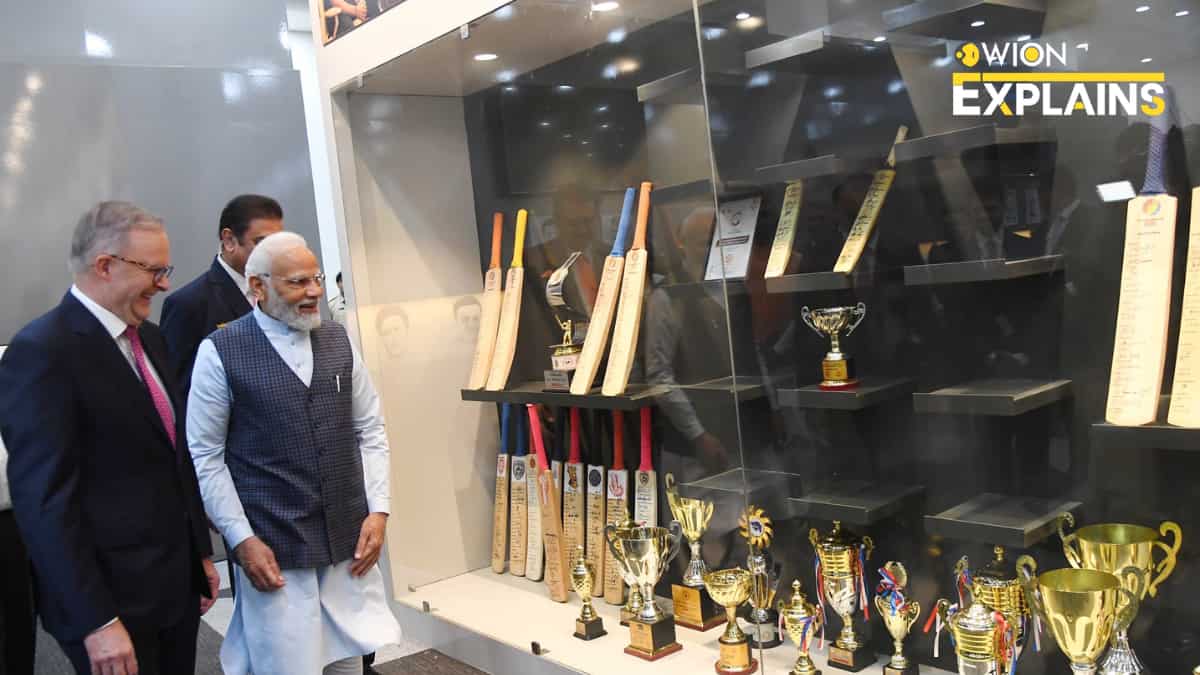
India's Prime Minister Narendra Modi with Australia's Prime Minister Anthony Albanese in March 2023
In Kolkata's historic Eden Gardens, as Australia played against South Africa in the second semifinal of ICC Men's Cricket World Cup 2023, the geopolitical playground of Ahmedabad for the quadrennial event's final had its permutations and combinations ready.
Despite spectators at Eden Gardens' firmly on South African side that day, it was a contest between India's fellow member of BRICS — Brazil, Russia, India, China and South Africa — and New Delhi's Quad partner Australia. The latter prevailed over South Africa.
As the South African side lived up to their 'choker' reputation, with yet another failure in a big game at the ICC World Cup, New Delhi dispatched a message of invitation to Canberra.

It was this exact stadium where India's Prime Minister Modi and Australian PM Anthony Albanesein March had marked '75 years of India-Australia friendship through cricket' as they handed caps showing with national emblems to rival captains Steve Smith and Rohit Sharma.
The photographic symbolism of that Test match held significance as a boost to India’s already strong diplomatic ties with Australia. Both are part of the Commonwealth of Nations and Quadrilateral Security Dialogue (or Quad) and share economic, political, security, lingual and sporting ties. In 1996, India and Australia started playing the Border-Gavaskar Trophy, a test series named after two legendary players from India and Australia: Sunil Gavaskar and Allan Border.
)
Trump says Russia has ‘lost control’ of its diesel industry, calls for end to ‘ridiculous, never-ending’ war
)
Asian Games: Indian women's hockey team thrash Indonesia 17-1, blasts 36 goals in 2 matches
)
Putin's United Russia party wins 355 seats in Duma election; 4 other parties cross threshold to enter parliament
)
AI kill switch explained: Why shutting down a dangerous AI may not be as simple as pressing a button
)
Delhi Air pollution: Strict crackdown on waste burning
)
‘0% chance’: Nvidia CEO Jensen Huang dismisses AI extinction fears by 2030
)
Samay Raina-Mukesh Chhabra controversy explained: What happened over girlfriend joke on India's Got Latent?
)
Four decades after leaving Kolkata, the Birlas may be coming back for more
)
Apple reportedly building AI server with M8 Ultra chips, may use Nvidia technology
)
BTS' fans question iHeartRadio’s treatment of group after brief festival set
)
Glitch in the matrix caught on camera: Woman vanishes after talking to reporter
)
IIT Bombay tensions ease after three-hour open house; director’s assurances pacify students
)
Samsung raises Galaxy S26 prices by Rs 20,000: Here’s what each model now costs
)
J&K Assembly Session begins amid chaos: BJP, ruling alliance clash as statehood demand dominates
)
Bessent meets China’s He Lifeng to prepare for Trump-Xi summit
)
Four Hands, Two Sonatas ep (5-8) review: Song Kang Lee, Jun Young elevate the emotional stakes after a tragic turn
)
The Verdict | The Mecca Agreement is under scrutiny as Houthis attack Saudis
)
Who was Sheikh Ahmed bin Rashid Al Maktoum? From Dubai Royal family to police, sports and racing
)
Saudi Arabia exits China-led mBridge digital currency platform amid Saudi-Houthi conflict
)
Maharashtra TET paper leak: Chargesheet reveals papers smuggled in shoe insoles for Rs 8,000
)
'Lot of things to learn from experienced players': Jayasuriya backs Rohit, Virat for 2027 ODI World Cup
)
Taylor Swift has a 'proud wife' moment as Travis Kelce scores first touchdown of season: 'That’s my husband!'
)
Chancellor Friedrich Merz vows to stay on as exit polls signal major poll setback
)
Pakistan kills 3 civilians in air strikes on Afghanistan, Taliban vows retaliation | Gravitas
)
Mahabharat actor Saurav Gurjar arrested in Hyderabad, sent to 14-day judicial custody in sexual exploitation case
)
North Korea's nuclear tests triggered 1,399 earthquakes: Earth is still shaking | Gravitas
&im=FitAndFill=(700,400))
New OTT releases this week (September 21-27, 2026): Shaque: Trust No One, Hunkkaar, Don’t Be Shy- 5 new titles coming to Netflix, Prime Video and more
)
WATCH | Mysterious lights over Tehran caught on video. Drone, aircraft or something else?
)
What is Yom Kippur and why is it celebrated? All you need to know about the Jewish Day of Atonement
)
Iranian airlines to shut worldwide on Sept 23, Bessent warns of US banking ban
)
White House TV pool halts Trump coverage after CNN barred from UNGA events
)
Pilot recreates Mona Lisa in sky over Oklahoma and Arkansas in four-hour flight: VIDEO
)
Fitna Al-Khawarij: Decoding biggest security threat to Pakistan | Gravitas
)
Jailer 2: Vidya Balan joins Rajinikanth's upcoming film as Kantha | Watch
)
Microsoft executive called AI training the ‘largest theft of labour in human history’
)
40-foot waves crash into cruise ship in dangerous stretch near Antarctica. Watch
)
Mystery explosions rock Aleppo, residents told to stay indoors
)
BTS fans mock iHeartRadio’s day 2 turnout after short set controversy
)
The Scandal, why so scandalous? Ji Chang Wook leaves you gasping for air
For the final, Albanese deputed Australian Deputy Prime Minister Richard Marles in Ahmedabad. Albanese's deputation of Marles for the final match could be seen in context of his recent visit to China, a first by an Australian Prime Minister in seven years and a move from Canberra to normalise its ties with Beijing that went sour in recent years.
In Ahmedabad on Nov 20, the invincible India lost to a resurgent Australia in the summit clash. Over a billion heartbreaks later, India's Prime Minister Modi handed over the World Cup trophy to Australian captain Pat Cummins.
The India-Australia summit clash also coincided with the second edition of the "2+2" ministerial dialogue between Australian defence minister Marles and Foreign Minister Penny Wong and their Indian counterparts Rajnath Singh and Dr S. Jaishankar in New Delhi.
In Delhi, Marles also played Gully Cricket, a term for the way cricket is played by children and teenagers in the streets and alleys. In an interview with WION's diplomatic correspondent Sidhant Sibal, he described the India-Australia clashes as 'pinnacle of the game'.
Launched in 2018, the 2+2 dialogue is a format of meeting of the foreign and defence ministers of India with the countries it shares close ties with, on strategic and security issues.
Besides Australia, India holds 2+2 dialogues with three other key strategic partners, namely, the United States, Japan, and Russia. With all these countries, India's strategic ties are significant. Apart from Russia, New Delhi's other 2+2 dialogue counterparts are also its partnersin the Quadrilateral Security Dialogue (QSD) or Quad.
Cricket, Quad and World Cup: How do they add up?
The Quad is a diplomatic partnership between Australia, India, Japan, and the United States aimed to supporting an open, stable and prosperous Indo-Pacific that is inclusive and resilient. The terms inclusive and resilient are often described as diplomatic euphemisms directed against China's maritime belligerence in the Indo-Pacific.
The dialogue is also paralleled by joint military exercises of an unprecedented scale, titled Exercise Malabar. The diplomatic and military arrangement is widely viewed as a response to increased Chinese economic and military power in the region, especially in South China Sea where Beijing has expanded its maritime claims in the recent years near the Japanese and Filipino waters.
In recent years, Australia and China have accused each other over human rights violations and have described national security threats from individuals linked with each other's capitals.
Add cricket into Quad, and a security equation with a complementary people-to-people element emerges as the top focus of an expansive bilateral equation.
In recent years, India has emerged as a key partner for Australia and Canberra seeks to diversify its strategic partnerships beyond its traditional reliance on China. The addition of a sporting warmth into the equation often reflects in the close-door talks between the leaders and their summation which is published in the joint statements.
In May 2023, when Indian Prime Minister Narendra Modi visited Australia, an official readout from PM Modi referred to his sixth visit to Australia as a sign of "the depth in our comprehensive relations, the convergence in our views and the maturity of our ties."
"If I may say in the language of cricket, our ties have entered the T-20 mode," Modi said while referring to the quickest format of the game, implying the way India-Australia ties appear to have surpassed "this depends on time" diplomatic catchphrase.
The two countries will now also hold India-Australia summit annually, the first of which was held in March earlier this year.
(Note: This story has been updated to reflect the results of the summit clash of ICC ODI World Cup 2023 between India and Australia.)