Can US President Donald Trump bypass Congress on Greenland or will lawmakers intervene?

&imwidth=600&imheight=450&format=webp&quality=medium "Can US President Donald Trump bypass Congress on Greenland or will lawmakers intervene?")
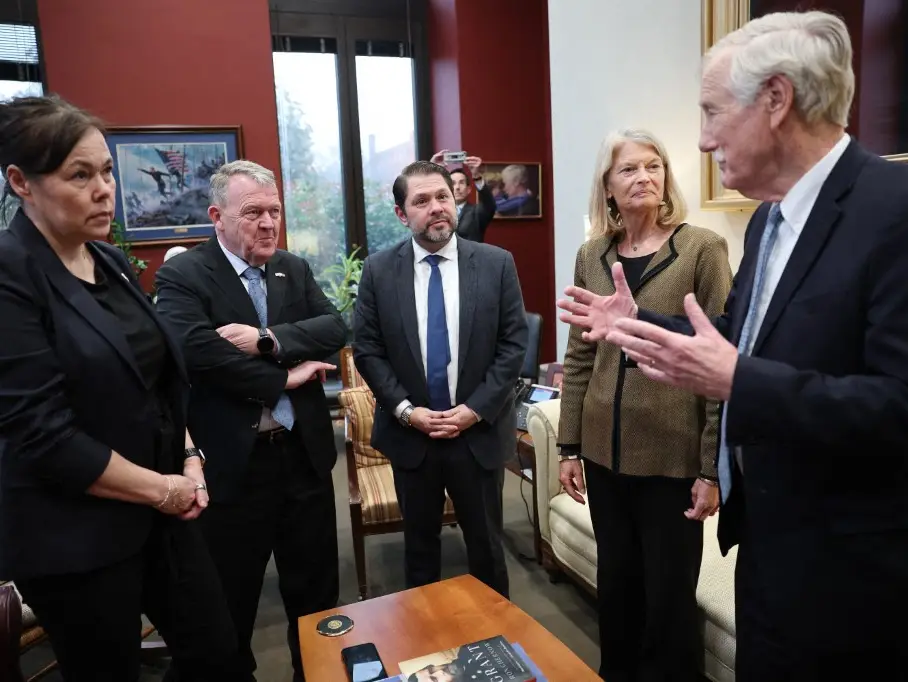
Greenland Minister of Foreign Affairs Vivian Motzfeldt, Minister for Foreign Affairs of Denmark Lars Lokke Rasmussen , U.S. Sen. Ruben Gallego (D-AZ), U.S. Sen. Lisa Murkowski (R-AK), and U.S. Sen. Angus King (I-ME) speak ahead of a meeting with members of the Senate Arctic Caucus in the Hart Senate Office Building on Capitol Hill Photograph: (AFP)
Trump’s push to acquire Greenland is facing growing resistance from Republicans, raising questions about executive power, NATO unity, and Congress’s role
President Donald Trump’s renewed effort to bring Greenland under US control is triggering unease among Republicans on Capitol Hill, exposing widening cracks within the party over America’s expanding military footprint overseas. While Democrats have firmly opposed the idea, it is still uncertain whether enough Republicans are prepared to break ranks and actively block any attempt to acquire the Arctic territory. Just as unclear is whether Trump would heed Congressional resistance or move forward unilaterally, continuing a pattern seen throughout his second term as US involvement abroad has intensified.
What started as a debate over Greenland has evolved into a larger confrontation over the Trump administration’s use of military power, economic pressure, and diplomatic leverage to advance American interests in places such as Venezuela, Iran, and beyond. Although Republicans have largely stood behind Trump’s foreign policy since his return to office, resistance is growing. A number of GOP lawmakers are now aligning with Democrats and NATO partners, arguing that a takeover of Greenland would breach both US law and international norms.
Several Republican leaders have publicly dismissed the idea of purchasing Greenland or using military force to seize it. Others have joined Democrats in pushing back against Trump’s proposal to impose tariffs on countries that refuse to support his bid for the territory, which governs itself but remains under Danish sovereignty. Senator Thom Tillis of North Carolina warned that such tariffs would harm American businesses and allies while strengthening geopolitical rivals. He said the policy would play directly into the hands of leaders like Vladimir Putin and Xi Jinping by weakening NATO cohesion. Additional Republican voices have cautioned that Trump’s ambitions risk destabilising the transatlantic alliance at a time when relations between the US and Europe are already strained. Senator Lisa Murkowski of Alaska, co-chair of the Senate Arctic Caucus, stressed that Greenlanders’ right to self-determination must be respected.
Trump, however, has maintained that US ownership of Greenland is essential to counter China and Russia’s influence in the Arctic. He has repeatedly stated that the U.S. will obtain the territory “one way or another.” When questioned by the BBC about whether the issue could damage NATO, Trump dismissed the concern, reiterating that Greenland is vital to both American and global security. Despite Trump’s insistence, opposition on Capitol Hill is intensifying. Congress holds key tools to challenge the president, particularly control over federal spending. Any attempt to purchase Greenland would require explicit congressional approval, according to legal experts, and both Denmark and Greenland have reiterated that the island is not for sale.
Daniel Schuman of the American Governance Institute noted that existing funds are unlikely to be redirected for such a purchase. Still, he warned the administration could attempt to justify extraordinary executive authority, as it has in other policy areas, to bypass Congress. Lawmakers alarmed by the prospect of military action in Greenland are exploring legislation to bar such moves without congressional consent. Whether these measures can gain sufficient Republican backing remains uncertain. Earlier this month, five Republican senators joined Democrats to advance a resolution aimed at halting further U.S. military involvement in Venezuela after last December’s operation that ousted Nicolás Maduro. Although the measure failed, it highlighted growing bipartisan frustration with Trump’s overseas military actions, particularly given his 2024 campaign pledge to limit foreign interventions.
Trending Stories
)
)
)
&im=FitAndFill=(700,400))
)
)
)
)
)
)
)
)
)
)
)
)
)
)
)
&im=FitAndFill=(700,400))
)
)
)
)
)
)
)
)
)
)
&im=FitAndFill=(700,400))
)
)
)
&im=FitAndFill=(700,400))
A bipartisan congressional delegation recently traveled to Denmark as a symbolic gesture of support for Greenland and its autonomy. The Senate’s role would also be critical if the US reached any formal agreement with Denmark. While a 1951 defense agreement already allows the U.S. to expand its military presence on the island, many Republicans argue full control of Greenland is unnecessary to meet security objectives.
Any treaty transferring territory would require a two-thirds Senate majority, a threshold Republicans are far from meeting. Senator Mitch McConnell has warned that annexing Greenland would irreparably damage trust with US allies.
Facing resistance, Trump could attempt a less formal arrangement that avoids Senate ratification. However, legal scholars question whether a president can lawfully conclude an agreement of this scale without congressional involvement. Trump has offered no clarity on the limits of his authority, telling reporters only that developments are forthcoming and would ultimately benefit all parties.

