&imwidth=800&imheight=600&format=webp&quality=medium "BRICS Summit climate change stance: Delhi Declaration hints at changing priorities of Global South")
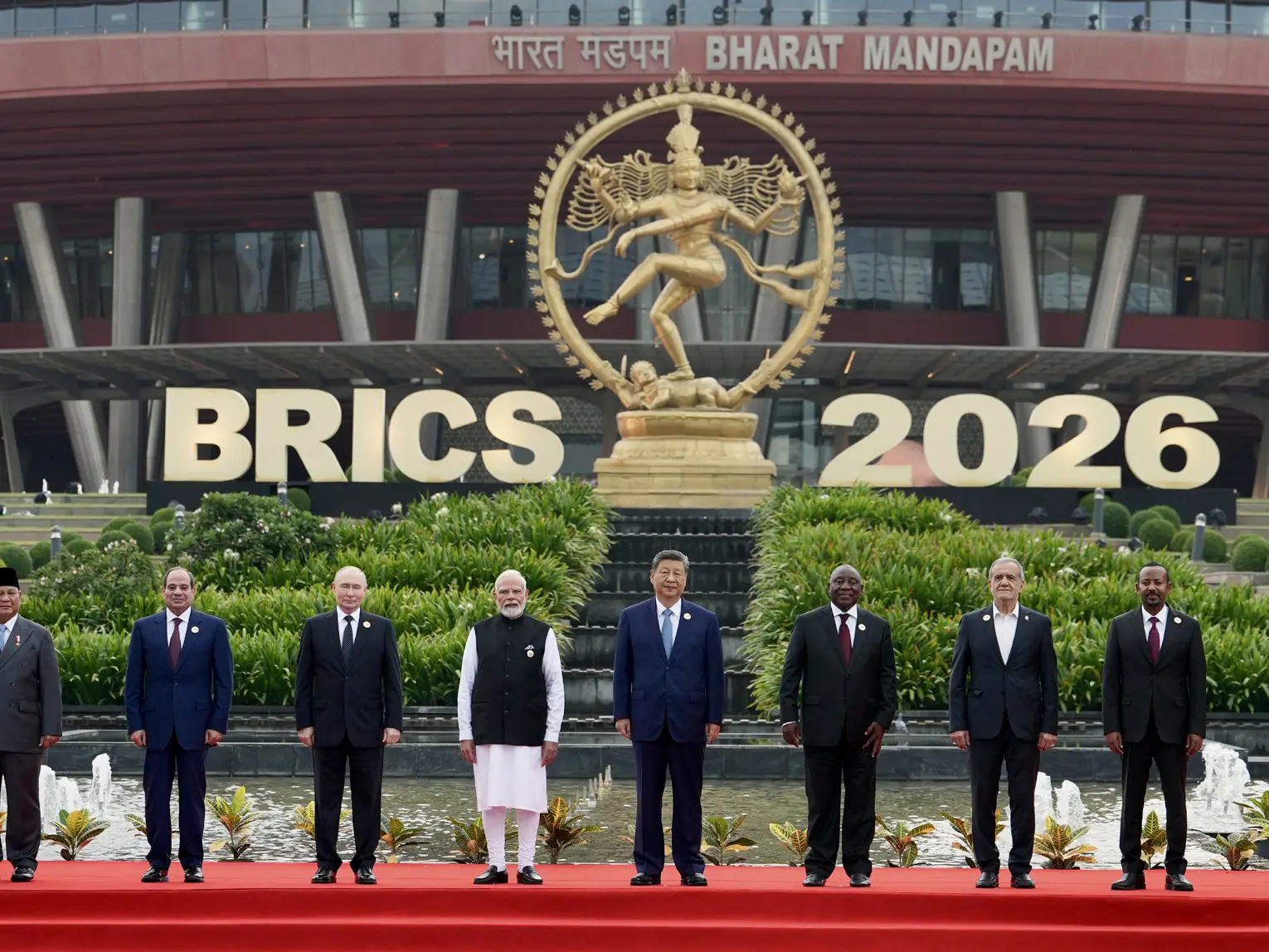
When it comes to climate change, the BRICS Summit's New Delhi Declaration reads less like a communique and more like a negotiating position for the Global South. The bloc representing 40 percent of global GDP, 26 percent of global trade and nearly half the world's population made a clear push that can be described simply as: We want to not just follow the rules on climate change, we want to write them too. Coming as it did after the devastating Nepal floods, climate change was not an incidental aspect of the BRICS Declaration. It was woven throughout seperate sections of the 45-page document.
The most pertinent features of BRICS Declaration on climate change:
- Climate finance is part of the growth and development agenda
- Debt is identified as a barrier to climate investment.
- Climate adaptation appears directly in discussions involving central banks and finance ministries
- BRICS seeks more financing options for developing economies, with a clear demand on developed countries when it comes to adoption.
- Trade policy is explicitly linked to the countries’ capacity to adapt. This is reflected in the challenge to carbon border measures.
- Opposition to protectionism is linked with support for multilateral trade rules even as BRICS vows to continue cooperation on trade and carbon markets
- There are boundaries between climate and security, with concern expressed about attempts to link security with the climate-change agenda.

"For a grouping as diverse and geopolitically complex as BRICS, achieving consensus on a forward-looking climate framework is no small feat," says Aarti Khosla, Founder and Director of Climate Trends.
The pushback on ‘carbon borders’: The most significant point?
Trending Stories
)
Why asking questions could be more important than memorising answers
)
BRICS Summit 2026 full schedule: Day-wise agenda, timings and key issues - All you need to know
)
BRICS Summit 2026: Iran's Pezeshkian praises PM Modi at BRICS
)
'Iran won't surrender': Pezeshkian sends blunt message to US while attending BRICS Summit in India
)
Why dehydration is the hidden cause of travel fatigue on long flights
)
Top 5 places to visit in Goa beyond its famous beaches
)
'He is popular...': Malaysian PM Anwar Ibrahim's praise for PM Modi during bilateral meeting | WATCH
)
BRICS Summit 2026: 30+ countries seek BRICS membership
)
Frustrated man demolishes his kitchen after thousands flock to see Mother Mary his wife spotted on the wall
)
BRICS Summit 2026: PM Modi, Xi reach key consensus on ties, China to assume BRICS chairmanship in 2027
)
Trump says Canada eager to reach a deal, it could come ‘fairly soon’ if Ottawa treats US farmers better
)
From drones to KAAN fighters: Turkey outlines 229% surge in defence spending amid regional shifts
)
‘Partners, not rivals’: Xi outlines four point plan for stronger India-China ties
)
Could staying indoors all day affect your health?
)
Bigg Boss 20: Uditi Singh reacts to ex Karan Wahi’s possible wildcard entry
)
Why going digital does not always mean becoming more efficient
)
800 million years old - Scientists discover 'fingerprints' of supercontinent Gondwana in ancient rocks
)
ENG vs PAK: Joe Root breaks Sachin Tendulkar’s record for most Test fifties
)
Israel spent nearly $470,000 on PM's hair, makeup since 2019, data shows
)
From severe mobility problems to recovery: Madhuri the elephant’s journey of wildlife care
)
BRICS Summit day 1: New Delhi declaration adopted with full consensus, big diplomatic win for India
)
From India, Putin warns Europe against sending troops to Ukraine, Zelensky expresses willingness to meet him at G20 Summit
)
Did Iran President Pezeshkian touch feet of Hindu spiritual leader at Delhi event as shown in viral video?
)
9-year-old Chennai prodigy clears Cambridge IGCSE grade 10 exams
)
9/11 attack anniversary: The day that changed America forever
)
Why does your body need time to adjust after a long journey?
)
Baba Vanga's first prophecy for 2027 is out, and straight out of science fiction
)
Why does your skin need protection from UV rays?
)
How does the loss of forests affect the way wildlife lives and moves?
)
IND vs AFG, 1st T20I: When and where to watch live streaming in India?
)
Anthropic is giving Claude to schools free, and the reason is not philanthropy
)
BRICS Summit: China resumes Guangzhou-New Delhi flight, issues 'good-neighbourliness' remark ahead of Xi-Modi meet
)
Why do wild animals need quiet places to survive?
)
Humans may lose control of AI: Anthropic CEO calls for slowdown, Altman, Musk back him
The BRICS joint declaration's opposition to the so-called ‘carbon border adjustment mechanisms’ (CBAMs) pushed by European Union has perhaps the sharpest language on climate change issues. And that, was a work in progress. At the 12th BRICS Environment Ministers' Meeting in Delhi, the bloc had already described CBAM as punitive, discriminatory and protectionist . Now it is etched in the leaders' text, which called CBAM “unilateral, punitive, discriminatory and protectionist,” that undermined developing countries' efforts to address climate impacts and build adaptive capacity.
The message to Brussels: Climate ambition and tariff policy can't travel in the same bus.
Elsewhere, the declaration demanded to restore a functioning WTO dispute-settlement system. It also warned that tariffs pursued under environmental objectives disrupt supply chains and widen economic disparities.
Also read: BRICS built 350 meetings' worth of climate cooperation this year, almost none of it comes with money
Net Zero goes missing from the text
Rathin Roy, Distinguished Professor at the Kautilya School of Public Policy, points to a conspicuous absence of what he calls “that favourite Euro-American phrase — Net Zero.”
"For the BRICS, Net Zero is an outcome of a profoundly unsustainable development system."
The keyword here is differentiated responsibilities and national circumstances. Fossil fuels will remain in the energy mix of emerging and developing economies, while renewables, hydrogen and nuclear energy will sit alongside.
Developing economies will scale up clean energy on timelines set by their own development needs, not by deadlines written elsewhere.
After Nepal flood tragedy, resilience is not just a buzzword
BRICS Summit was taking place just two weeks after the glacier-triggered floods in Nepal killed nearly 1,400 people, and the declaration pushed adaptation, climate finance and disaster risk reduction to the front of the text.
For most of the bloc, climate is not an emissions accounting problem. It is a question of whether infrastructure survives the next monsoon.
And the Declaration reflected the urgency. The text leaned hard into preparedness, with mentions on early-warning integration, voluntary principles for climate-resilient urban infrastructure, anticipatory action and drought-resilient seed systems.
Debt was named as a barrier to climate investment, and developed countries were asked for additional, predictable and accessible adaptation finance.
Ulka Kelkar of WRI India highlights that the proposed Insurance Resilience Centre and Risk Lab could offer an alternative to conventional insurance approaches that lose effectiveness as climate risk rises.
BRICS wants to write climate change rules, not just follow them
The declaration firmly connects climate adaptation to reforms of global financial and economic systems. It seeks IMF quota reform, a correction in World Bank shareholding patterns and greater developing-country representation at the UN, while backing Ethiopia's COP32 presidency and sending a constructive signal to COP31.
Archana Chaudhary of Climate Trends aptly concludes the BRICS framing: emerging economies are asking not only for a greater share of global growth, but a greater role in writing the rules that shape it.
Li Shuo says the real test is whether BRICS can translate rhetoric into stronger climate action as Western countries retreat from their commitments. That will decide what kind of geopolitical force the bloc becomes.