

&imwidth=800&imheight=600&format=webp&quality=medium "BRICS stitches climate into its trade and growth agenda, experts say")
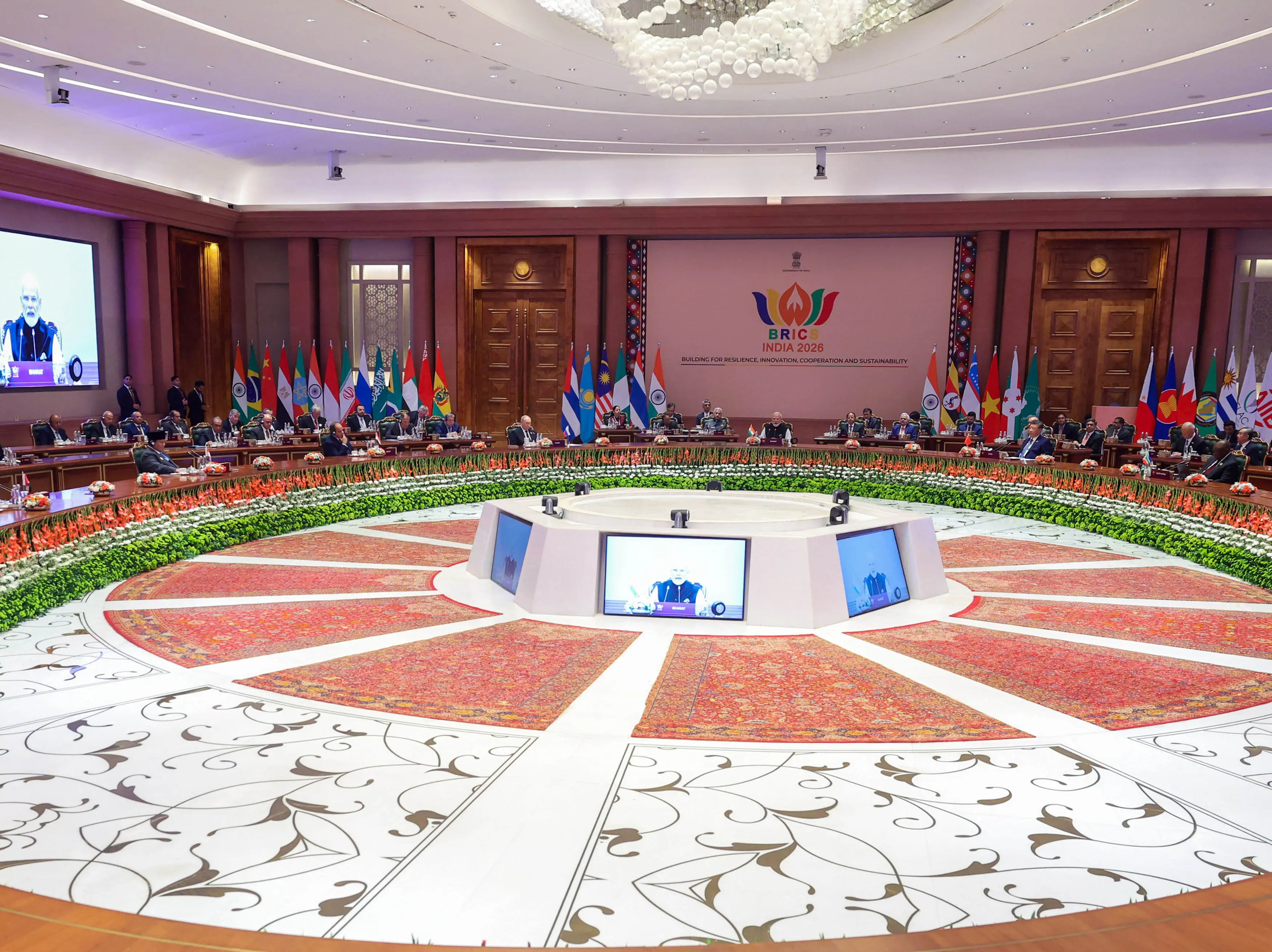
Buried inside the 45-page New Delhi Declaration is a wager: that climate resilience sells better to a fractious bloc of eleven nations when it's framed as economics rather than environmentalism.
That reading came up again and again as analysts picked through the document this week. "What is interesting about the declaration, apart from its inordinate length, is that it is profoundly multilateral," said Rathin Roy, an economic advisor and dean at GITAM School of Humanities and Social Sciences.
He pointed out that wherever climate change appears in the text, the word "including" tends to come first.
"So this is sustainable development, including climate. They are weaving in a broader lens." Roy also noted something missing entirely: the phrase "net zero," a staple of European climate diplomacy, doesn't appear once. "The framing is profoundly different from the way the Europeans framed the climate change problem," he said.
The declaration takes a direct shot at the EU's carbon border tax, calling such measures "unilateral, punitive, discriminatory and protectionist." Li Shuo, director of the China Climate Hub at the Asia Society Policy Institute, called this a deliberate stance.
"BRICS is determined to chart its own course on climate and energy, one that emphasizes the alignment of development and decarbonization rather than treating them as competing priorities," he said, adding that the bloc's insistence on keeping fossil fuels in the mix for developing economies "signals that these leading Global South countries intend to define the terms of their own energy transition."
Trending Stories
&imwidth=180&imheight=135&format=webp&quality=medium)
Police called after 3-year-old scores 10 goals in 12 minutes at Florida youth soccer game
&imwidth=180&imheight=135&format=webp&quality=medium)
Israel polls: Highest early turnout since 1973; Netanyahu’s Likud alleges fraud, ‘attempt to steal’ election
&imwidth=180&imheight=135&format=webp&quality=medium)
'Shove that ballroom up your a**': Trump heckled at Mississippi rally over White House ballroom renovations | WATCH
&imwidth=180&imheight=135&format=webp&quality=medium)
India invites Pakistan, along with other SCO member countries for SCO Civilisational Dialogue in Delhi
&imwidth=180&imheight=135&format=webp&quality=medium)
Mitchell Starc leads Australia’s fightback with six-wicket haul on day 1 of Cape Town Test
&imwidth=180&imheight=135&format=webp&quality=medium)
'Already tired of his 9-to-5': Baby born with a moustache becomes internet sensation, video goes viral | Watch
&imwidth=180&imheight=135&format=webp&quality=medium)
Supreme Court seeks Centre's response to DNPA's challenge to DPDP Act
&imwidth=180&imheight=135&format=webp&quality=medium)
Hijack scare unfolds on United flight over suspicious text message. Here is what happened
&imwidth=180&imheight=135&format=webp&quality=medium)
'I've done my work sincerely': AR Rahman on facing backlash over Ramayana soundtrack
&imwidth=180&imheight=135&format=webp&quality=medium)
Russia, Iran eye joint oil and gas projects as Pezeshkian, Putin hold talks in Moscow
&imwidth=180&imheight=135&format=webp&quality=medium)
Uganda arrests its 'worst serial killer and cannibal' who hacked 38 people to death
&im=FitAndFill=(700,400)&imwidth=180&imheight=135&format=webp&quality=medium)
New OTT releases this week (October 26-November 1, 2026): Baththa, Akka, The One About Matthew Perry- 7 titles coming on Netflix, Prime Video and more
&imwidth=180&imheight=135&format=webp&quality=medium)
'Hell of a beautiful a**': Trump compliments Nicki Minaj as rapper joins him in Michigan rally
&imwidth=180&imheight=135&format=webp&quality=medium)
'You Still Can't...': Yuvraj mocks Abhishek Sharma after 35-ball 100 in 3rd T20I vs New Zealand
&imwidth=180&imheight=135&format=webp&quality=medium)
'This is America. Back up': Shouting match breaks out between US and Cuban officials at UN | WATCH
&imwidth=180&imheight=135&format=webp&quality=medium)
'Hire the robot, fire the human': Bill Gates's words hint at a bleak future
&imwidth=180&imheight=135&format=webp&quality=medium)
Israel elections: Record voter turnout in decades as Opposition edges ahead of Netanyahu in early projections
&imwidth=180&imheight=135&format=webp&quality=medium)
Israel elections 2026: What happens if Netanyahu loses | Gravitas
&imwidth=180&imheight=135&format=webp&quality=medium)
Storm Boelo’s fierce winds push passenger plane onto grass in UK, terrifying landing caught on cam
&imwidth=180&imheight=135&format=webp&quality=medium)
52 years later, DNA evidence links serial killer Ted Bundy to 1974 murder of 17-year-old
&imwidth=180&imheight=135&format=webp&quality=medium)
India and US defence ministers set for bilateral talks in Philippines
&imwidth=180&imheight=135&format=webp&quality=medium)
'He is a red flag': Ex-India strength and conditioning coach on Rohit's fitness regime
&imwidth=180&imheight=135&format=webp&quality=medium)
'Complete lack of confidence' in Netanyahu, says Eisenkot after Opposition leads in exit polls; Arab parties make gains
&imwidth=180&imheight=135&format=webp&quality=medium)
Trump accused of 'brutal' rape by ex-Miss Switzerland; Beatrice Keul alleges 'Don's best friend' Epstein facilitated assault in 1993
&imwidth=180&imheight=135&format=webp&quality=medium)
Maurene Comey, daughter of ex-FBI director James Comey, was unlawfully fired as federal prosecutor, judge rules
&imwidth=180&imheight=135&format=webp&quality=medium)
Democrats allege 'desperate efforts to cover up' Trump's involvement in Jeffrey Epstein sex crimes, release 50-page report
&imwidth=180&imheight=135&format=webp&quality=medium)
Brazil's Flavio Bolsonaro flees to US after presidential election defeat to Lula
&imwidth=180&imheight=135&format=webp&quality=medium)
'She is a beautiful woman': Trump mocks Mexican President Sheinbaum, mimics her voice at US Midterms rally
&imwidth=180&imheight=135&format=webp&quality=medium)
‘After Breaking Bad, Prison Break has begun in Tamil Nadu’: Stalin turns sarcastic in slamming Vijay govt over Theni jailbreak
&imwidth=180&imheight=135&format=webp&quality=medium)
‘Food poisoned by meat’: Trump mocks James Talarico over campaign absence, as former Texas Chief Justice endorses Democrat
&imwidth=180&imheight=135&format=webp&quality=medium)
Trump says he will accept midterm results ‘if they’re honest’, refers to his veto powers
&imwidth=180&imheight=135&format=webp&quality=medium)
US midterms 2026: Democrat Annie Andrews gains bipartisan backing against Trump's pick Darline Graham in South Carolina Senate race
&imwidth=180&imheight=135&format=webp&quality=medium)
Shah Rukh Khan unveils new poster of King, Internet reacts
&imwidth=180&imheight=135&format=webp&quality=medium)
France protests: Demonstrators may pay up to €10,000 for riot damage under new bill
&imwidth=180&imheight=135&format=webp&quality=medium)
Delhi traders urge Rahul Gandhi to postpone INDIA bloc rally once again
Ambassador Manjeev Puri of The Energy and Resources Institute framed the summit itself as an act of endurance. "It is important that all these nations, who may have political disagreements, have stood together in unity on the critical issues of development and sustainability," he said, citing shared pushback against unilateralism and renewed work on cross-border payments and supply chains.
Disaster preparedness got specific attention. Ulka Kelkar of WRI India welcomed new voluntary principles requiring climate risk to be built into land-use planning, along with a proposed BRICS Insurance Resilience Centre. "This would be crucial to prevent maladaptation," she said, adding that BRICS nations are increasingly climate finance donors, not just recipients.
On energy manufacturing, Subrahmanyam Pulipaka, CEO of the National Solar Energy Federation of India, pointed to scale: BRICS nations already hold more than half the world's installed renewable capacity, he said, and a proposed Solar Photovoltaic Cooperation Roadmap "provides an important opportunity to translate this scale into deeper industrial cooperation."
Climate researcher Archana Chaudhary summed up the shift: "It does not treat climate resilience as a standalone environmental issue. It places it inside a wider argument about economic resilience, industrial capacity, trade, finance and national policy space."
Whether that argument survives contact with rising debt burdens and diverging national interests, analysts said, is next year's question.
