
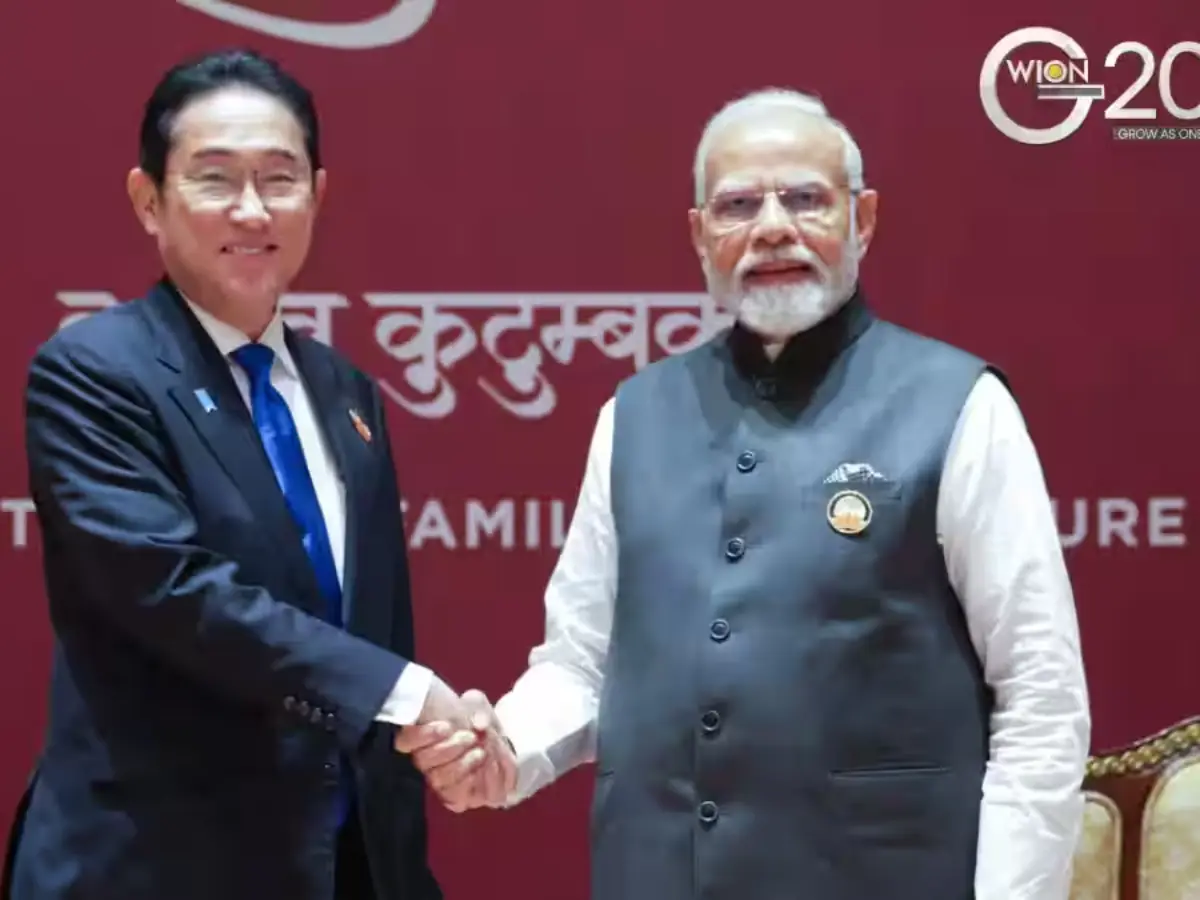
&imwidth=800&imheight=600&format=webp&quality=medium "A look at the status of Bay of Bengal–Northeast value-chain concept proposed by former Japan PM Kishida")
Former Japanese Prime Minister Fumio Kishida proposed the Bay of Bengal–Northeast India Industrial Value Chain Concept during his 2023 visit to India. It was envisioned as a core pillar of Japan's updated Free and Open Indo-Pacific (FOIP) vision. Its primary aim was to form a trilateral economic cluster by linking Northeast India with Bangladesh and leveraging deep-water access to the Indian Ocean.
Kishida's idea was to treat the landlocked Northeast India, which is rich in resources, and Bangladesh, in need of industrial diversification, as a single interconnected economic zone. It was supposed to be done in three ways. First, by developing the Matarbari Deep-Sea Port in Bangladesh under Japan's "BIG-B" (Bay of Bengal Industrial Growth Belt) initiative. Kishida wanted it to be like a high-capacity gateway equivalent to major global ports. Second, strengthening connectivity through the Northeast.
This included constructing robust road, rail, and bridge infrastructure across Indian states like Assam, Mizoram, and Tripura. All of these would hook directly into Bangladesh’s transport networks. Third, Japanese and global private sectors would be encouraged to invest in building manufacturing and supply hubs. Raw materials from Northeast India could flow smoothly to Bangladesh for processing and be exported globally via the Bay of Bengal.

Also Read: Semiconductors to biogas: What’s really on the table at the Modi-Takaichi summit? | WION Decodes
Progress and current status
Work on the infrastructural front has made reasonable progress. As part of India’s "Act East" policy, transport corridors have been expanded. This includes national highway coverage in the Northeast under the Bharatmala scheme. Budget allocations for the region's rail connectivity has risen sharply.
Trending Stories
)
The Early Spring is proof not everyone can talk about their real feelings, and it is perfectly OK
)
UN votes to ‘correct the map’ as India backs fairer world view
)
Nigerian Navy discovers 99,000 litres of suspected stolen, illegally refined products as it intensifies anti-crude oil theft operations
)
Who is Aditi Paudel? 17-year-old becomes Japan's first literacy ambassador
)
Bengaluru: Officials find 40 kg expired chilli at chairman's club
)
Jaishankar rejects trade link to ending Ukraine war
)
Israeli strikes on Lebanon kill three, injure 23 despite truce
)
Alpine glacier was covered with sheep wool sheets to prevent melting. It worked
)
South Korea mulls deploying military assets to Strait of Hormuz
)
World's fifth-largest economy, British army can't afford to train
)
Breaking | Vance takes the podium: First White House briefing since Leavitt's exit
)
Taiwan raises 'concerns' over China's missile test
)
BRICS 2026: $1 trillion sovereign capital set to converge in Delhi for first iBRICS Summit
)
What is Iran's Pickaxe Mountain that Trump has again threatened to bomb?
)
UN votes to correct world map that visually shrank Africa for 450 years
)
Former NewJeans member Danielle launches YouTube channel, hints at new solo journey
)
Bangladesh batter Towhid Hridoy creates history with 350 not out in South Africa
)
Brendan Fraser’s transformation fuels The Mummy 4 excitement as fans welcome back Rick O’Connell
&im=FitAndFill=(700,400))
Krishna Janmashtami 2026: From Dhaniya Panjiri to Makhana Kheer- 5 best sweet dishes perfect for celebrating Lord Krishna’s birth
)
Donald Trump plans to travel to Ireland on Qatari-donated jet amid security concerns
)
Nazi-looted art to return to Jewish heirs
)
Eight killed in Kerala’s Thrissur after car rams into lorry parked on highway
&im=FitAndFill=(700,400))
Why Russian fighter jets use bulky, low-pressure tyres compared to US jets
)
FBI-wanted fraud accused arrested in Jalandhar over $600,000 scam
&im=FitAndFill=(700,400))
Why US tanks weigh over 20 tons more than Russian tanks
&im=FitAndFill=(700,400))
New Friday OTT releases (September 4, 2026): GDN, Dhamaal 4, Jagamae Sangeetham- Watch 6 new movies and TV shows on Netflix, Prime Video and more
)
Killing the Himalayas slowly: Human urine is melting a glacier on Mount Everest
The Japan International Cooperation Agency (JICA) has funded critical highways, bridges, and continued with the multi-phase construction of the Matarbari Deep-Sea Port, maintaining its heavy ODA loan commitments in both India and Bangladesh. The project aligns closely with broader regional goals, notably the BIMSTEC Masterplan for Transport Connectivity. It aims to seamlessly integrate waterways, rail, and digital networks across the Bay of Bengal.
Also Read: The ¥10 trillion test: Can Japan double its India investment push after early ¥5 trillion success?
Challenges
However, the political and strategic landscape is posing significant challenges to the progress of the plan. Japan and India planned to use this value chain to counter Chinese maritime influence in the Bay of Bengal. However, a change in regional dynamics has created a challenging situation. For example, Bangladesh has awarded the development of an economic zone at Mongla Port, its second-largest seaport, to a Chinese state-owned enterprise. While roads and ports are being built, "soft infrastructure" is still moving along slowly.
This includes harmonising customs procedures, aligning maritime tariffs, and establishing standard cross-border regulations. A high-efficiency industrial value chain cannot happen with these bureaucratic trade barriers acting as a roadblock.
The Bay of Bengal–Northeast value chain has moved from being just a conceptual blueprint into an operational economic corridor. The Northeast is being connected to the sea. However, its ultimate success as a strictly Japan-India-backed manufacturing hub depends on how the two countries navigate the regulatory bottlenecks and growing economic competition in the Bay.

