When Rakhi unified Bengal: The story of Rabindranath Tagore’s 1905 anti-partition protest

&imwidth=600&imheight=450&format=webp&quality=medium "When Rakhi unified Bengal: The story of Rabindranath Tagore’s 1905 anti-partition protest")
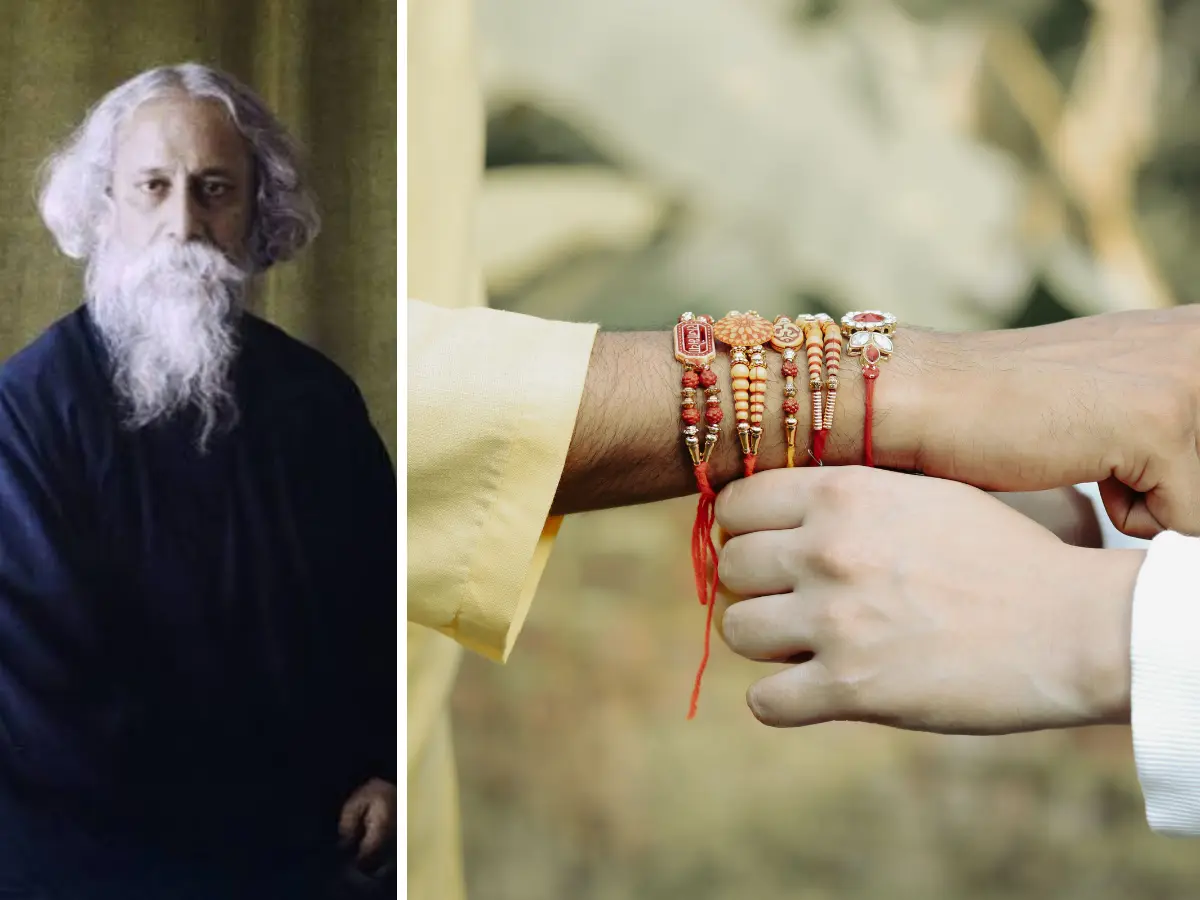
Rabindranath Tagore introduced Rakhi in Bengal in 1905
At the dawn of the 20th century in India, Nobel Laureate Rabindranath Tagore used Rakhi as a symbol for communal harmony and to protest against the partition of Bengal in 1905. Thus, the traditional festival got a nationalist spin to resist oppression.
The festival of Rakshabandhan or Rakhi traditionally celebrates the bond of siblings, particularly of brothers and sisters. Over the years, the celebration has taken on its own spin, with siblings, irrespective of gender, celebrating their bond. A typical Hindu festival, Rakshabandhan has, over the decades, served different purposes and meanings for different communities. In East India, Rakhi was introduced by poet Rabindranath Tagore, not as a festival for brothers and sisters, but to fortify a bond between Hindus and Muslims, and prevent Bengal’s partition in 1905 by the British.
The world we live in is polarised. Lines are often drawn based on one's religion and colour. A moment from history serves as a timely reminder of religious harmony that once existed in India. On Rakshabandhan, here’s a look back at a time when the sacred thread was used to resist division on religious lines. A move that was
Rakhi celebration to stop Bengal’s partition
At the dawn of the 20th century, Bengal was at its peak of nationalist movement. This emerged as a big threat to the British Raj. Thus, in 1905, Lord Curzon announced the Partition of Bengal, a policy explicitly designed to divide the region along religious lines—creating a Muslim-majority Eastern Bengal and Assam, and a Hindu-majority Western Bengal. While it was termed an administrative restructuring, it was, in reality, a means of dividing the region that had become the epicentre of nationalism and nationalist activities.
In response, Nobel laureate Rabindranath Tagore conceived a masterstroke of cultural resistance. Rather than relying solely on political speeches or petitions, Tagore drew on the traditional festival of Rakshabandhan to make a statement about Hindu-Muslim unity in Bengal. Rakhi was till then historically known as a domestic ritual where sisters tie protective threads (rakhis) on their brothers' wrists, but Tagore reimagined the custom as a public act of communal solidarity.
Celebrating Rakhi in Muslim neighbourhoods of Kolkata
Trending Stories
&imwidth=280&imheight=210&format=webp&quality=medium)
&im=FitAndFill=(700,400)&imwidth=280&imheight=210&format=webp&quality=medium)
&imwidth=280&imheight=210&format=webp&quality=medium)
&imwidth=280&imheight=210&format=webp&quality=medium)
&imwidth=280&imheight=210&format=webp&quality=medium)
&im=FitAndFill=(700,400)&imwidth=280&imheight=210&format=webp&quality=medium)
&imwidth=280&imheight=210&format=webp&quality=medium)
&imwidth=280&imheight=210&format=webp&quality=medium)
&imwidth=280&imheight=210&format=webp&quality=medium)
&imwidth=280&imheight=210&format=webp&quality=medium)
&imwidth=280&imheight=210&format=webp&quality=medium)
&imwidth=280&imheight=210&format=webp&quality=medium)
&imwidth=280&imheight=210&format=webp&quality=medium)
&imwidth=280&imheight=210&format=webp&quality=medium)
&imwidth=280&imheight=210&format=webp&quality=medium)
&imwidth=280&imheight=210&format=webp&quality=medium)
&imwidth=280&imheight=210&format=webp&quality=medium)
&imwidth=280&imheight=210&format=webp&quality=medium)
&imwidth=280&imheight=210&format=webp&quality=medium)
&imwidth=280&imheight=210&format=webp&quality=medium)
&imwidth=280&imheight=210&format=webp&quality=medium)
&imwidth=280&imheight=210&format=webp&quality=medium)
&imwidth=280&imheight=210&format=webp&quality=medium)
&imwidth=280&imheight=210&format=webp&quality=medium)
&im=FitAndFill=(700,400)&imwidth=280&imheight=210&format=webp&quality=medium)
&imwidth=280&imheight=210&format=webp&quality=medium)
&imwidth=280&imheight=210&format=webp&quality=medium)
&imwidth=280&imheight=210&format=webp&quality=medium)
&imwidth=280&imheight=210&format=webp&quality=medium)
&imwidth=280&imheight=210&format=webp&quality=medium)
&imwidth=280&imheight=210&format=webp&quality=medium)
&imwidth=280&imheight=210&format=webp&quality=medium)
&imwidth=280&imheight=210&format=webp&quality=medium)
&imwidth=280&imheight=210&format=webp&quality=medium)
&imwidth=280&imheight=210&format=webp&quality=medium)
On October 16, 1905—the day partition officially took effect—Tagore declared a day of widespread mourning (Arandhan), asking Bengalis to shut their kitchens as a sign of shared grief. He then called upon Hindus and Muslims across the province to step into the streets and tie yellow silk threads onto each other’s wrists, symbolising an unbreakable, sacred bond of brotherhood.
Tagore personally led a massive procession down the streets of Kolkata after taking a ritual dip in the Ganges. Barefoot and singing patriotic songs, the procession marched directly into Muslim-dominated neighbourhoods of Kolkata. Tagore and his followers visited local mosques, market stalls, and homes, tying rakhis onto Muslim clerics, shopkeepers, and labourers. Tagore even composed the famous song "Banglar Mati, Banglar Jol" ("Soil of Bengal, Water of Bengal"), invoking a shared cultural identity that transcended religious faith.
Similar marches of solidarity were organised in Dhaka and Sylhet to make a loud statement of resistance against the partition of Bengal. For those who walked the streets singing Tagore songs of unity, Rakhi went beyond familial bonds and became a symbol of national unity.
Rakhi, thus became a visual representation against British rule. Tagore’s move was seen as a strong statement of unity that could not be broken on the basis of religion.
The simple act of tying a thread became one of the defining symbols of the Swadeshi movement, successfully rallying mass participation across socio-economic and religious lines.
The sustained public pressure and unified agitation eventually compelled the British Crown to annul the Partition of Bengal in 1911.
Tagore’s legacy of using Raksha Bandhan remains one of modern history’s most profound examples of using cultural symbols to unite divided communities. Once perceived as a festival for familial bonds, the same sacred thread became a symbol of unity against oppression and communal divide.
A century later, Rakhi has evolved in ways that celebrate bonds. One doesn’t need a brother or a sister to celebrate the bond of love. Rakhi remains one of those Indian festivals that celebrate brotherhood and friendships, reiterating that traditions evolve with time, sometimes as a mark of resistance, and at other times to celebrate bonds.

