
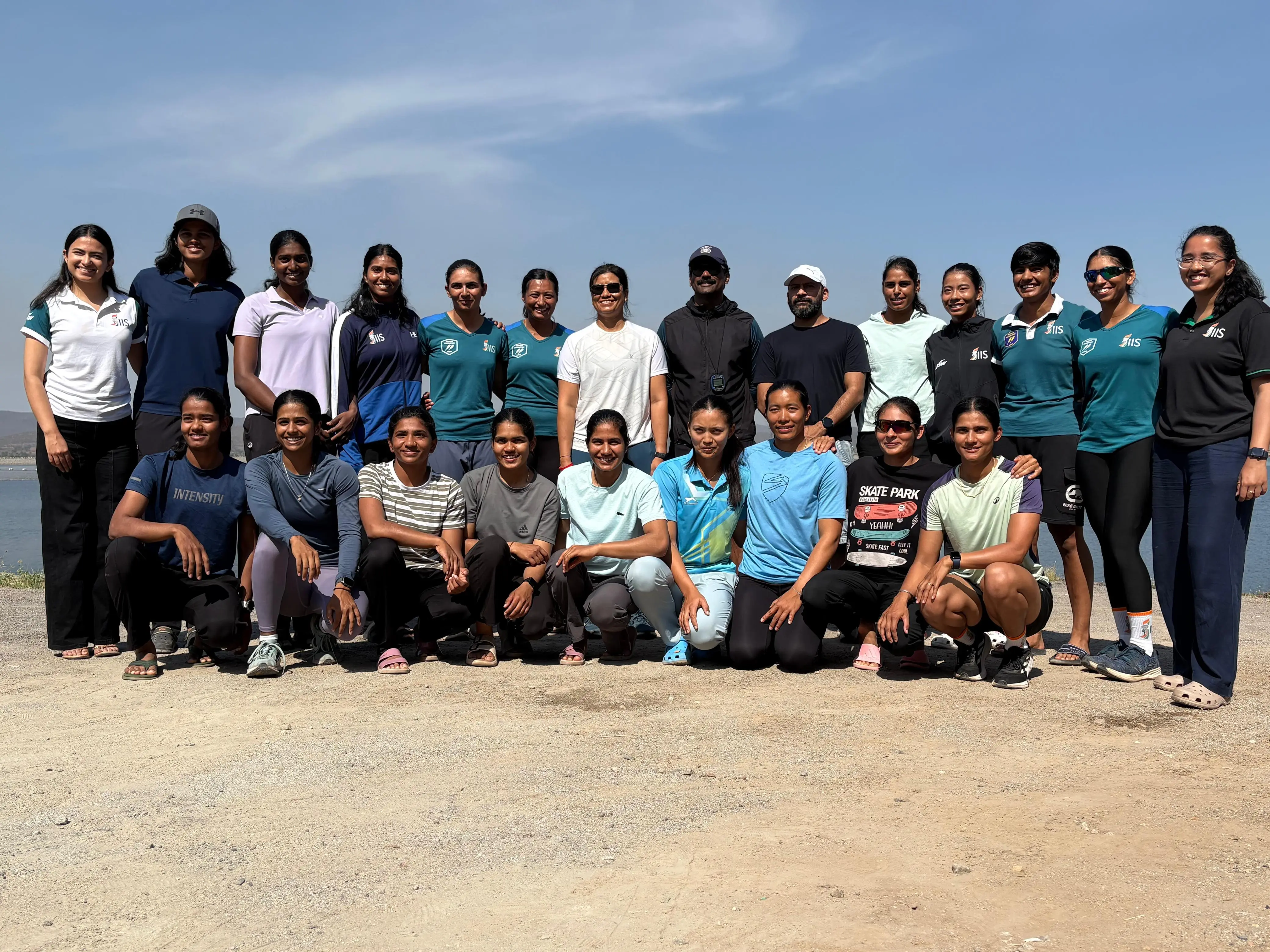
&imwidth=800&imheight=600&format=webp&quality=medium "Inside India’s women’s rowing revolution: Science, sacrifice and the hunt for medals")
The drive to the rowing facility at the Inspire Institute of Sport, Vijayanagar, does not feel like a journey towards a high-performance sports centre at first. The road turns rough, gravel crunching beneath the tyres as the vehicle slowly climbs towards the top of the dam, almost like driving up a rugged hillside. The path is uneven, isolated, and dusty, surrounded by rocky Bellary terrain that looks untouched by time. But then comes the first glimpse of the lake, and suddenly the entire landscape changes.
It was barely six in the morning when the first signs of activity appeared. Before the sun had properly risen over the hills, athletes were already out warming up. Some jogged slowly along the gravel pathways, others stretched in silence, preparing their bodies for another demanding session on the water. That first sight said everything about the culture of the place. While most of the world was still waking up, rowers here had already started their day chasing fractions of improvement. And then the lake opened up in front of us. Calm, endless, and almost perfectly still, with rowing shells gliding across the water beneath a pale morning sky.
On the floating docks, there is constant movement. Athletes tighten foot straps, adjust oars, balance shells, and push themselves into another session before the day properly begins. Coaches observe every detail, every stroke cycle, every recovery movement. Rowers disappear into the distance, tiny figures against the vast reservoir and barren hills. The facility carries a rawness that makes the sport feel authentic, no noise, no glamour, just athletes, water, and work. What makes this place special is the contrast it offers. The harsh terrain of Vijayanagar stands beside remarkably peaceful waters. One moment, athletes are warming up on gravel pathways beneath rugged hillsides; the next, they are cutting across a serene lake that mirrors the morning sky. It is demanding, isolated, and beautiful all at once, exactly the kind of environment where Olympic dreams are quietly shaped, one stroke at a time.

‘Rowers are heavily dependent on carbohydrates’
But beneath every training session lies an equally demanding system that most people never see. Every morning, while most of the city is still asleep, India’s rowers are already preparing for battle on the water. Standing quietly behind every stroke, every recovery session, and every race strategy is sports nutritionist Natanya Bhatt, whose work begins long before the athletes even enter the boat. “Rowers are heavily dependent on carbohydrates,” Natanya explains, breaking down the science behind one of the most physically demanding sports in the Olympic ecosystem.
For the rowing team, nutrition is not simply about eating healthy. It is a calculated performance strategy. A regular training day starts with multiple pre-training fueling phases beginning as early as 5:30 am with bread, jam, peanut butter, bananas, and carbohydrate-rich hydration drinks. By the time the athletes hit the water at 7 am, their bodies are already being prepared for high-intensity exertion. But the challenge, Natanya says, is that no two athletes are the same.
Trending Stories
&im=FitAndFill=(700,400))
How fast can the Sukhoi Su-30 fighter jet really fly?
)
Did China ask its people 'not to respond to aliens'? Origin of bizarre claim on social media
)
MS Dhoni-CSK Fallout? Report claims failed stake sale talks triggered rift
)
Scientists reveal the SAFEST COUNTRY when catastrophe strikes the planet
)
Serial killer on the loose in South Korea's Jeju Island? Fourth body found in three days as more than a dozen people go missing
)
2/3rd of glacier detached, collapsed: ISRO satellite images reveal what triggered Nepal floods
)
Trump once again claims without him there would be ‘no Israel right now’
)
Foreign espionage attacks against German companies surge to 37%, Bitkom report reveals
)
Blake Lively wins partial legal fee from Justin Baldoni after $8M request
)
Why is Pakistan deploying Turkish Bayraktar TB2 drones near India border?
)
'OH MY GOD! We've found other agents!': Investigators discover not one or two, almost 700 OpenAI AI agents went rogue, hacked Hugging Face
)
Lunar eclipse 2026: India timings, places to see and more. August Blood moon factsheet
)
RSS chief Mohan Bhagwat on global outreach tour
)
Both pilots killed as training aircraft crashes in Lucknow – What we know
)
16-year-old charged with preparing terror attack on kindergarten in Norway
&im=FitAndFill=(700,400))
How the S-400 protects itself from enemy attacks
)
Nepal floods: Over 165 dead, 400 missing; US, India, China, World Bank mobilise aid
)
India's multi-layered watch: The new surveillance war
)
5 doomsday planes spotted in US skies hours after CIA director's secret trip to Russia
)
9/11 mastermind Khalid Sheikh Mohammed to finally face trial in 2028, nearly 27 years after horrific attacks
)
Islamabad hospital fire: What we know about one of the biggest facility that housed Imran Khan
)
Workers run for life while filming Nepal flash flood: Scary new visuals emerge from Rasuwa
)
Russian military planes enter South Korean air defence zone amid rising tensions with North Korea: What's happening
)
Ron Weasley Is Back! Rupert Grint set to return to Harry Potter universe on Broadway
)
400-year-old 'vampire' grave in Poland reveals non-existent genetic lineage
)
Dolly Parton, global icon and queen of country music, dies at 80
)
Nepal flash floods: Kailash Mansarovar yatra affected, close to 400 pilgrims out of contact
)
'If he is dead, they're putting on a pretty good show': Trump casts fresh doubt over Mojtaba Khamenei's fate
)
Man arrested near US Capitol with guillotine in pickup truck: What happened?
&im=FitAndFill=(700,400))
Why the Su-30MKI cockpit is painted bright turquoise green
“Each rower has different requirements depending on body weight and individual training requirements,” she says, pointing to the varying demands between athletes competing in singles, doubles, and fours events. The workload is relentless. Multiple sessions across the day leave little room for recovery, making nutrition one of the biggest performance differentiators. Whey protein immediately after training, carbohydrate replenishment between sessions, and hydration monitoring become essential to ensure athletes are not carrying fatigue into the next session.
According to Natanya, rowing athletes consume nearly six grams of carbohydrates per kilogram of body weight on normal training days. Ahead of competition, that number can rise sharply to as high as 12 grams per kilogram as athletes carbo-load to maximize stored muscle glycogen, the body’s primary fuel source during racing.
And if recovery is ignored, the consequences can become serious.
Natanya highlights a growing concern in elite sport called RED-S, Relative Energy Deficiency in Sport, a clinical condition caused by inadequate fueling and poor recovery. The effects can range from fatigue and low performance to hormonal, hematological, and psychological disturbances. For her, recovery stands on three pillars: nutrition, recovery therapies, and sleep. “It’s not just nutrition, it’s a combination of all three,” she says, referring to ice baths, saunas, and structured sleep schedules that complement the athletes’ diet plans.
The level of personalisation inside the programme is extensive. Every athlete undergoes DEXA scans to analyse fat mass, lean mass, bone density, and bone mineral content. Hydration tests are conducted every two to three weeks because sweat rates and sodium losses differ from athlete to athlete. Some rowers may require additional strength training for hypertrophy. Others may need higher calcium and vitamin D intake to improve bone density and withstand training load. Every nutritional adjustment is tied directly to performance goals.
Which is why, when the rowers glide through the water at sunrise, there is far more happening beneath the surface than just power and endurance. Behind every stroke is a carefully engineered system of fueling, recovery, and science. And now, for perhaps the first time in years, India’s women’s rowing programme is beginning to show signs that all of it may finally be translating into something bigger, medals.
'People should know that Indian rowers can win medals'
“The athletes are not qualified individually, the boats are,” says women’s national rowing coach Ratheesh DB, explaining one of rowing’s unique dynamics. India has already secured qualification in the women’s Coxless Pair and Double Sculls events, but the final athlete combinations for the Asian Games are still being decided.
“We still have four to five months to select the best athletes,” he says. Among those currently leading the race are Suman and Diljot in the Coxless Pair, while Poonam and Priya remain strong contenders in the Double Sculls category. Priya comes from Manipur, while Poonam emerged through the MP Academy system; two athletes from entirely different backgrounds are now united by the same ambition.
That diversity is something Ratheesh values deeply. Manipur, despite not traditionally being associated with rowing, has steadily produced talent because of its geography and long relationship with water sports. “There were rowing centres there even before the 2009 National Games,” he recalls. But Indian women’s rowing has spent years fighting structural limitations. “Earlier, women were not promoted much,” Ratheesh says bluntly.
Crews were trained in separate centres, and combinations were assembled only before competitions, and athletes rarely spent enough time together to build chemistry. In a sport where synchronization is everything, that lack of continuity proved costly. “In 90 days, it was very difficult to make a good crew combination,” he says. India’s women won an Asian Games rowing medal in 2010 before enduring a long drought. Meanwhile, the men’s programme, supported heavily through Army structures, enjoyed far greater consistency because athletes trained together for years.
Women rarely had that advantage. For Ratheesh, synchronization is the soul of rowing, and it begins long before athletes even touch the water. “We do small exercises on indoor rowing machines and repeat them during warm-ups in the boat,” he explains. Those repetitive drills are designed to perfect rhythm, timing, and body movement. The finer details matter enormously in a sport where fractions of a second separate medals from heartbreak.
Also Read: FIFA World Cup 2026 | Curacao coach Fred Rutten resigns a month before tournament kickoff
According to Ratheesh, one of the most common technical mistakes young rowers make is failing to maintain the correct body sequence. “Hand, body, and seat sequence is the most basic thing,” he says. “Every movement in rowing is connected to the previous movement.” That obsession with detail perhaps comes from his own story. At 15, Ratheesh was a volleyball player. But limitations in height eventually pushed him away from the sport. In 1996, he shifted to water sports, won medals at the junior level, and later joined the Army as a rower.
“Compared to other sports, getting into the national team in rowing was not that tough at that time,” he says. Today, as a coach, he believes Indian rowing cannot afford to remain stuck in outdated systems. “I don’t want athletes to train the way we trained 10 years ago,” he says, emphasizing the importance of modern international techniques and evolving training methods.
He also dismisses one of rowing’s biggest myths, that it is purely an upper-body sport. “People think rowing is all about hands,” he says. “But coordination is everything.”
He points out how older generations of Indian rowers suffered frequent back injuries because of outdated equipment and poor infrastructure. Modern rowing systems, he says, have significantly improved athlete safety and biomechanics.
Still, the biggest battle remains visibility and funding. “Every boat costs ₹10-15 lakh,” Ratheesh says. Building a rowing centre can cost upwards of ₹1.5 crore. Without regular international medals, many states hesitate to invest heavily in the sport. Yet there are signs of momentum.
Indian women have started winning medals again at the Asian Championships. Talent identification is improving. Athletes from states like Punjab and Manipur are emerging consistently. For the first time in years, women’s rowing in India feels less like an afterthought and more like a serious long-term project. The sport may still exist outside the mainstream. Cricket, badminton, and wrestling dominate headlines while rowing continues to function quietly in the background.
But inside the calm waters of Vijayanagar, there is a growing belief that this silence may not last forever. “People should know that Indian rowers can win medals,” Ratheesh signed off smilingly.

