Ex-Pakistan PM Zulfikar Ali Bhutto, hanged in 1979, didn’t get a fair trial, rules Supreme Court

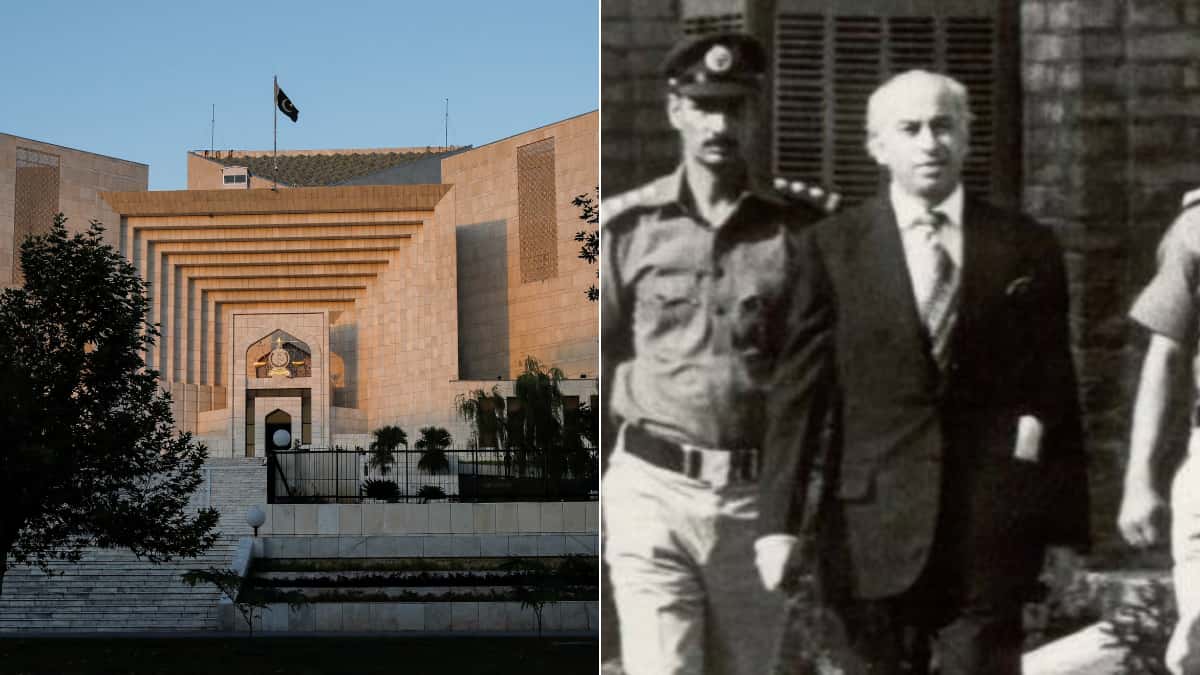
Zulfikar Ali Bhutto
Zulfikar Ali Bhutto, former prime minister of Pakistan, was hanged in 1979 after being convicted of murder, but he didn't get a fair trial, the Supreme Court ruled on Wednesday (Mar 6).
Bhutto served as the fourth president of Pakistan from 1971 to 1973 and also as the ninth prime minister of the South Asian nation from 1973 to 1977.
Fourty-four years ago, Bhutto was hanged after a trial under the military regime of late General Zia-ul-Haq.

The ex-prime minister founded the Pakistan People's Party (PPP), which is now run by his grandson and former foreign minister Bilawal Bhutto Zardari.
In remarks telecast live of the ruling, Chief Justice of Pakistan (CJP) Qazi Faez Isa said, "We didn't find that the fair trial and due process requirements were met."
Also read:Unexpected snowfall takes several lives in Pakistan, Afghanistan; Northwest India shivers in March
)
The Early Spring is proof not everyone can talk about their real feelings, and it is perfectly OK
)
UN votes to ‘correct the map’ as India backs fairer world view
)
Nigerian Navy discovers 99,000 litres of suspected stolen, illegally refined products as it intensifies anti-crude oil theft operations
)
Who is Aditi Paudel? 17-year-old becomes Japan's first literacy ambassador
)
Bengaluru: Officials find 40 kg expired chilli at chairman's club
)
Jaishankar rejects trade link to ending Ukraine war
)
Israeli strikes on Lebanon kill three, injure 23 despite truce
)
Alpine glacier was covered with sheep wool sheets to prevent melting. It worked
)
South Korea mulls deploying military assets to Strait of Hormuz
)
World's fifth-largest economy, British army can't afford to train
)
Breaking | Vance takes the podium: First White House briefing since Leavitt's exit
)
Taiwan raises 'concerns' over China's missile test
)
BRICS 2026: $1 trillion sovereign capital set to converge in Delhi for first iBRICS Summit
)
What is Iran's Pickaxe Mountain that Trump has again threatened to bomb?
)
UN votes to correct world map that visually shrank Africa for 450 years
)
Former NewJeans member Danielle launches YouTube channel, hints at new solo journey
)
Bangladesh batter Towhid Hridoy creates history with 350 not out in South Africa
)
Brendan Fraser’s transformation fuels The Mummy 4 excitement as fans welcome back Rick O’Connell
&im=FitAndFill=(700,400))
Krishna Janmashtami 2026: From Dhaniya Panjiri to Makhana Kheer- 5 best sweet dishes perfect for celebrating Lord Krishna’s birth
)
Donald Trump plans to travel to Ireland on Qatari-donated jet amid security concerns
)
Nazi-looted art to return to Jewish heirs
)
Eight killed in Kerala’s Thrissur after car rams into lorry parked on highway
&im=FitAndFill=(700,400))
Why Russian fighter jets use bulky, low-pressure tyres compared to US jets
)
FBI-wanted fraud accused arrested in Jalandhar over $600,000 scam
&im=FitAndFill=(700,400))
Why US tanks weigh over 20 tons more than Russian tanks
&im=FitAndFill=(700,400))
New Friday OTT releases (September 4, 2026): GDN, Dhamaal 4, Jagamae Sangeetham- Watch 6 new movies and TV shows on Netflix, Prime Video and more
)
Killing the Himalayas slowly: Human urine is melting a glacier on Mount Everest
Bilawal's father, Asif Ali Zardari, had filed a judicial reference during his tenure as president in 2011, and the ruling was in response to that.
The reference sought an opinion by the top court on revisiting the death sentence awarded to Bhutto.
The chief justice said that it was a unanimous decision taken by a nine-member bench headed by him.
The larger bench consisted of Justice Sardar Tariq Masood, Justice Syed Mansoor Ali Shah, Justice Yahya Afridi, Justice Amin-ud-Din Khan, Justice Jamal Khan Mandokhel, Justice Muhammad Ali Mazhar, Justice Syed Hasan Azhar Rizvi and Justice Musarrat Hilali.
The CJP Isa announced the unanimous opinion, stating, "The proceedings of the trial by the Lahore High Court and of the appeal by the Supreme Court of Pakistan do not meet the requirements of the fundamental right to a fair trial and due process enshrined in Articles 4 and 9 of the Constitution, and later guaranteed as a separate and fundamental right under Article 10A of the Constitution."
Also read:Emboldened after pact with China, President Muizzu says all Indian officials will leave by May 10
Watch:Why timing of the Achakzai's raid is notable
Pakistan's top court also acknowledged that there had been "some cases in our judicial history that created a public perception that either fear or favour deterred the performance of a duty to administer justice in accordance with the law".
"We must therefore be willing to confront our past missteps and fallibilities with humility, in the spirit of self-accountability, and as a testament to our commitment to ensure that justice must be served with unwavering integrity and fidelity to the law," Justice Isa said.
Meanwhile, he also admitted that "we cannot correct ourselves and progress in the right direction until we acknowledge our past mistakes".
Shehbaz Sharif, who recently took oath as the prime minister after a disputed election in February, hailed the ruling.
"It is a positive development that a wrong done by a court has been corrected by a court," Sharif said in a statement from his office.
Bilawal also reacted to the judgement. Taking to his official X social media account, he said that the SC's opinion came "44 years after judicial murder and more than 12 years after [the] presidential reference was filed".
"The pursuit of justice was a labour of love by President Asif Ali Zardari in the name of his wife Shaheed Mohtarma Benazir Bhutto. Our family waited 3 generations to hear these words," he added.
(With inputs from agencies)