Unusual organisms found in hot springs of Yellowstone National Park might help in search for alien life

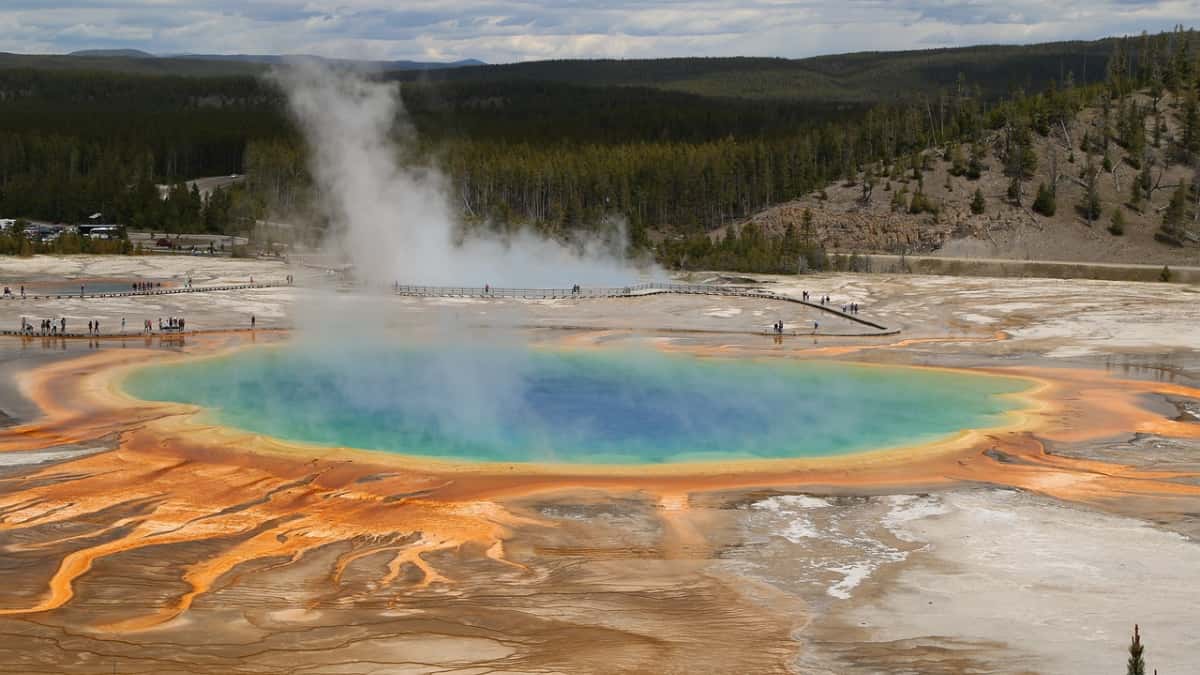
Yellowstone National Park
Scientists have found two never-before-seen groups of microbes that live in the hot springs of Yellowstone National Park,United States. The discovery, made by researchers from Montana State University, was published in the journal Nature on July 24.
The study, titled, "Cultivation and visualization of a methanogen of the phylum Thermoproteota", revealed that the new microbe groups are dubbed Methanomethylicia and Methanodesulfokora. They are methanogens, single-celled organisms that produce methane.
Methanogens, known to science since 1933, are methane-producing bacteria, especially an archaean which reduces carbon dioxide to methane, unlike humans and other animals who eat food, inhale oxygen and exhale carbon dioxide to survive.

The findings of the research may have implications for the search for extraterrestrial life and the fight against climate change.
It was earlier believed that all bacteria that produced methane belonged to a single phylum called Euryarchaeota. Now, the discovery of the two new microbial groupings confirms that methane-producing microorganisms are more diverse. They were previously only identified from DNA samples.
&imwidth=180&imheight=135&format=webp&quality=medium)
Blasts heard in Sanaa as Saudi-led coalition warns civilians to evacuate; Houthis vow retaliation
&imwidth=180&imheight=135&format=webp&quality=medium)
China's counter-surveillance industry booms amid heightened espionage fears | Gravitas
&imwidth=180&imheight=135&format=webp&quality=medium)
Saudi Arabia strikes Yemen oil sites as Houthi missiles target Riyadh; 'limited fire' breaks out at Aramco
&im=FitAndFill=(700,400)&imwidth=180&imheight=135&format=webp&quality=medium)
Navratri 2026: 9 days, 9 forms of Goddess Durga and 9 colours- Check the complete list
&imwidth=180&imheight=135&format=webp&quality=medium)
Trump accuses Houthis of driving up oil prices before US midterms, warns of consequences
&imwidth=180&imheight=135&format=webp&quality=medium)
New Delhi rejects Beijing’s claims and remarks on Ladakh location naming exercise
&imwidth=180&imheight=135&format=webp&quality=medium)
Russian woman and Bihar boy's love story goes viral after she reaches India to marry him
&imwidth=180&imheight=135&format=webp&quality=medium)
US Midterms 2026: In Alaska, cost-of-living anxiety meets strangest ballot in high-stakes Senate race
&imwidth=180&imheight=135&format=webp&quality=medium)
CMs Vijay-Naidu meet in Vijayawada, discuss water sharing, river-linking
&imwidth=180&imheight=135&format=webp&quality=medium)
'Don't ever mess with nature!': Trump’s tiger attack post triggers social media backlash as victim's family issues heartbreaking tribute
&imwidth=180&imheight=135&format=webp&quality=medium)
OpenAI employee arrested by FBI after allegedly hiding recording device in office
&imwidth=180&imheight=135&format=webp&quality=medium)
1,500 drones illuminate Mumbai sky as Cordelia Cruises unveils second ship, Cordelia Sky
&imwidth=180&imheight=135&format=webp&quality=medium)
Delhi Police arrest Cockroach Janta Party's Saurav Das, Ashutosh Ranka, Ajinkya Shinde in Jantar Mantar case, to be produced before court
&imwidth=180&imheight=135&format=webp&quality=medium)
Pope Leo XIV diagnosed with lung cancer after surgery, Vatican says 'successful surgery and recovering'
&imwidth=180&imheight=135&format=webp&quality=medium)
Pakistan to chair UN-backed global Borrowers’ Platform as its own debt burden mounts, triggers sarcastic reactions on social media
&imwidth=180&imheight=135&format=webp&quality=medium)
Robot gropes girl, makes thrusting movements in bizarre crime in Germany
&imwidth=180&imheight=135&format=webp&quality=medium)
France accuses Musk of ‘online harassment’ of European leaders, warns of poll interference
&imwidth=180&imheight=135&format=webp&quality=medium)
MI5 chief warns Russia is UK’s ‘aggressor number one’ as Iran and AI threats grow
&imwidth=180&imheight=135&format=webp&quality=medium)
'Turn approver, resign, we'll forgive you': Rahul Gandhi claims receiving messages from CEC Gyanesh Kumar
&imwidth=180&imheight=135&format=webp&quality=medium)
Trump reconsidering calling off Nidal Hasan's execution livestream. Here's why
&imwidth=180&imheight=135&format=webp&quality=medium)
‘My president, I mean my husband’: Trump's new press secretary Katie Zacharia's first briefing goes off the rails in 14 minutes
&imwidth=180&imheight=135&format=webp&quality=medium)
‘How many people did she illegally bring from Somalia?’ Trump targets Ilhan Omar, questions her net worth
&imwidth=180&imheight=135&format=webp&quality=medium)
Marco Rubio to visit India next week, focus on energy cooperation and strategic ties
&imwidth=180&imheight=135&format=webp&quality=medium)
L Murugan resigns as Union Minister, expresses wish to return to grassroots
&imwidth=180&imheight=135&format=webp&quality=medium)
'Ouch!!! That must hurt': Kangana Ranaut hails Kamal Haasan's sharp reply to Elon Musk over Starlink row
&imwidth=180&imheight=135&format=webp&quality=medium)
Girl 'dead' for 8 hours wakes up at her own funeral, dad insists she wasn't breathing
&imwidth=180&imheight=135&format=webp&quality=medium)
Sidhu Moose Wala’s younger brother wins hearts by recreating late singer’s signature move at Toronto Hologram Show
&imwidth=180&imheight=135&format=webp&quality=medium)
UK school ditches technology, shifts from screen to pen and paper for learning
&im=FitAndFill=(700,400)&imwidth=180&imheight=135&format=webp&quality=medium)
New OTT releases this week (October 12-18, 2026): Sacrifice, Koffee with Karan S9, Roadies Rebirth- 6 titles coming on Netflix, JioHotstar and more
&imwidth=180&imheight=135&format=webp&quality=medium)
Anupam Kher joins Ranbir Kapoor's Ramayana as Jatayu, new poster unveiled
&imwidth=180&imheight=135&format=webp&quality=medium)
Netanyahu wants to join Saudi's war on Houthis, but Crown Prince denies: Report
&imwidth=180&imheight=135&format=webp&quality=medium)
Measles kills again: 6 dead in Pennsylvania as America faces its worst outbreak in decades | Gravitas
&imwidth=180&imheight=135&format=webp&quality=medium)
Ken Paxton's Dubai night out with two US fugitives sparks political storm as Texas Senate race tightens
&imwidth=180&imheight=135&format=webp&quality=medium)
Cornell University suspends fraternity parties over 2024 gang rape allegations
Methane is a gas that is 28 times more potent than carbon dioxide when it comes to trapping heat in the atmosphere.
In a statement, microbiologist Roland Hatzenpichler of Montana State, an author of the paper, said: "All we knew about these organisms was their DNA. No one had ever seen a cell of these supposed methanogens; no one knew if they actually used their methanogenesis genes, or if they were growing by some other means."
Also read:Watch: Mysterious fireball flies through night sky from California to Texas. People say it was...
Two distinct study groups—one from China and the other from the US—have succeeded in cultivating these microorganisms in the lab, confirming that they actually produce methane.
The finding is significant as methanogens produce 70 per cent of the world's methane, with Hatzenpichler saying: "Methane levels are increasing at a much higher rate than carbon dioxide, and humans are pumping methane at a higher rate into the atmosphere than ever before."
Scientists are still trying to find out whether Methanomethylicia in non-extreme conditions grows by using methanogenesis or if they use some other mechanism.
They may be able to change the circumstances in their habitats and reduce the amount of methane released into the atmosphere if they comprehend this.
"My best bet is that they sometimes grow by making methane, and sometimes they do something else entirely, but we don't know when they grow, or how, or why. We now need to find out when they contribute to methane cycling and when not," Hatzenpichler said.
Also read:South America and Africa once tore apart and formed an oceanic crust. Its evidence lies in Angola
Will this aid the search for 'aliens'?
Newsweek said in its report that the exobiology programme of the National Aeronautics and Space Administration (NASA) also funded the research.
The US-based space agency is invested in methanogens because they may give insights into life on Earth more than three billion years ago as well ashint atthe potential for life on other planets and moons where methane has been detected.
(With inputs from agencies)