&imwidth=800&imheight=600&format=webp&quality=medium "Signal from the early universe: Radio burst travels 10 billion years to reach Earth. It came from a...")
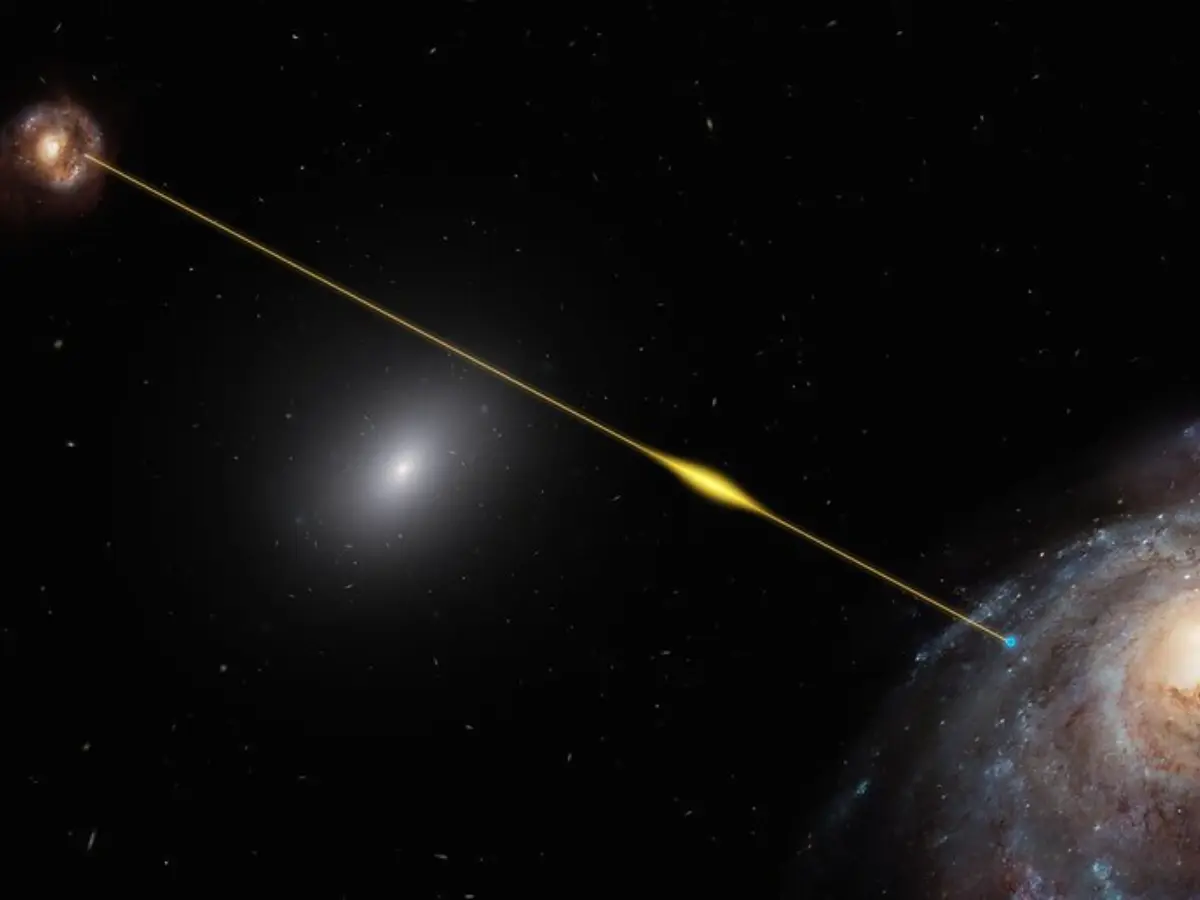
The South African MeerKAT observatory recorded a radio signal from space, or a fast radio burst (FRB), on March 4, 2024. It was super short but equally intriguing. Scientists say that this FRB travelled a whopping 10 billion years to reach us, way before our Sun and Earth were born. The discovery was announced in a paper published on the arXiv preprint server earlier this month after being first presented at the FRB2025 conference in Montreal, Canada, in July. Researchers said that the radio burst originated from a dwarf galaxy undergoing a strong burst of star formation. However, a likely candidate wasn't discovered initially, and it was only revealed after numerous analyses. When FRBs travel from deep space, crossing intergalactic matter, the waves slow down slightly. For longer wavelengths, this process is even stronger.
Also Read: Radio signal that took 8 billion years to reach Earth came from seven interacting galaxies
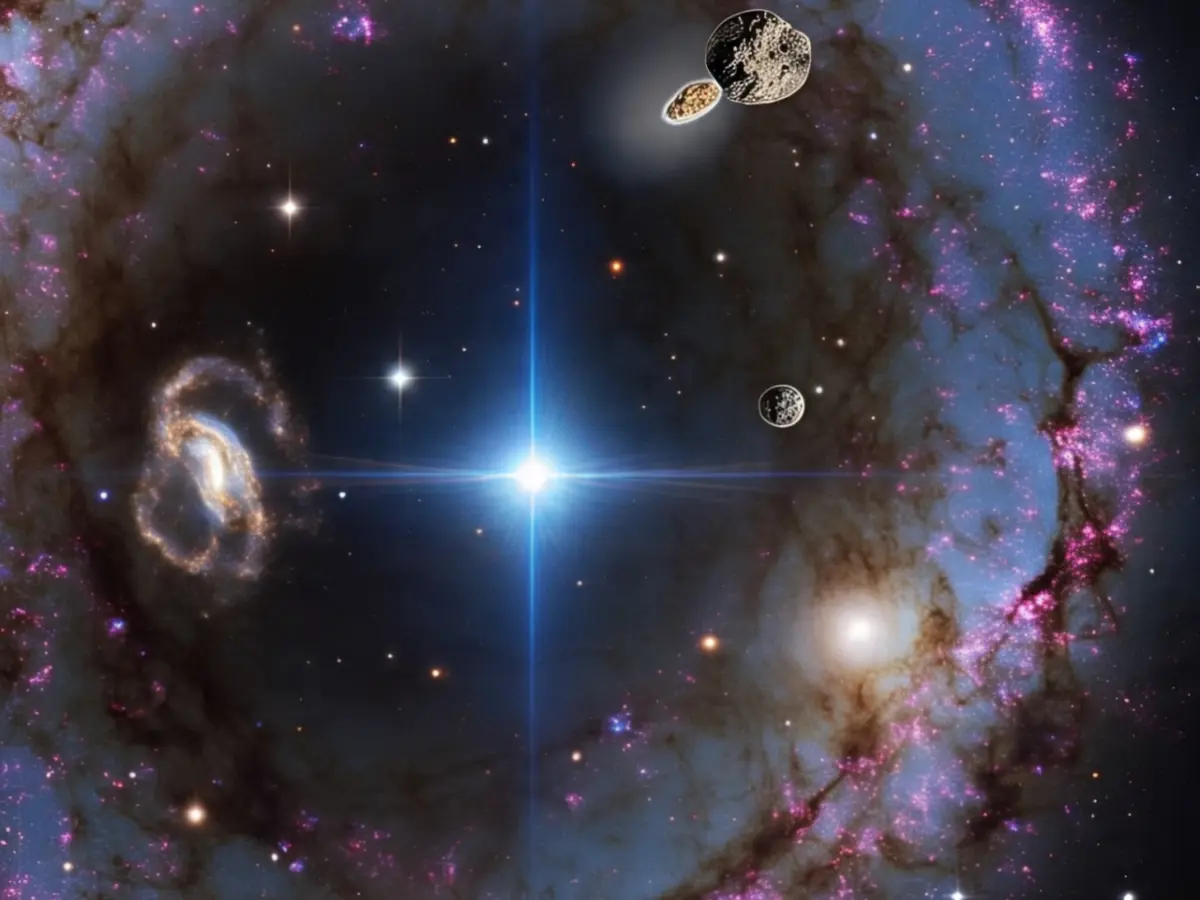
This is what gave away the age of the radio signal spotted by the South African observatory. Since its dispersion measure was unusually large, it hinted that the signal had travelled from an extremely distant point in space. Scientists turned to the Keck telescope on Mauna Kea, Hawai’i, and the MMT Observatory in Arizona to understand where the signal came from. Both instruments failed to detect a host galaxy. When they did not succeed, the James Webb Space Telescope was brought into play and proved a game changer. Its Near-infrared Camera picked up a 28th-magnitude faint light at the burst’s location. This was found to be a dwarf galaxy where young stars were being constantly born.

Understanding the age of the radio burst
The researchers then needed to understand the age of the radio wave. For this, they needed to measure how much the galaxy’s light waves were stretched by cosmic expansion while travelling towards Earth. A team led by Manisha Caleb, University of Sydney, used Webb’s NIRSpec spectrograph to observe this phenomenon and found that the radio signal originated when the universe was only around 3 billion years old.
Trending Stories
)
Why asking questions could be more important than memorising answers
)
BRICS Summit 2026 full schedule: Day-wise agenda, timings and key issues - All you need to know
)
BRICS Summit 2026: Iran's Pezeshkian praises PM Modi at BRICS
)
BRICS rejects EU carbon tax as ‘punitive’, ‘discriminatory’; warns of burden on Global South
)
'Iran won't surrender': Pezeshkian sends blunt message to US while attending BRICS Summit in India
)
Why dehydration is the hidden cause of travel fatigue on long flights
)
Top 5 places to visit in Goa beyond its famous beaches
)
'He is popular...': Malaysian PM Anwar Ibrahim's praise for PM Modi during bilateral meeting | WATCH
)
BRICS Summit 2026: 30+ countries seek BRICS membership
)
Frustrated man demolishes his kitchen after thousands flock to see Mother Mary his wife spotted on the wall
)
BRICS Summit 2026: PM Modi, Xi reach key consensus on ties, China to assume BRICS chairmanship in 2027
)
Trump says Canada eager to reach a deal, it could come ‘fairly soon’ if Ottawa treats US farmers better
)
From drones to KAAN fighters: Turkey outlines 229% surge in defence spending amid regional shifts
)
‘Partners, not rivals’: Xi outlines four point plan for stronger India-China ties
)
Could staying indoors all day affect your health?
)
Bigg Boss 20: Uditi Singh reacts to ex Karan Wahi’s possible wildcard entry
)
Why going digital does not always mean becoming more efficient
)
800 million years old - Scientists discover 'fingerprints' of supercontinent Gondwana in ancient rocks
)
Israel spent nearly $470,000 on PM's hair, makeup since 2019, data shows
)
From severe mobility problems to recovery: Madhuri the elephant’s journey of wildlife care
)
BRICS Summit day 1: New Delhi declaration adopted with full consensus, big diplomatic win for India
)
From India, Putin warns Europe against sending troops to Ukraine, Zelensky expresses willingness to meet him at G20 Summit
)
Did Iran President Pezeshkian touch feet of Hindu spiritual leader at Delhi event as shown in viral video?
)
9-year-old Chennai prodigy clears Cambridge IGCSE grade 10 exams
)
Reacher actor Alan Ritchson, wife Catherine part ways after 20 years of marriage
)
Why does your body need time to adjust after a long journey?
)
Baba Vanga's first prophecy for 2027 is out, and straight out of science fiction
)
Why does your skin need protection from UV rays?
)
How does the loss of forests affect the way wildlife lives and moves?
)
IND vs AFG, 1st T20I: When and where to watch live streaming in India?
)
Anthropic is giving Claude to schools free, and the reason is not philanthropy
)
BRICS Summit: China resumes Guangzhou-New Delhi flight, issues 'good-neighbourliness' remark ahead of Xi-Modi meet
)
Why do wild animals need quiet places to survive?
)
Humans may lose control of AI: Anthropic CEO calls for slowdown, Altman, Musk back him
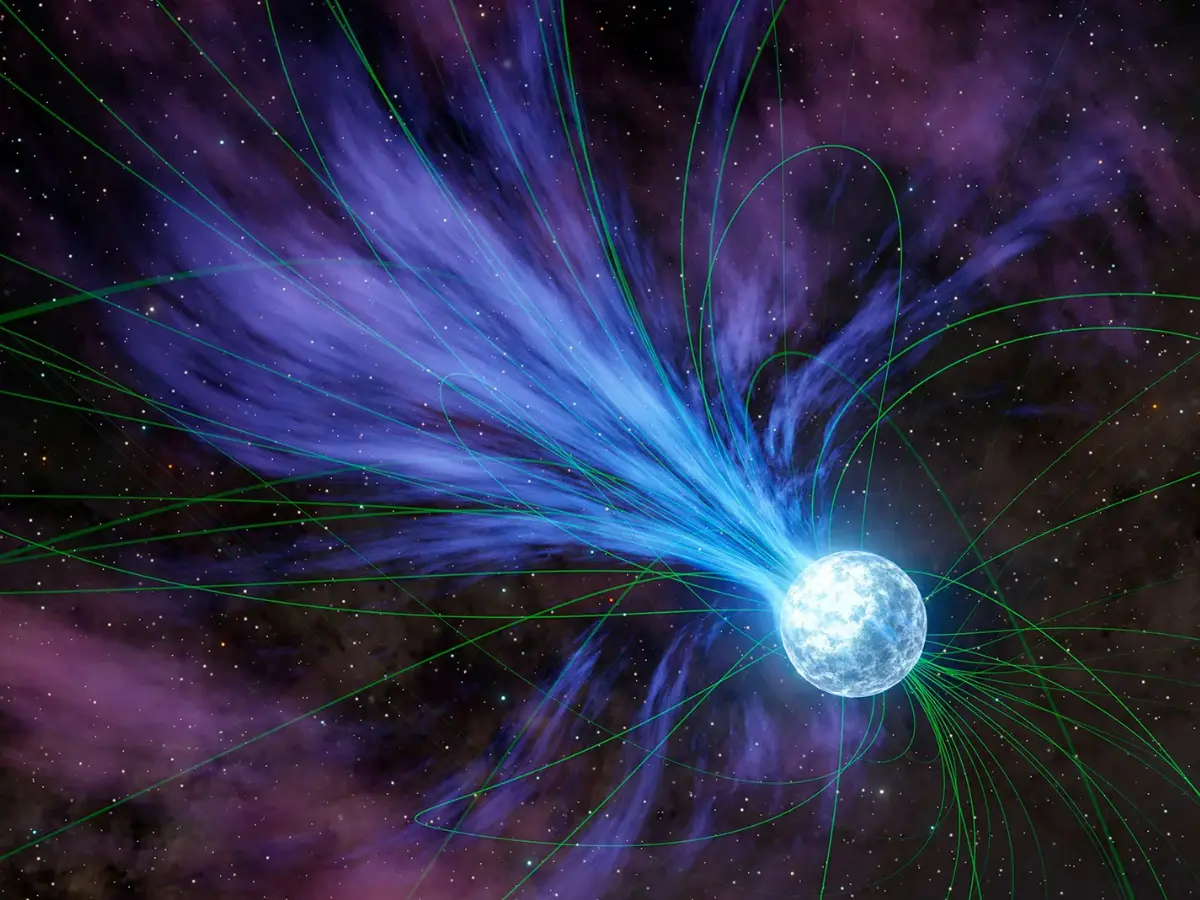
What are magnetars?
The team also believes that their observation can help solve the mystery of magnetars that are believed to release these radio bursts. Magnetars are reportedly strongly magnetised neutron stars, and could either form right after a star dies or when two neutron stars merge. Caleb's paper states that the merger is common in older galaxies. However, the radio wave studied by her team originated from a young galaxy, which means the magnetar in this case formed right after a stellar explosion.