Moon flybys could slash space mission fuel costs by millions, scientists reveal

&imwidth=600&imheight=450&format=webp&quality=medium "Moon flybys could slash space mission fuel costs by millions, scientists reveal")
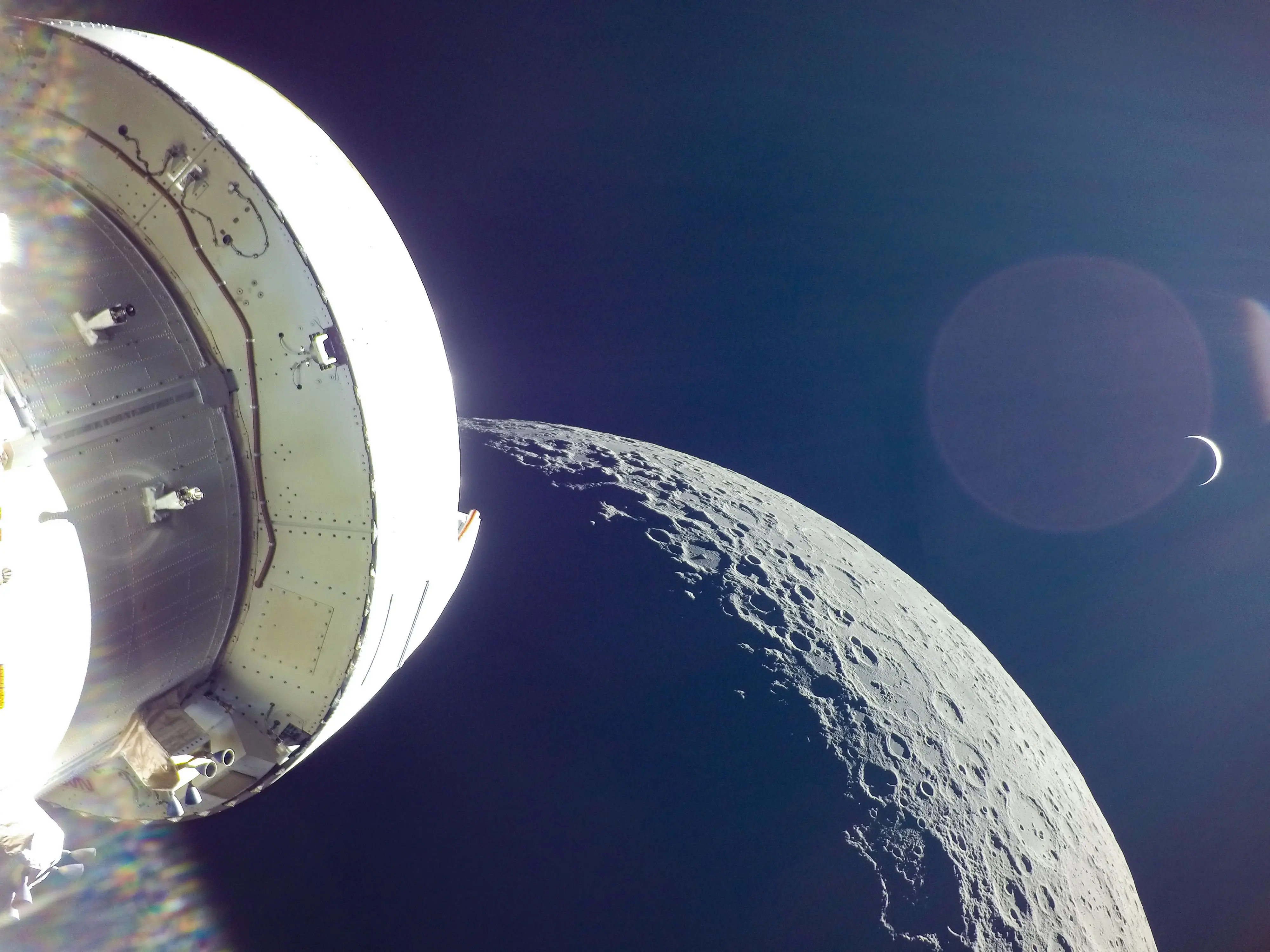
Representation Image Photograph: (Wikimedia Commons)
This research, however, demonstrates that the same technique can be used to slow a spacecraft down, reducing the energy, and therefore fuel, required to achieve a stable orbit around a planet.
The Three-Body Problem is a real challenge in astrodynamics. It describes the complex gravitational interactions between three celestial bodies, making precise orbital calculations difficult. For mission planners, this problem is both a source of complexity and an opportunity: if navigated carefully, it can allow spacecraft to enter stable orbits with significantly reduced fuel requirements.
Using moons for gravity assists
A recent study by researchers at the Beijing Institute of Technology, published in Acta Astronautica, explores how spacecraft could leverage gravity assists from planetary moons to enter more efficient orbits. Traditional gravity assists are used to increase a spacecraft's speed by slingshotting around a planet. This research, however, demonstrates that the same technique can be used to slow a spacecraft down, reducing the energy, and therefore fuel, required to achieve a stable orbit around a planet.
Large planets with multiple moons, such as Jupiter, are ideal candidates. The study simulated a flyby of Callisto, one of Jupiter’s four major Galilean moons, and found a measurable decrease in fuel consumption needed to achieve a stable orbit within the Jovian system. While missions like the Jupiter Icy Moon Explorer (JUICE) cannot retroactively benefit, future missions could see substantial savings.
Weak stability boundaries and trajectory mapping
The study also highlights the use of weak stability boundaries (WSBs), regions in space where the gravitational pulls from two bodies nearly cancel out. WSBs allow a spacecraft to transition from an escape trajectory to a stable orbit with minimal energy expenditure. To identify these regions, scientists employ Poincaré Mapping, which records the position and velocity of an object at regular intervals across a mathematical plane. Simulating enough points can reveal pathways to stable trajectories.
Trending Stories
)
)
)
)
)
)
)
)
)
)
)
)
)
)
)
)
)
)
)
)
)
)
)
)
)
)
)
)
)
)
)
)
)
)
&im=FitAndFill=(700,400))
)
)
)
)
The presence of moons increases the number of potential WSBs. For instance, Jupiter’s 97 moons provide multiple opportunities for gravity-assisted orbit insertion, giving mission designers greater flexibility and reducing overall mission cost.
Future prospects
Beyond fuel savings, moon-assisted trajectories could have other applications. Past research suggests that certain planetary systems, such as Neptune and Triton, could theoretically capture interstellar objects if conditions align perfectly. While this is largely serendipitous, controlled moon flybys remain within human reach, offering predictable reductions in fuel requirements and enabling more ambitious interplanetary missions.
This research opens new avenues in astrodynamics, presenting both a practical tool for future spacecraft and a rich area for theoretical exploration. By harnessing the gravitational interplay of moons and planets, scientists can design more efficient, cost-effective missions, extending humanity’s reach into the solar system.