
&imwidth=800&imheight=600&format=webp&quality=medium "Pakistan, China and the sea between: Why India's third carrier is about geography, not pride")
India's carrier debate is often reduced to the wrong question. It is made to sound like a matter of prestige, tonnage or naval nostalgia. It is not. The third aircraft carrier is not about pride. It is about geography.
India lives in one of the most unforgiving strategic neighbourhoods in the world. To the west is Pakistan, a nuclear-armed adversary with a long record of hostility and military adventurism. To the north and east is China, a nuclear-armed great power with whom India has fought a war and continues to face unresolved land-border tensions.
To the south is not emptiness, but the Indian Ocean—the maritime space through which India's trade, energy, influence and strategic future move every single day.

This is India's strategic reality: two hostile continental fronts and a maritime frontier across the Arabian Sea, the Bay of Bengal and the wider Indian Ocean Region. That geography demands a fleet structure that can be present on both seaboards when the nation needs it. Today, India is one carrier short of that requirement.
This is not a theoretical gap. It is an availability problem. Any navy that has operated major platforms understands the tyranny of maintenance, refit, training cycles, crew work-up, aviation certification and operational deployment.
Trending Stories
&im=FitAndFill=(700,400))
How fast can the Sukhoi Su-30 fighter jet really fly?
)
Did China ask its people 'not to respond to aliens'? Origin of bizarre claim on social media
)
MS Dhoni-CSK Fallout? Report claims failed stake sale talks triggered rift
)
Scientists reveal the SAFEST COUNTRY when catastrophe strikes the planet
)
Serial killer on the loose in South Korea's Jeju Island? Fourth body found in three days as more than a dozen people go missing
)
2/3rd of glacier detached, collapsed: ISRO satellite images reveal what triggered Nepal floods
)
Trump once again claims without him there would be ‘no Israel right now’
)
Foreign espionage attacks against German companies surge to 37%, Bitkom report reveals
)
Blake Lively wins partial legal fee from Justin Baldoni after $8M request
)
Why is Pakistan deploying Turkish Bayraktar TB2 drones near India border?
)
'OH MY GOD! We've found other agents!': Investigators discover not one or two, almost 700 OpenAI AI agents went rogue, hacked Hugging Face
)
Lunar eclipse 2026: India timings, places to see and more. August Blood moon factsheet
)
RSS chief Mohan Bhagwat on global outreach tour
)
Both pilots killed as training aircraft crashes in Lucknow – What we know
)
16-year-old charged with preparing terror attack on kindergarten in Norway
&im=FitAndFill=(700,400))
How the S-400 protects itself from enemy attacks
)
Nepal floods: Over 165 dead, 400 missing; US, India, China, World Bank mobilise aid
)
India's multi-layered watch: The new surveillance war
)
5 doomsday planes spotted in US skies hours after CIA director's secret trip to Russia
)
9/11 mastermind Khalid Sheikh Mohammed to finally face trial in 2028, nearly 27 years after horrific attacks
)
Islamabad hospital fire: What we know about one of the biggest facility that housed Imran Khan
)
Workers run for life while filming Nepal flash flood: Scary new visuals emerge from Rasuwa
)
Russian military planes enter South Korean air defence zone amid rising tensions with North Korea: What's happening
)
Ron Weasley Is Back! Rupert Grint set to return to Harry Potter universe on Broadway
)
400-year-old 'vampire' grave in Poland reveals non-existent genetic lineage
)
Dolly Parton, global icon and queen of country music, dies at 80
)
Nepal flash floods: Kailash Mansarovar yatra affected, close to 400 pilgrims out of contact
)
'If he is dead, they're putting on a pretty good show': Trump casts fresh doubt over Mojtaba Khamenei's fate
)
Man arrested near US Capitol with guillotine in pickup truck: What happened?
&im=FitAndFill=(700,400))
Why the Su-30MKI cockpit is painted bright turquoise green
A carrier is not available every day simply because it exists on the order of battle. The old naval logic is simple: if a country needs one carrier continuously available, it needs at least three hulls — one deployed, one preparing or recovering, and one in maintenance. This "rule of three" is not a luxury calculation. It is the mathematics of maritime readiness.
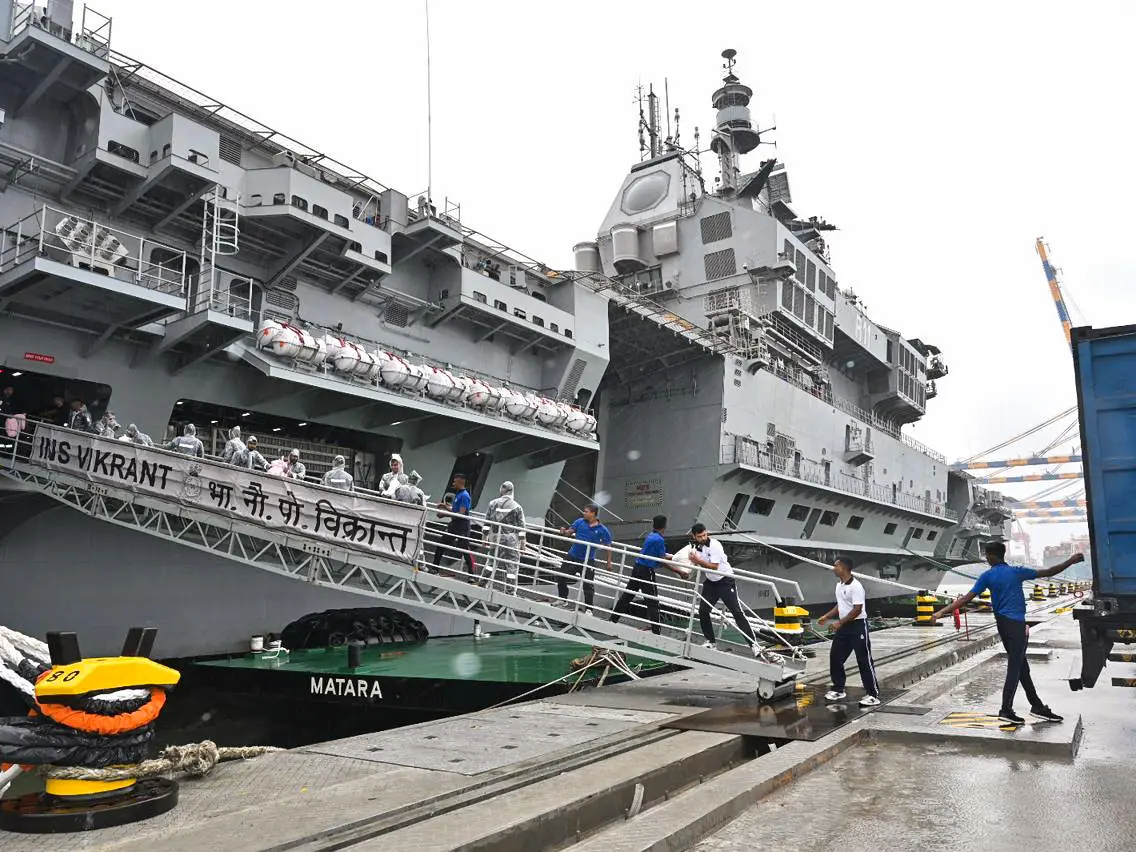
India currently has two aircraft carriers: INS Vikramaditya and INS Vikrant. That gives the Navy capability. It does not yet give it guaranteed availability across both seaboards during a national crisis.
Now place this within a two-front scenario. A crisis erupts on the western land border with Pakistan. At the same time, Chinese naval activity increases in the Bay of Bengal, the eastern Indian Ocean or near the approaches to the Andaman and Nicobar Islands.
This is not an alarmist fantasy. The 2020 Galwan crisis showed that Beijing is willing to apply pressure when India is forced into strategic distraction. A coordinated or opportunistic land-maritime pressure scenario is exactly the kind of situation for which serious military planning exists.
In such a crisis, if one Indian carrier is in refit or deep maintenance, the remaining carrier must choose. Does it move west into the Arabian Sea to support maritime pressure against Pakistan, protect energy routes and shape escalation? Or does it move east to counter Chinese naval signalling, reassure partners, and defend India's eastern maritime approaches? A carrier cannot be in two seas at the same time.
That is the heart of the third-carrier argument. It is not a question of emotion. It is about ensuring that India is never forced to choose between the Arabian Sea and the Bay of Bengal when both may be contested simultaneously.
The Pakistan dimension is often under-discussed. A carrier battle group operating in the western theatre does not merely threaten naval targets. It forces Pakistan to distribute attention, air defence, coastal surveillance, naval assets and political anxiety at a time when it may prefer to concentrate all pressure on the land border. Karachi and Pakistan's wider coastal infrastructure have always been central to its economic and military vulnerability.
A credible Indian carrier presence in the Arabian Sea changes Pakistan's planning problem. It creates uncertainty, complicates escalation and opens another axis of pressure without immediately crossing the nuclear threshold. That is what sea power does at its best. It gives political leadership options short of, during and beyond conflict. But that option must be available when the nation needs it, not merely when the refit cycle permits it.
The China dimension is larger and more long-term. The People's Liberation Army Navy already operates three carriers, and according to recent assessments, China may seek a total carrier force of up to nine by 2035.
Whether the exact number arrives on that timeline or not, the direction is unmistakable: China is building a blue-water navy with carrier aviation as a central instrument of power projection. This is supported by a growing network of access points across the Indian Ocean Region—Djibouti, Gwadar, Hambantota, Chittagong and other nodes that together create the infrastructure of sustained far-seas operations.
For India, this matters because the Indian Ocean is not a distant theatre. It is our front yard, our economic lifeline and our strategic depth. A Chinese carrier group signalling in the eastern Indian Ocean directly affects Indian maritime security, regional confidence and the balance of influence in our own oceanic neighbourhood. A two-carrier India can surge. A three-carrier India can sustain. That difference is everything.
The energy dimension ties the argument together. India imports nearly 87–88 per cent of its crude oil requirement, much of it through sea lines of communication running through the Strait of Hormuz, the Arabian Sea, the Red Sea and the Gulf of Aden. A disruption in these routes is not merely a naval problem. It is an economic emergency.
No serious country outsources the security of its energy arteries. A carrier battle group gives India the ability to position sovereign air power where land bases are either unavailable, politically constrained or operationally insufficient.
That is the point often missed in the carrier debate. A destroyer can defend and strike. A submarine can deny and ambush. A maritime patrol aircraft can search and classify. But an aircraft carrier carries sovereign air power to sea—aviation, command, surveillance, strike, air defence, helicopters, unmanned systems, logistics and political signalling in one mobile instrument of national power.
Having served over four years onboard INS Viraat and operated from carriers, destroyers and frigates, I can say this plainly: a carrier is not just a platform. It is a floating air station, a command centre, a logistics machine, a deterrence signal and a national statement. It is also one of the most demanding military systems a country can operate. That is precisely why only serious navies persist with it.
The third carrier must therefore be seen not as an isolated procurement case but as a national maritime architecture decision. India has already demonstrated the ability to build an indigenous carrier through INS Vikrant. The skills, vendor chains and design confidence absorbed through that effort must not be allowed to fade. Warship-building capability is not a tap that can be turned on after a decade of hesitation. A follow-on carrier is not only about fleet numbers; it is about preserving and deepening India's hard-won carrier-building ecosystem.
The question is not whether India can afford a third carrier. The question is whether India can afford a carrier gap in the decade when China is expanding, Pakistan remains hostile, and the Indian Ocean becomes the central arena of competition.
The future Indian carrier need not be a copy of the past. It must be designed for the next fight — networked, survivable, integrated with destroyers, submarines, P-8I aircraft, MH-60R helicopters, UAVs, space-based surveillance, electronic warfare and long-range precision strike. It must be part of a kill web, not merely a battle group in the traditional sense.
The carrier air wing must evolve to include fighters, airborne early warning, unmanned systems, loyal wingman concepts and electronic warfare payloads. The carrier will remain relevant not because it is immune to threats, but because it adapts faster than the threats trying to kill it.
The United States is not retiring carriers because missiles exist. China is not avoiding carriers because it has missiles. France, Britain and others continue to treat carrier aviation as a strategic capability because sea-based air power gives a nation choices that no other platform can fully replace. India's geography is even more demanding.
We do not have the luxury of choosing between the Arabian Sea and the Bay of Bengal. We cannot assume that a western crisis will remain western, or that a northern crisis will remain continental. We cannot assume that China will wait outside the Indian Ocean while India is occupied elsewhere, or that Pakistan will not exploit distraction. Strategy built on such assumptions is not strategy. It is hope.
A third carrier gives India continuous options across both seaboards — one available in the western theatre, one in the eastern theatre or work-up cycle, and one in maintenance or refit. It gives the Navy flexibility, political leadership choice, and adversaries uncertainty. That is deterrence.
The third carrier is not about building a monument. It is about matching fleet structure to geography. It is about ensuring that India's maritime power is available when crisis comes, not when the maintenance calendar is convenient. Two hostile land borders and a three-sea maritime frontier require every instrument of national power.
The third carrier is the missing instrument. From the flight deck, this is not about pride. It is about presence. And in the Indian Ocean, presence is power.
DISCLAIMER: The opinions expressed in this article are solely those of the author and do not necessarily reflect the views of WION.