'Over my dead body': Lt Gen Sagat Singh’s Bold leap that won 1971 war | How a daring helicopter crossing of Meghna river ended the war in 13 days

&imwidth=600&imheight=450&format=webp&quality=medium "'Over my dead body': Lt Gen Sagat Singh’s Bold leap that won 1971 war | How a daring helicopter crossing of Meghna river ended the war in 13 days")
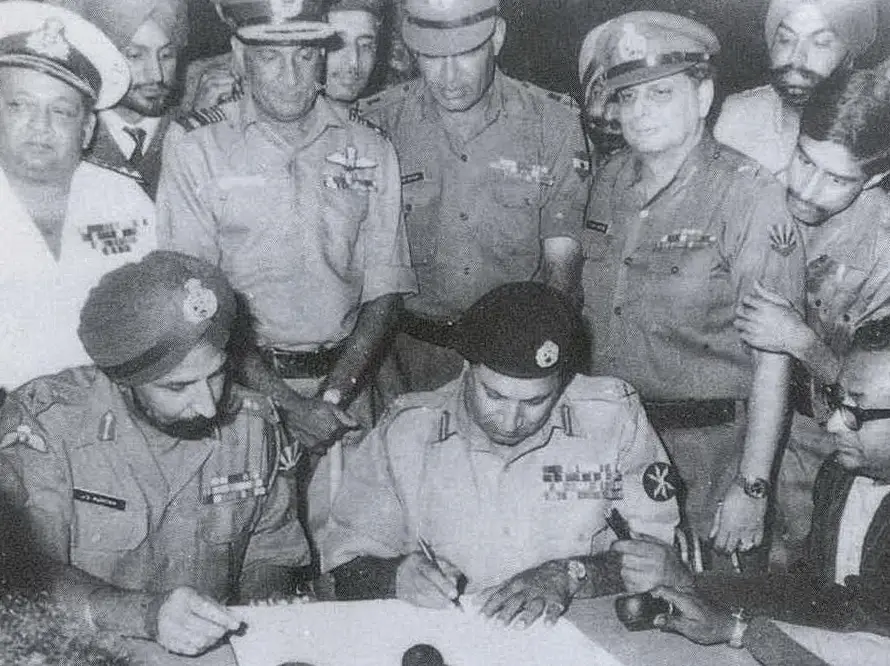
1971 Instrument of Surrender Photograph: (Wikimedia Commons)
This Vijay Diwas, the Meghna heli-bridge stands as a symbol of bold leadership, innovation, and courage. Without Sagat Singh’s decision to defy orders and move fast, the war could have dragged on, allowing foreign powers to interfere and possibly deny Bangladesh its freedom.
As India marks the 54th anniversary of its 1971 victory, one crucial name is still missing from most history books — Lieutenant General Sagat Singh. As commander of IV Corps, his bold decisions and refusal to wait changed the course of the war and forced Pakistan’s surrender.
The River That Was Meant to Stop India
By December 7, 1971, the Indian Army was moving rapidly toward Dhaka. Lt Gen Sagat Singh’s IV Corps, based in Agartala, had already captured Akhaura and Brahmanbaria at great speed. But the advance suddenly stopped at the Meghna River — one of the widest rivers in the world, stretching about 3.6 kilometres even at its narrowest point.
The railway bridge at Ashuganj had been blown up by retreating Pakistani troops. On the opposite bank, Pakistani forces were heavily dug in at Bhairab Bazar. They believed the river would delay India long enough for international pressure — possibly from the US or China — to force a ceasefire.
Army engineers warned that building a bridge would take weeks. A normal river crossing would be slow and extremely costly in lives. Acting on this assessment, Eastern Army Commander Lt Gen Jagjit Singh Aurora ordered Sagat Singh to halt and wait.
“Jaggi, Over My Dead Body”
Trending Stories
&im=FitAndFill=(700,400)&imwidth=280&imheight=210&format=webp&quality=medium)
&imwidth=280&imheight=210&format=webp&quality=medium)
&imwidth=280&imheight=210&format=webp&quality=medium)
&imwidth=280&imheight=210&format=webp&quality=medium)
&imwidth=280&imheight=210&format=webp&quality=medium)
&imwidth=280&imheight=210&format=webp&quality=medium)
&imwidth=280&imheight=210&format=webp&quality=medium)
&imwidth=280&imheight=210&format=webp&quality=medium)
&imwidth=280&imheight=210&format=webp&quality=medium)
&imwidth=280&imheight=210&format=webp&quality=medium)
&imwidth=280&imheight=210&format=webp&quality=medium)
&imwidth=280&imheight=210&format=webp&quality=medium)
&imwidth=280&imheight=210&format=webp&quality=medium)
&imwidth=280&imheight=210&format=webp&quality=medium)
&imwidth=280&imheight=210&format=webp&quality=medium)
&imwidth=280&imheight=210&format=webp&quality=medium)
&imwidth=280&imheight=210&format=webp&quality=medium)
&imwidth=280&imheight=210&format=webp&quality=medium)
&imwidth=280&imheight=210&format=webp&quality=medium)
&imwidth=280&imheight=210&format=webp&quality=medium)
&imwidth=280&imheight=210&format=webp&quality=medium)
&imwidth=280&imheight=210&format=webp&quality=medium)
&imwidth=280&imheight=210&format=webp&quality=medium)
&imwidth=280&imheight=210&format=webp&quality=medium)
&imwidth=280&imheight=210&format=webp&quality=medium)
&imwidth=280&imheight=210&format=webp&quality=medium)
&imwidth=280&imheight=210&format=webp&quality=medium)
&im=FitAndFill=(700,400)&imwidth=280&imheight=210&format=webp&quality=medium)
&im=FitAndFill=(700,400)&imwidth=280&imheight=210&format=webp&quality=medium)
&imwidth=280&imheight=210&format=webp&quality=medium)
&imwidth=280&imheight=210&format=webp&quality=medium)
&imwidth=280&imheight=210&format=webp&quality=medium)
&imwidth=280&imheight=210&format=webp&quality=medium)
&imwidth=280&imheight=210&format=webp&quality=medium)
&im=FitAndFill=(700,400)&imwidth=280&imheight=210&format=webp&quality=medium)
&imwidth=280&imheight=210&format=webp&quality=medium)
At 52, Sagat Singh was not the kind of commander who believed in waiting. A World War II veteran, he had led Indian troops during the liberation of Goa in 1961 as commander of the 50th Parachute Brigade, earning his maroon beret at the age of 42. In 1967 at Nathula Pass, he had defied orders and struck Chinese forces, securing Indian control that still holds today.
When Lt Gen Aurora flew in on December 8 and repeated his order not to cross the Meghna, Sagat Singh’s reply became legendary: “Jaggi, over my dead body.”
Operation Cactus Lily: A Daring Idea
Sagat Singh worked closely with Group Captain Chandan Singh of the Indian Air Force to plan something never attempted by India before — a large-scale heliborne crossing.
The plan was simple but risky: use Mi-4 helicopters to fly entire infantry units across the Meghna at night. The helicopters would land in paddy fields, marked by torches placed by Mukti Bahini fighters.
The helicopters had never been used on such a scale. The landing zones were rough, visibility was poor, and Pakistani forces were nearby.
The Night That Changed the War
On the night of December 9, 1971, the plan was put into action. The 4th Battalion of the Guards Regiment boarded Mi-4 helicopters at Brahmanbaria. Flying low, just above treetops, the helicopters crossed the dark Meghna waters.
Squadron Leader Pushp Kumar Vaid, who flew 35 sorties and later received the Vir Chakra, recalled:
“The Mi-4 never let us down. It was a wonderful workhorse.”
A Blitzkrieg Towards Dhaka
By dawn on December 10, Indian troops had secured the railway bridge at Narsingdi, just 12 kilometres from Dhaka. Their mission was clear — prevent Pakistani forces from blowing up the bridge. Over the next 36 hours, 14 Mi-4 helicopters flew more than 200 sorties, transporting the entire 311 Mountain Brigade — nearly 5,000 soldiers and 680 tonnes of equipment — across the Meghna.
The Pakistani command was completely shocked.
Lt Gen A.A.K. Niazi, Pakistan’s commander in East Pakistan, had believed the Meghna was impossible to cross. His 27th Infantry Brigade, positioned at Bhairab Bazar, was suddenly outflanked and surrounded. Indian troops had appeared behind enemy lines, making Pakistani defences useless.
The Collapse of Pakistani Resistance
By December 12, Indian artillery was already within range of Dhaka. Pakistani resistance began to fall apart. Just four days later, on December 16, 1971, at 4:31 pm, Lt Gen Niazi signed the instrument of surrender. A total of 93,000 Pakistani soldiers became prisoners of war — the largest military surrender since World War II.
The General History Almost Forgot
Despite planning the operation that effectively ended the war, Sagat Singh remained in the background during the surrender ceremony. He was awarded the Padma Bhushan and Param Vishisht Seva Medal. When a junior officer was promoted ahead of him after the war, he accepted another Corps command quietly and later retired to Jaipur, where he named his farmhouse “Meghna Farm.”
Field Marshal Sam Manekshaw once said: “If a man says he is not afraid of dying, he is either lying or he is a Gurkha.” One could add — or Sagat Singh.
A Legacy Written in the Air
This Vijay Diwas, the Meghna heli-bridge stands as a symbol of bold leadership, innovation, and courage. Without Sagat Singh’s decision to defy orders and move fast, the war could have dragged on, allowing foreign powers to interfere and possibly deny Bangladesh its freedom.
In March 2013, Bangladesh honoured this legacy by inviting Ran Vijay Singh, Sagat Singh’s son, to Dhaka — calling his father “the liberator of Bangladesh.”
Lt Gen Sagat Singh passed away on September 26, 2001, but his legacy lives on — in Goa, Sikkim, and most importantly, in a free Bangladesh, where 14 helicopters once flew through the night, carrying not just soldiers, but the destiny of a new nation.
