

&imwidth=800&imheight=600&format=webp&quality=medium "Hard ball or soft state? Pakistan's White House rock show reveals double-faced diplomacy")
When can we expect the US to have a military base in Balochistan or the Khyber region?
That's the cynical question I asked myself as news poured from and on Pakistan over the past month about various aspects of diplomacy and defence that sent mixed signals. I was a bit confused for a while, but then a famous subcontinental proverb came to mind, and things fell into place -- almost.
I was reminded of that proverb used by Maleeha Lodhi, Pakistan's celebrity journalist-turned-diplomat, in a magazine article in the 1980s. As I recall, she was mocking her country's then-military ruler, General Zia Ul Haq. The elephant has different teeth to show and different ones to eat, wrote the London School of Economics-educated feminist who has had the distinction of being appointed as high commissioner to the UK and ambassador to the US by otherwise warring Pakistan parties and military ruler General Parvez Musharraf.
Also read | Pakistan Army chief or shopkeeper? Asim Munir ridiculed for rare earth minerals photo-op with Trump. Watch
Her words ring true across the border, as the proverb is a shared one, though a lot else might be at odds between India and Pakistan. Haathi ke daanth khane ke aur, dikhane ke aur.
It seems to me that some words and actions of the Islamabad establishment are meant to please the White House and its incumbent, Donald Trump, while others involve pacifying a domestic audience upset over Israel's attacks on Palestinians. There could also be some long-term hedging by Islamabad to prove to no one in particular that Pakistan is a sovereign state with no pronounced tilt.
Trending Stories
&imwidth=180&imheight=135&format=webp&quality=medium)
'My name has always been Ilhan Omar': Congresswoman hits back at Trump, calls him a 'creep'
&imwidth=180&imheight=135&format=webp&quality=medium)
Gravitas | US attack could trigger WW III: Russian planes in Tehran, Israeli jets, US warships in action
&imwidth=180&imheight=135&format=webp&quality=medium)
Viral video shows cross falling on Colombia priest, no official confirmation | WATCH
&imwidth=180&imheight=135&format=webp&quality=medium)
'This is humiliation': Vijay Deverakonda under fire over controversial marriage proposal remark on Koffee With Karan 9
&imwidth=180&imheight=135&format=webp&quality=medium)
US Navy, Marine Corps boards defy Trump's transgender military ban, vote to retain troops
&imwidth=180&imheight=135&format=webp&quality=medium)
Will the US attack Iran this weekend? Trump's envoy says, 'absolutely'
&im=FitAndFill=(700,400)&imwidth=180&imheight=135&format=webp&quality=medium)
Why do army tanks have different types of armour?
&imwidth=180&imheight=135&format=webp&quality=medium)
India-China face-off continues near Arunachal’s Taksing, reveals ITBP chief in first official confirmation of tensions
&imwidth=180&imheight=135&format=webp&quality=medium)
Nairobi building collapse: Several feared trapped after 16-storey structure crumbles; rescue operation underway
&imwidth=180&imheight=135&format=webp&quality=medium)
Pakistan airline PIA unveils new crew uniforms, faces online criticism
&imwidth=180&imheight=135&format=webp&quality=medium)
Did Neha Bora call for Bangladesh-like GenZ protest, 'anarchy' in India? WION Fact-checks viral claim
&imwidth=180&imheight=135&format=webp&quality=medium)
'Completely insane, never happened': Trump's son-in-law denies allegations of secret dealings with Saudi, UAE
&imwidth=180&imheight=135&format=webp&quality=medium)
India’s 2022 CWG silver medallist Sabbhineni Meghana announces international retirement
&imwidth=180&imheight=135&format=webp&quality=medium)
Horrific video shows the moment 18-year-old fell to her death from Mexico amusement park ride
&imwidth=180&imheight=135&format=webp&quality=medium)
IND-W vs ZIM-W, 1st ODI: Rawal, Charani star in India’s nine-wicket win over Zimbabwe
&imwidth=180&imheight=135&format=webp&quality=medium)
Microsoft AI diagnoses complex medical cases more than twice as accurately as doctors, study finds
&imwidth=180&imheight=135&format=webp&quality=medium)
Google Fitbit Air’s new health guardian feature tracks trends: How it works
&imwidth=180&imheight=135&format=webp&quality=medium)
US midterms 2026: Trump revises Canada tariffs as Susan Collins faces tight re-election race in Maine
&imwidth=180&imheight=135&format=webp&quality=medium)
US midterms 2026: Viral video claims Lindsey Graham paid underage men for sex; clip released weeks before his sister's Senate race
&imwidth=180&imheight=135&format=webp&quality=medium)
AI deepfakes are spreading online: Why is removing them so difficult?
&imwidth=180&imheight=135&format=webp&quality=medium)
China's dancing robot turns violent bodyguard, lifts cars and fights intruders - Watch
&imwidth=180&imheight=135&format=webp&quality=medium)
Global cybersecurity alert: PHP flaws trigger website shutdowns as hack attempts surge into millions
&imwidth=180&imheight=135&format=webp&quality=medium)
'You’re a horrible little reporter, aren’t you?': Trump snaps at NBC reporter questioning his support for Ramaswamy's campaign ad
&imwidth=180&imheight=135&format=webp&quality=medium)
US start-up claims it turned Mercury into Gold, beats CERN’s 2025 record
&imwidth=180&imheight=135&format=webp&quality=medium)
US charges two former FBI officials with lying to Congress about Hunter Biden probes. 'Politically motivated' Trump grievance or something else?
&im=FitAndFill=(700,400)&imwidth=180&imheight=135&format=webp&quality=medium)
New Friday OTT releases (October 23, 2026): Gajab Raat, Dorothy, Chaar Yaar- Watch these 6 new movies and TV shows on Netflix, Prime Video and more
&imwidth=180&imheight=135&format=webp&quality=medium)
US midterms 2026: Trump administration sues to block Alaska Senate election certification if Republican Dan Sullivan loses. What's happening?
&imwidth=180&imheight=135&format=webp&quality=medium)
Anthropic security chief issues grim cyberattack warning: ‘It’s going to get a lot worse’
&imwidth=180&imheight=135&format=webp&quality=medium)
Tu Hai Meri Kiran film review: Sonakshi Sinha and Zaheer Iqbal's thriller gets tangled in its own twists
&imwidth=180&imheight=135&format=webp&quality=medium)
First Lady Melania Trump secures ceasefire between Russia, Ukraine in Oleshky: White House
&imwidth=180&imheight=135&format=webp&quality=medium)
One man, 8 months of work, and a river dirty again: Why Bittu Tabahi may quit
&imwidth=180&imheight=135&format=webp&quality=medium)
Jenna Ortega plans TV break after Wednesday: ‘I want to leave time for new things’
&imwidth=180&imheight=135&format=webp&quality=medium)
Five killed, several injured after explosion in Bihar's Siwan as firecrackers catch fire
&imwidth=180&imheight=135&format=webp&quality=medium)
Iran targeting US diplomats? Intelligence warns of 'advanced' assassination plots: Report
&imwidth=180&imheight=135&format=webp&quality=medium)
Emmanuel Macron calls Paris suburb shooting a 'racist terrorist attack' after one killed, several injured
Conflicting images do send mixed signals, as do diplomatic tightrope walks.
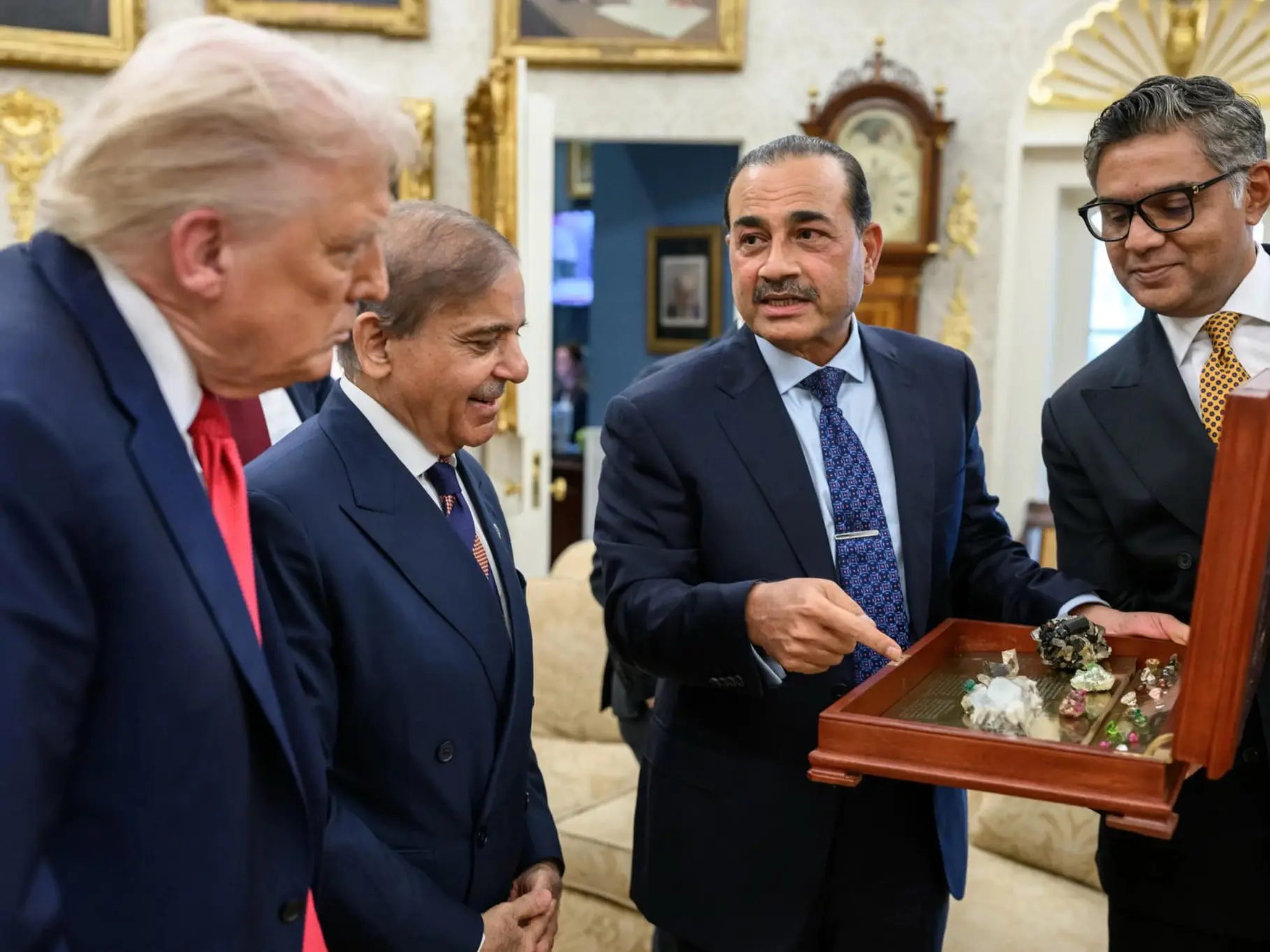
Field Marshal Asim Munir, a rare example of a Hafiz-e-Quran who also doubles as an extraordinary friend of Uncle Sam, was recently seen displaying some hard rock classics (not the musical variety) to President Donald Trump at the White House in the company of Prime Minister Shehbaz Sharif, who seemed to be playing second fiddle to the army strongman.
Now, a Hafiz-e-Quran (Guardian of the Quran) is a title given to a Muslim who has memorised the entire Holy Quran by heart, understanding its teachings and acting upon them. In the backdrop of an outrage in the Muslim world about what Israel is doing in Gaza, Munir's rock show was more than tricky.
The rocks were ostensibly proof of rare earth minerals found in Balochistan, and a signal that the place was for Washington to use. Given Islamabad's strongly denied accusations that India has a role to play in Balochistan's insurgency, and given that the Chinese already have a presence in the region through the Gwadar port they are building, the displayed rocks were a likely suggestion for third-party intervention by the US in the region.
Coincidentally, both Rolling Stones and Rare Earth are names of classic rock bands, and one may be forgiven for using digressive puns to illustrate a point, but it is clear that Pakistan's rulers were out to gather some moss by inviting US investors to Balochistan as they showcased rare earth minerals, in which China has an edge in a cutting-edge technology race in which the minerals are vital in areas like electronics and green energy. Not just Balochistan, even Khyber Pakhtunkhwa, an equally troubled province rocked by local militants inspired by Afghanistan's Taliban, is said to be rich in rare earths.
Such heavy metal diplomacy is what made me think of whether and when the US will get access to Balochistan (or KP) -- first as a country with investment interests and later, possibly, as one that must protect its interests with military support.
Look at the location. Both KP and Balochistan are close to Iran as well as Afghanistan, with a missile range that is comfortably proximate to China. It doesn't get more strategic than this.
Consider the fact that days before the White House rock show, Taliban officials rejected the idea that the US may retake Afghanistan's Bagram air base after Trump hinted at that. US officials have since denied the idea, but you never know in geopolitics. Options may involve future engagement -- or alternatives in the same region.
As I have argued before, Pakistan's location is so strategic for the US that it is often forced to make peace, if not friendship, with its generals.
The generals in a failing economy know their position well, but they have to show they are smartly neutral and that Pakistan is sovereign as a country. That probably explains the recent defence pact between Pakistan and Saudi Arabia that talks of mutual help in the face of any aggression. A gentle reminder that might be of help here is that there is a Shia-Sunni conflict playing out in which Iran, Balochistan, and Yemen fall in the Shia zone, and fit well into the US scheme of disciplining Iran and Yemen's Houthi rebels who get Tehran's support.
But what do Pakistan's rulers tell their ordinary Muslim citizens and assorted humanists upset over the US and Israel joining forces in the attacks on Palestinian territories? Here's where I believe Islamabad's recent rhetoric about Pakistan being a nuclear power that might help generate a Muslim version of NATO (North Atlantic Treaty Organisation) fits in. This might also help Pakistan's intelligence apparatus psychologically "manage" jihadist groups that work with an Islamist narrative with help from the generals.
Last month, at a summit of over 40 Muslim countries in Doha after Israel's strikes in Qatar, Pakistan proposed an "Arab-Islamic task force", hinting at a NATO-style military alliance.
How does that tally with Trump's Palestine policy or the West's concerns over Islamist extremists in general?
A lot would depend on how you look at it. One can see Pakistan's posturing as a short-term attempt to balance a clear pro-US stance with some fluffy ideas to address a domestic constituency weaned on the greatness of Islam. Or one can see it as an effort to somehow "play" the Trump administration by telling White House's narcissistic incumbent exactly what he wants to hear while building its geopolitical strengths for an indefinite future.
While the proverb on the elephant having different teeth to eat and different ones to show fits in rather well, the question that we cannot easily answer is whether Pakistan's generals are trying to hoodwink their own countrymen and women or vulnerable officials at the White House and the State Department. Watch this space.
