

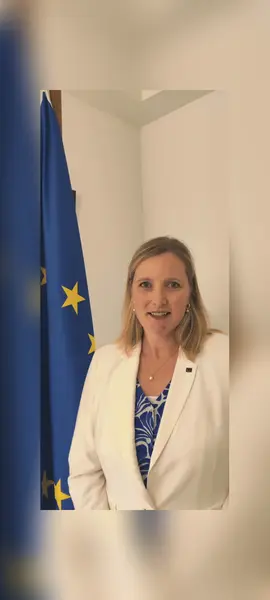
Chair of the Political and Security Committee of the European Union, Delphine Pronk has termed India, EU ties at a 'strategic high' as she highlighted how both sides are working on a range of issues like counterterrorism. Speaking to WION's Sidhant Sibal, Pronk, who is on her first visit to India in the current capacity, condemned the Pahalgam terror attack. She said the EU, "firmly condemned any terrorist attack. We need to engage in dialogue with democracies like India on counterterrorism". Asked if The Resistance Group will be listed as a terror group under EU regulation, she said, "can't preempt.." but "terrorism should be countered".
The Political and Security Committee (PSC) of the European Union is a permanent body of member states' ambassadors based in Brussels, responsible for overseeing the EU's Common Foreign and Security Policy (CFSP) and Common Security and Defence Policy (CSDP).
On Friday, members of the Political and Security Committee (PSC) met Foreign Secretary Vikram Misri, Deputy National Security Adviser Pavan Kapoor, Secretary (West) Sibi George, and other senior officials. The 30-member PSC delegation, on its first-ever visit to Asia, led by Delphine Pronk, Chair of the Committee, and included PSC Ambassadors of EU Member States along with officials from the European Commission and the European External Action Service.
WION: What has been the key highlight of your India visit?
Delphine Pronk: I am here on the maiden voyage of the members of the European Political and Security Committee. We are a Brussels-based committee with 27 ambassadors, and I'm bringing them to India because our partnership is strategic, and it's important, and it's at an all-time high. We have met with several officials, including the Secretary of Defence, Secretary of Foreign Affairs. We've met with think tanks, representatives of the defence industry, civil society organizations, and many other partners and friends, and it's really amazing to see the dynamics in our relationship. We are at a strategic high, and we're here to engage, to listen, and then also to take that back to Brussels when we are deciding on next steps.
WION: How do you see India-EU relationship?
Delphine Pronk: They're strong and they're strategic. And it's not just meetings. It is also important joint exercises, such as the one that we had with our defensive military operation EUNAVFOR ASPIDES, with our military maritime mission EUNAVFOR ATALANTA, where we work together with the Indian Navy, and it's also engaging in dialogue on matters of security and defence, and that includes counterterrorism, that includes our defence outlook, but also the discussion on the threats that we are jointly facing, such as hybrid threats and security for all of our people.
WION: Terrorism is a major concern for India, for the European Union as well. We saw the Pahalgam terror attack by Pakistani-trained terrorists. What is the European Union's view? What is your view about it, and how do you plan to strengthen the counterterror cooperation when it comes to India and the EU
Delphine Pronk: We firmly condemn any terroristic act, and that is also what we did immediately, and that is why we need to engage in a dialogue with democracies and like-minded partners, such as with India, on a strategic way forward to counterterrorism. And there are many things that we can exchange and learn from each other to make sure that for our democracies and for the safety of our people, we work together and fight terrorism. We also fight against security issues that we're jointly facing on a world stage. So that's also what we are engaging in.
Trending Stories
&im=FitAndFill=(700,400)&imwidth=180&imheight=135&format=webp&quality=medium)
What is the real meaning behind Pete Hegseth's tattoos?
&imwidth=180&imheight=135&format=webp&quality=medium)
Zohran Mamdani's Garba dance goes viral as he joins Indian community's Navratri celebrations | WATCH
&imwidth=180&imheight=135&format=webp&quality=medium)
Rafale Marine fighter begins flight trials in Goa ahead of Indian Navy induction
&imwidth=180&imheight=135&format=webp&quality=medium)
Explosions heard in Iran’s Hormozgan province near Strait of Hormuz: State media
&imwidth=180&imheight=135&format=webp&quality=medium)
Shock, anger and despair in Bangladesh over the executions
&imwidth=180&imheight=135&format=webp&quality=medium)
Russia to send first tanker carrying 40,000 tonnes diesel to US after Trump-Putin deal – What we know
&imwidth=180&imheight=135&format=webp&quality=medium)
WATCH | Mysterious haze grips Ohio city as toxic chemical leak forces mass evacuation – What is happening?
&imwidth=180&imheight=135&format=webp&quality=medium)
Kim Jong Un death rumors explode | China accused of secretly sending troops to Pyongyang
&imwidth=180&imheight=135&format=webp&quality=medium)
James Bond auction: Own Daniel Craig's Skyfall suit, Ana de Armas' dress and 300+ rare 007 collectibles
&imwidth=180&imheight=135&format=webp&quality=medium)
Trump says end to Ukraine war is 'closer than ever'; Witkoff's Putin remarks spark criticism
&imwidth=180&imheight=135&format=webp&quality=medium)
Trump waves at 'empty space' in viral video,' critics claim 'mental decline getting worse' | WATCH
&imwidth=180&imheight=135&format=webp&quality=medium)
US Midterms 2026: Sugar Land, Plano, Irving: How Texas’s Indian-American belt could shape poll outcomes
&imwidth=180&imheight=135&format=webp&quality=medium)
Macron slams Trump and other foreign leaders' 'stupid comments' on France riots as fresh protests loom
&imwidth=180&imheight=135&format=webp&quality=medium)
IND vs NZ T20Is: Will Sooryavanshi play? Skipper Shreyas Iyer clears the air on Samson vs Vaibhav debate
&imwidth=180&imheight=135&format=webp&quality=medium)
US midterms: Democrats sue Trump administration over alleged 'threats and intimidation' ahead of election, Musk issues warning to Dems
&imwidth=180&imheight=135&format=webp&quality=medium)
‘Her heart and mind in good shape’: What Helen Haines’ husband said after MP loses both legs in ‘targeted’ attack
&imwidth=180&imheight=135&format=webp&quality=medium)
Israel election 2026: Three possible scenarios after October 27 polls
&imwidth=180&imheight=135&format=webp&quality=medium)
US midterms 2026: What polls and prediction markets indicate about Congress
&imwidth=180&imheight=135&format=webp&quality=medium)
US Midterms 2026 and money: From Bloomberg to Musk, corporate donors, super PACs and lobbies, it's all about the cash
&imwidth=180&imheight=135&format=webp&quality=medium)
Ramayana promotion takes a funny turn after Ranbir Kapoor's verbal blunder, leaves fans in splits | Watch
&imwidth=180&imheight=135&format=webp&quality=medium)
US orders embassy staff, families to leave Saudi Arabia amid Houthi attacks: Report
&imwidth=180&imheight=135&format=webp&quality=medium)
Priyanka Chopra celebrates Dussehra 2026 with Nick Jonas and daughter Malti Marie | See pics
&im=FitAndFill=(700,400)&imwidth=180&imheight=135&format=webp&quality=medium)
New OTT releases this week (October 19-25, 2026): Gajab Raat to Chaar Yaar-8 titles to watch during Dussehra week on Netflix, Prime Video and more
&imwidth=180&imheight=135&format=webp&quality=medium)
US business activity grows in June, but tariffs and inflation cloud outlook
&imwidth=180&imheight=135&format=webp&quality=medium)
'I’m not saying it’s extraterrestrial' - 'Mutant' creature forces Mexicans to flee their homes
&imwidth=180&imheight=135&format=webp&quality=medium)
‘I caution the president...’: Trump’s ex-press secretary warns after Zacharia’s exit
&imwidth=180&imheight=135&format=webp&quality=medium)
Hunger makes alcohol more appealing, study finds
&imwidth=180&imheight=135&format=webp&quality=medium)
Finance influencer dies by suicide in Chennai; father accuses tech CEO, who denies charge
&imwidth=180&imheight=135&format=webp&quality=medium)
France protests: 'Block everything' movement escalates as public fury over austerity grows; over 200 arrested. Here's all you to need to know
&imwidth=180&imheight=135&format=webp&quality=medium)
Kolkata airport: CISF detects ₹1.13 crore in US dollars hidden in bags of 2 Bangkok-bound passengers
&imwidth=180&imheight=135&format=webp&quality=medium)
Feds obtain DNA evidence that could prove Ilhan Omar married her brother: Report
&imwidth=180&imheight=135&format=webp&quality=medium)
US midterms 2026: Trump's approval rating hits record low as Democrats gain ground
&imwidth=180&imheight=135&format=webp&quality=medium)
Turkey, Qatar, Pakistan and Indonesia sign 'Badr' defence cooperation pact in Doha
WION: Has the EU considered designating The Resistance Group as a terrorist organization, like the US did?
Delphine Pronk: I cannot preempt what the decision of 27 sovereign nations is for specific listings. But we are very clear in our firm and principled position that terrorism should be fought. It should be countered. We have on several levels this engagement and dialog. There was a high-level Indian delegation in Brussels last week. So for sure, those conversations will continue, also between diplomats and those who are technical work colleagues, to further that dialogue.
WION: War happening in Ukraine, this is something that is on top of the mind of every European policymaker and the people now, how do you see India's position on that? India has been reiterating its stance on dialogue & diplomacy. So how do you see India's stance? What kind of conversation are you having with the Indian side?
Delphine Pronk: Well, what is clear is that for the past three and a half years, we have seen a full-fledged, unprovoked and unjustified Russian invasion in Ukraine. We should not forget that this was an invasion into a sovereign nation where territorial integrity is contested and where national sovereignty is not being respected. India and the EU are the biggest democracies in the world, and we are also strong defenders of the UN Charter, which has territorial integrity and national sovereignty at its heart. So we should call out aggression when we see it happening. And this is not just a European issue or Ukrainian issue. This affects the world order and world peace as we want it and as we know it. No one wants peace more than the Ukrainians. They have been under constant attack for the past three and a half years, and also what we witnessed last week was a very serious and gross violation of the European airspace, with the Russian drones entering into our safe and secure skies. So this is something that is not just a particular European issue. It affects our security, and we ask for partners such as India to make sure that we're working towards a just and sustainable peace. The only one who will be able to also show that he is serious about that is President Putin. But up to now, his acts have not shown that he is serious, despite many high level conversations, many high level engagements to ensure a just and sustainable peace for Ukraine and therefore also for our continent, those are conversations that we're having also with Indian high level officials. And I think we're seeing eye to eye that peace security are essential elements of our partnership, and to make sure that we uphold the international rules-based order.
WION: Shifting focus from Europe to the Indo-Pacific, you're seeing a pivot towards the Indo-Pacific region. How important is India in that context, and to what extent is it a topic of discussion?
Delphine Pronk: India is a key partner in our Indo-Pacific strategy and in our policy and dialog. We have had a very firm and committed strategy to the Indo Pacific because all these theatres are extremely interconnected. Our latest military naval operation, Operation Aspides, is also doing just that to secure the safe passage of consumer ships that are going from one part of the world to another part of the world. So we're engaging with partners in the Indo Pacific. Very soon, in Brussels, we will host the fourth ministerial Indo Pacific dialogue. We also hope that the Indian Foreign Minister will accept the invitation of the high representative to be there, because it is important to showcase that we have many interests and many values that bring us together in the Indo Pacific that is such a strategic area of interest and concern for us both.
WION: My last question to you is how both sides are cooperating in areas like misinformation, hybrid threats. We've already talked about the maritime domain as well. But what's the future like? And perhaps you can end the interview with your own perspective, given the fact that the next four or five months will be significant for India-EU relationship, culminating in the big summit.
Delphine Pronk: It's not just hard military power that we see at our European borders. It is indeed also the hybridity of threats that are destabilising our democracies. It is foreign information and manipulation of information, it is cyberattacks, and it's all of those domains that we see that there is really a momentum now to engage and to take the EU India relationship forward. For that, the 27 EU member states that I also brought to India on this very intense and useful, fruitful working visit, to Brussels, decide on next steps, and that could include a Security of Information Agreement, because trust between partners is essential when we work on sensitive topics like defence and security. And that could then also lead to India's participation in our permanent structured cooperation, but also to what is in the making a Security and Defense Partnership, I cannot preempt the decision of the 27, but our working visit this week and the high level engagements that we have, for sure, will help us also in a better understanding of each other's position.
