

&imwidth=800&imheight=600&format=webp&quality=medium "Is protesting fundamental right in India? Decoding all rights and restrictions as per the law: EXPLAINED")
The right to peaceful protest plays a significant role in Indian democracy, serving as a vital mechanism for citizens to express dissent and hold institutions accountable without violence. However, under the legal framework of India, the right to demonstrate is not unfettered and must be exercised within specific constitutional bounds.
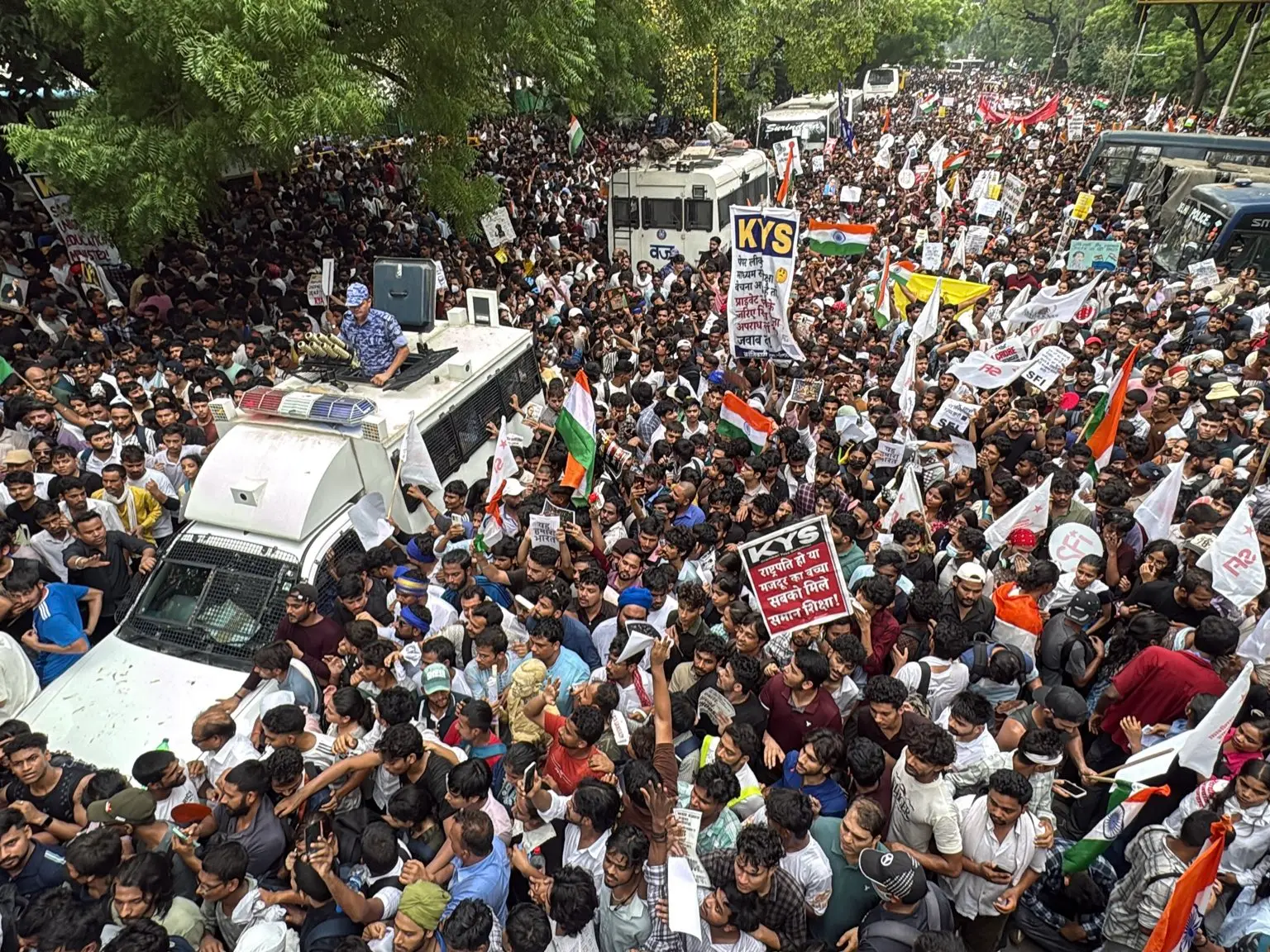
The topic related to protest came to trend on the internet after a massive protest erupted at Jantar Mantar by an outfit, Cockroach Janta Party (CJP), which was born as a satirical platform on social media. The members of CJP formed a group and started their demonstration at New Delhi's Jantar Mantar demanding the resignation of the Union Education Minister.
The development unfolded after the NEET UG paper was leaked after the examination was held in May this year. Since then, several students and their families have demanded greater accountability from the government, as at least 21 students have died by suicide after the paper leak. The re-test was conducted late last month.
Is protesting a fundamental right in India?
The Constitution of India does not explicitly mention a standalone "Right to Protest." Still, the Supreme Court has repeatedly held that it is an implicit Fundamental Right derived from Article 19: Article 19(1)(a) guarantees the Freedom of Speech and Expression, enabling citizens to publicly express dissent and communicate grievances. And Article 19(1)(b) guarantees the right to Assemble Peaceably and Without Arms, laying the legal foundation for rallies and public meetings.
This right is not absolute. Under Article 19(2) and Article 19(3), the State can impose reasonable restrictions in the interest of the sovereignty and integrity of India, security of the State, public order, decency, or morality and preventing incitement to an offence or causing public nuisance. However, protesters do not have the right to block public thoroughfares indefinitely or cause public nuisance. In response, authorities can enforce regulatory measures (like Section 144) to prevent breaches of peace or imminent danger.
Trending Stories
&imwidth=180&imheight=135&format=webp&quality=medium)
Finance influencer dies by suicide in Chennai; father accuses tech CEO, who denies charge
&imwidth=180&imheight=135&format=webp&quality=medium)
450 villagers in UP rush to take anti-rabies shots after consuming 'charnamrit'
&im=FitAndFill=(700,400)&imwidth=180&imheight=135&format=webp&quality=medium)
New Friday OTT releases (October 23, 2026): Gajab Raat, Dorothy, Chaar Yaar- Watch these 6 new movies and TV shows on Netflix, Prime Video and more
&imwidth=180&imheight=135&format=webp&quality=medium)
Trump ordered to answer questions under oath in BBC defamation lawsuit by December 11
&imwidth=180&imheight=135&format=webp&quality=medium)
ENG vs SL: Harry Brook breaks Shubman Gill’s record for fastest ODI double century
&imwidth=180&imheight=135&format=webp&quality=medium)
US midterms 2026: US Supreme Court allows New Hampshire to restrict student IDs for voting
&imwidth=180&imheight=135&format=webp&quality=medium)
US to get 850 F-35 stealth fighter jets under 10-year Pentagon-Lockheed deal
&imwidth=180&imheight=135&format=webp&quality=medium)
Ilhan Omar breaks silence over alleged marriage to her brother; Trump thinks it's 'really good answer'
&imwidth=180&imheight=135&format=webp&quality=medium)
Did Neha Bora call for Bangladesh-like GenZ protest, 'anarchy' in India? WION Fact-checks viral claim
&imwidth=180&imheight=135&format=webp&quality=medium)
Netanyahu dials PM Modi, invites him and Capt Smit Machchhar to light torch on Israel’s Independence Day
&imwidth=180&imheight=135&format=webp&quality=medium)
What is the ‘heat ray’ weapon? Pete Hegseth reportedly authorises DHS to test it at US-Mexico border
&imwidth=180&imheight=135&format=webp&quality=medium)
Two BrahMos missiles on Tejas, triple the range and 100% indigenisation, says former BrahMos CEO
&imwidth=180&imheight=135&format=webp&quality=medium)
GRAVITAS | Putin fires nuclear-capable hypersonic missiles, Zelensky ready to surrender 25% territory
&imwidth=180&imheight=135&format=webp&quality=medium)
US midterms 2026: Elon Musk’s political spending hits $445 million as Republicans battle to retain Senate control
&imwidth=180&imheight=135&format=webp&quality=medium)
Horrific video shows the moment 18-year-old fell to her death from Mexico amusement park ride
&imwidth=180&imheight=135&format=webp&quality=medium)
Christa Pike's failed execution: Tennessee team struggled to insert IV lines, lawyer says
&imwidth=180&imheight=135&format=webp&quality=medium)
India-China face-off continues near Arunachal’s Taksing, reveals ITBP chief in first official confirmation of tensions
&im=FitAndFill=(700,400)&imwidth=180&imheight=135&format=webp&quality=medium)
Serbia elections: Nearly 150,000 people take to streets in massive rally against Aleksandar Vucic | In pics
&imwidth=180&imheight=135&format=webp&quality=medium)
AI slop or smart strategy? South African author Coral Hart defends Her 370 AI- assisted books in 20 months
&imwidth=180&imheight=135&format=webp&quality=medium)
Watch: India rejects ‘imprecise and unsupported’ references in UN migrant rights report
&imwidth=180&imheight=135&format=webp&quality=medium)
'This is despicable': Amy Acton hits back at Vivek Ramaswamy over Ohio campaign ad featuring her estranged mother
&imwidth=180&imheight=135&format=webp&quality=medium)
China's dancing robot turns violent bodyguard, lifts cars and fights intruders - Watch
&imwidth=180&imheight=135&format=webp&quality=medium)
From Agni-V to Project Kusha: How are India’s indigenous missile systems and defence shield reshaping modern warfare
&imwidth=180&imheight=135&format=webp&quality=medium)
One man, 8 months of work, and a river dirty again: Why Bittu Tabahi may quit
&imwidth=180&imheight=135&format=webp&quality=medium)
Saudi Arabia targeted yacht carrying 14 Indians in Red Sea, rescue underway, Houthis claim
&imwidth=180&imheight=135&format=webp&quality=medium)
SA vs AUS 2nd Test: Temba Bavuma reveals 'Tendulkar inspiration' behind career-best 179
&imwidth=180&imheight=135&format=webp&quality=medium)
France reports first human case of livestock virus Shamonda, patient dies; what we know so far
&imwidth=180&imheight=135&format=webp&quality=medium)
WATCH: Trump demands Ilhan Omar removal from Congress for 'using fake name to be sworn in'. So what is her real name?
&imwidth=180&imheight=135&format=webp&quality=medium)
ENG vs SL: Harry Brook’s 202 goes in vain as Sri Lanka pull off second-highest ODI chase
&imwidth=180&imheight=135&format=webp&quality=medium)
Viral video shows cross falling on Colombia priest, no official confirmation | WATCH
&imwidth=180&imheight=135&format=webp&quality=medium)
BCCI’s CoE cautious over Hardik Pandya’s fitness, sets expected comeback timeline
&imwidth=180&imheight=135&format=webp&quality=medium)
'Vivek should keep it up': Trump defends Ramaswamy's controversial campaign ad targeting Amy Acton
&imwidth=180&imheight=135&format=webp&quality=medium)
Putin says Russia is ready to resume Ukraine-US peace talks but rejects 'short ceasefire' amid deadly attacks
&imwidth=180&imheight=135&format=webp&quality=medium)
A secret code, a midnight escape and 300 deaths: The Russian officer who turned on Putin
&imwidth=180&imheight=135&format=webp&quality=medium)
Meghan Markle’s father Thomas under investigation over alleged child abuse images: Report
&imwidth=180&imheight=135&format=webp&quality=medium)
'It's a crime not to see this scene': Tehran puts Trump 'behind bars'
Distinction between peaceful protest and Civil Disobedience
Peaceful Protest
In a peaceful protest, people are protected under the Constitutional Right Article 19, which operates within the boundaries of the law (e.g., getting police permissions, gathering at designated spots, shouting slogans peacefully). In this development, the State/Police are constitutionally bound to facilitate and protect the gathering, subject to public order safety.
Civil Disobedience
This development involves the deliberate and intentional breaking of specific laws or orders (e.g., defying curfew, refusing taxes, blocking railways) as a form of moral resistance. It involves a conscientious breach of a rule to highlight an injustice, with the protester accepting the legal consequences.
Why is police permission required?
In the landmark Himat Lal K. Shah v. Commissioner of Police (1973) case, the Supreme Court ruled that requiring prior police permission to hold public meetings on public streets does not abridge the fundamental right of assembly. Instead, it acts as a regulatory measure: To prevent total gridlock, manage crowd density, and ensure emergency services (ambulances, fire engines) remain unaffected, the next step is to assess threat perception and prevent clashes between rival political or social groups.
Organisers must obtain a No Objection Certificate (NOC) or formal permit detailing the rally route, duration, and expected headcount from the relevant District Magistrate (DM) or Commissioner of Police.
Can police detain protesters?
Yes, Indian police can legally detain peaceful protesters under specific circumstances, even though the right to assemble peacefully is a fundamental right under Article 19(1)(b) of the Indian Constitution.
Preventive Detention: Under criminal procedure codes, police officers can detain individuals if there is a credible apprehension that they might commit a cognisable offence or disrupt public peace.
Unlawful Assembly: If a protest proceeds without valid permissions or continues after a dispersal order, participants can be detained for joining or continuing in an unlawful assembly.
Procedural Guarantees: Any detained protester retains fundamental protections under Article 22, including the right to know the grounds of arrest, consult a legal practitioner, and be produced before a magistrate within 24 hours.
Under what circumstances can prohibitory orders be imposed?
Prohibitory orders restrict public assembly and are primarily issued under Section 144 of the Code of Criminal Procedure (CrPC) (or corresponding provisions under the Bharatiya Nagarik Suraksha Sanhita, 2023 / BNSS).
Circumstances for imposition include:
A District Magistrate, Sub-Divisional Magistrate, or authorised Executive Magistrate can issue prohibitory orders when there is: An immediate, urgent threat of nuisance or apprehended danger and a risk to human life, health, or safety.
Is there a legal right to protest specifically at Jantar Mantar?
Yes, but subject to strict executive regulations. Historically, Jantar Mantar in New Delhi became a core designated protest zone. However, the law does not guarantee the right to protest at any location or without permission. To protest at any location in India, organisers must typically submit a formal application or letter to the local Deputy Commissioner of Police (DCP) several days in advance detailing the purpose, expected headcount, and duration of the demonstration.
In 2017, the National Green Tribunal (NGT) ordered a total ban on all protests there due to severe noise pollution and disturbance to nearby residents.

