
&imwidth=800&imheight=600&format=webp&quality=medium "India ranks 5th in Global Digital Economy, 4th in AI, but a capital gap threatens its ambitions: SIDE-26 report")
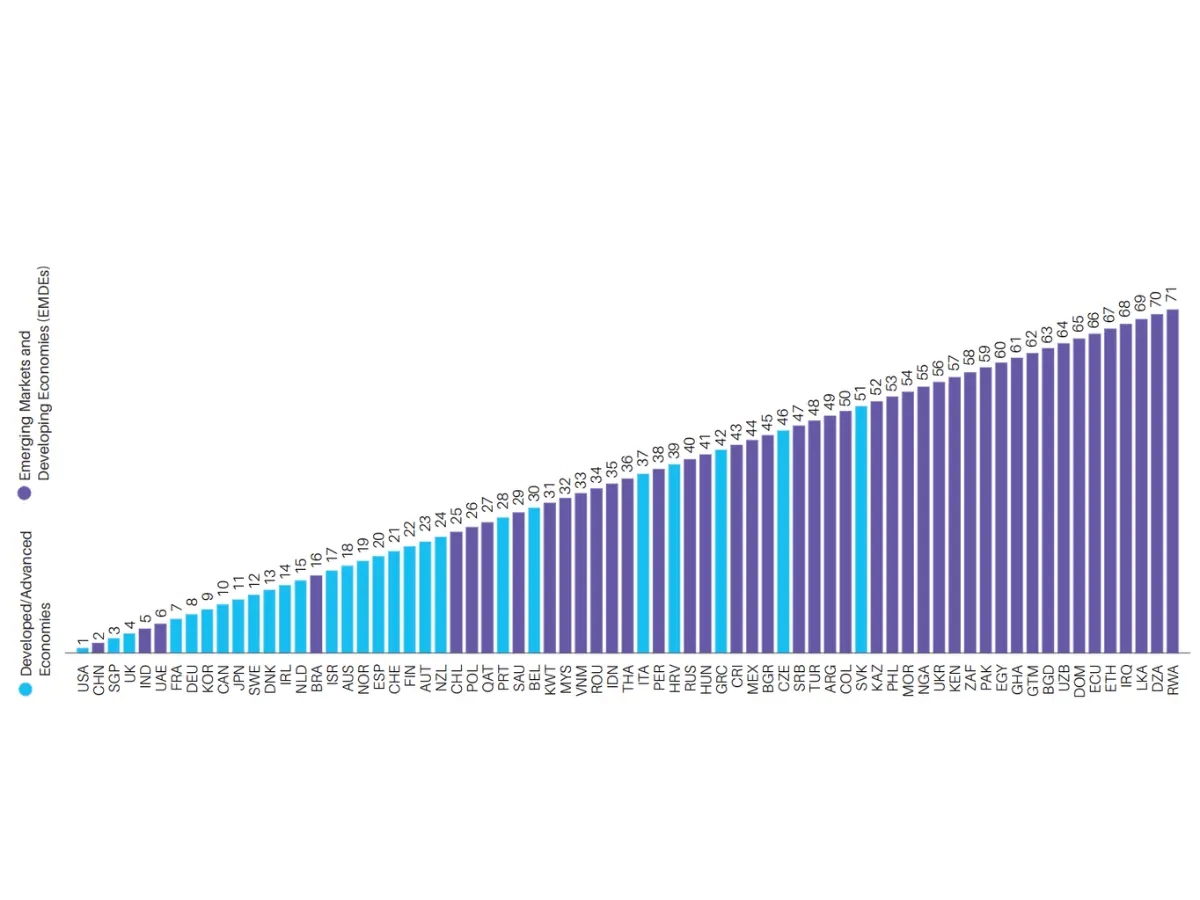
India has climbed to the fifth most digitalised economy in the world and secured the fourth position in a standalone artificial intelligence index, outpacing Germany, France, Japan, Canada, and South Korea in AI performance, according to the State of India's Digital Economy (SIDE) 2026 report released Thursday by the ICRIER-Prosus Centre for Internet and Digital Economy.
The rankings, drawn from a 71-country benchmarking exercise covering 96 per cent of global GDP, mark a three-place jump from India's eighth position in 2025. But the report, while broadly affirming India's digital momentum, contains findings that complicate the headline numbers, and the most consequential of them has nothing to do with rankings.
India commands 26 per cent of global AI users. It attracts just 1 per cent of global private AI investment.

That gap, between the scale of India's digital footprint and the capital flowing into it, is the structural tension at the heart of what the report calls India's "defining challenge."
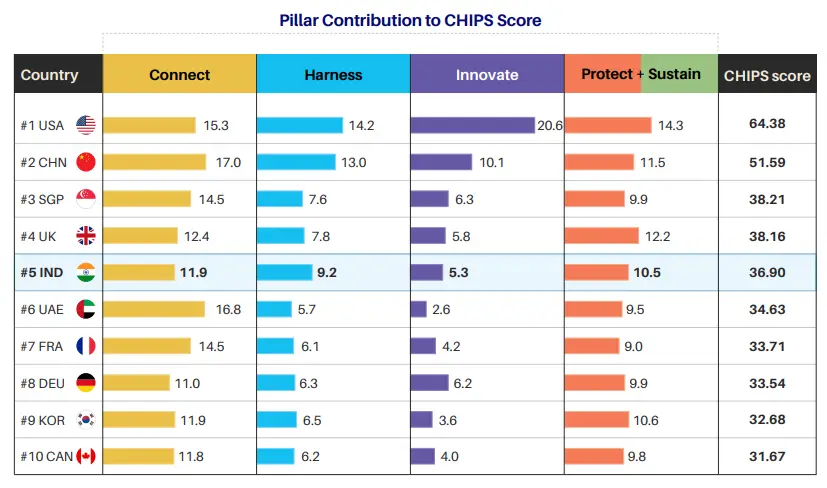
Top 10 Countries; India sits 5th globally, but its innovation score trails every country above it. Source credit: IPCIDE Team, State of India's Digital Economy 2026
Trending Stories
)
Putin's United Russia party wins 355 seats in Duma election; 4 other parties cross threshold to enter parliament
)
Delhi Air pollution: Strict crackdown on waste burning
)
‘0% chance’: Nvidia CEO Jensen Huang dismisses AI extinction fears by 2030
)
Samay Raina-Mukesh Chhabra controversy explained: What happened over girlfriend joke on India's Got Latent?
)
Trump's helipad event overshadowed by audio failure as major TV networks suspend pool coverage
)
Russia-Ukraine war: Russian strikes knock out three of Ukraine's largest steel plants
)
'Needs time away from the international scene': England white-ball captain Brook on pacer Brydon Carse's future
)
Glitch in the matrix caught on camera: Woman vanishes after talking to reporter
)
Anti-AI activists storm summit, say 'incompetent' leaders are leading us into a disaster - 'We need a vote'
)
Samsung raises Galaxy S26 prices by Rs 20,000: Here’s what each model now costs
)
IIT Bombay tensions ease after three-hour open house; director’s assurances pacify students
)
J&K Assembly Session begins amid chaos: BJP, ruling alliance clash as statehood demand dominates
)
Bessent meets China’s He Lifeng to prepare for Trump-Xi summit
)
US and China vie for AI dominance as calls grow for regulation | Gravitas
)
FIFA chief Infantino wants to reform governing body with consultation from federations
)
The Verdict | The Mecca Agreement is under scrutiny as Houthis attack Saudis
)
India at UNGA81: Jaishankar warns global order under 'growing stress', pushes for ‘reformed multilateralism’
)
Saudi Arabia exits China-led mBridge digital currency platform amid Saudi-Houthi conflict
)
'Lot of things to learn from experienced players': Jayasuriya backs Rohit, Virat for 2027 ODI World Cup
)
$110 billion Warner Bros merger: Paramount reaches settlement with 12 US states
)
Mahabharat actor Saurav Gurjar arrested in Hyderabad, sent to 14-day judicial custody in sexual exploitation case
&im=FitAndFill=(700,400))
New OTT releases this week (September 21-27, 2026): Shaque: Trust No One, Hunkkaar, Don’t Be Shy- 5 new titles coming to Netflix, Prime Video and more
)
From ‘communist’ to ‘great mayor’: Trump praises Mamdani after New York meeting, discusses immigration and housing
)
Report: Zelensky meets CIA chief Ratcliffe at Shannon airport, weeks after his secret Moscow trip
)
WATCH | Mysterious lights over Tehran caught on video. Drone, aircraft or something else?
)
How Zaheer Khan came to be CSK's head coach of IPL 2027
)
Pilot recreates Mona Lisa in sky over Oklahoma and Arkansas in four-hour flight: VIDEO
)
UK PM Burnham agrees to 'defensive' military support for Saudi Arabia against Houthis
)
Jailer 2: Vidya Balan joins Rajinikanth's upcoming film as Kantha | Watch
)
Microsoft executive called AI training the ‘largest theft of labour in human history’
)
IIT Bombay student death: CCTV footage becomes key evidence as police reconstruct Sahil Wakode's final hours
)
40-foot waves crash into cruise ship in dangerous stretch near Antarctica. Watch
)
US-Iran war, peace deals and more: What to expect from Trump's UNGA 2026 speech
)
Explainer: Why rare-earth export licences and Board of Trade are US priorities ahead of Trump-Xi summit
)
BTS fans mock iHeartRadio’s day 2 turnout after short set controversy
)
Two infants die after fire breaks out at RIMS newborn care unit in Telangana's Adilabad
)
The Scandal: Why so scandalous? Ji Chang Wook leaves you gasping for air
Where India genuinely leads
The AI talent story is real and the numbers support it. India holds the world's second-largest concentration of AI talent after the United States. On relative AI skills penetration, a measure of how widely AI capabilities are distributed across occupations, India ranks first globally as of March 2026, and its lead over the US is widening.
On public trust in AI, India scores 83.4, the highest among the top four AI nations. Singapore scores 55.6. China 33.0. The United States has no available score on this indicator. In an era where AI deployment is increasingly a governance challenge, not just a technical one, that is not a trivial number.
India's digitally delivered trade figures are, by any measure, exceptional. At USD 328 billion, India is the world's fourth-largest exporter of digitally delivered services, after the United States, the United Kingdom, and Ireland, despite being a lower-middle-income economy. Most developing countries of comparable income levels are net importers of digital services. India built a globally competitive IT and business services sector over decades, and that structural advantage is now showing up directly in trade data.
India also accounts for 19.9 per cent of global AI users, second only to China's 20.5 per cent, with the United States at 8.1 per cent. The report notes that China and India together account for nearly two-fifths of all AI users worldwide, a concentration that is reshaping how the technology diffuses globally.
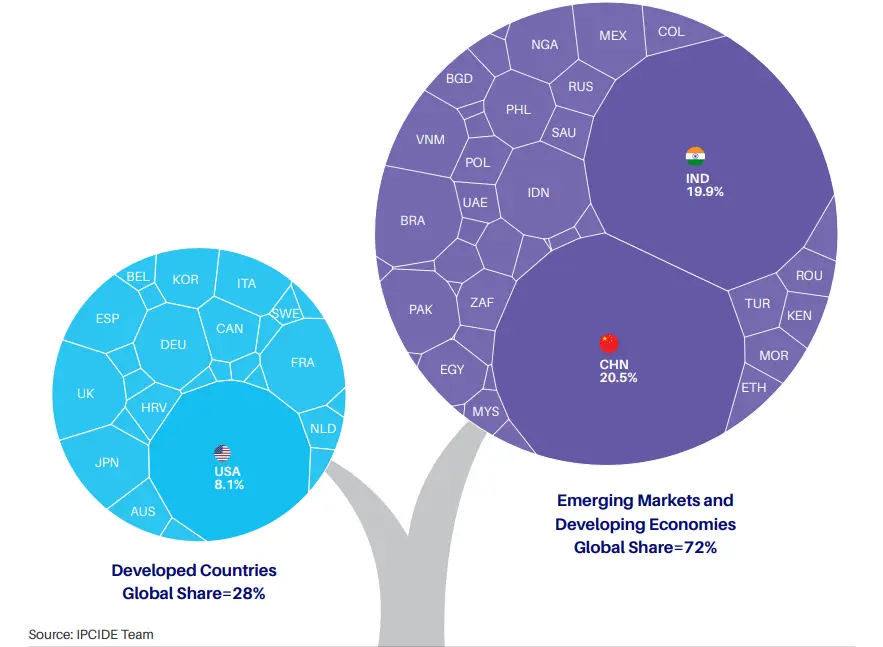
India and China together own nearly 40% of all global AI users, dwarfing the entire developed world. Source credit: IPCIDE Team, State of India's Digital Economy 2026
Where the numbers demand scrutiny
The improved ranking needs to be read carefully. The report's authors acknowledge that part of India's jump reflects methodological changes between the 2025 and 2026 editions, an expanded country sample that improved India's scores on indicators like download speeds, and the exclusion of gender divide and fintech indicators where India has historically underperformed. Year-on-year comparisons are, in the report's own words, to be "interpreted with some caution."
That caveat matters. India's connectivity ranking within the 71-country sample is 11th, behind the UAE, Qatar, China, Brazil, and several smaller advanced economies. The depth and quality of digital access for the average Indian user remains significantly below advanced economy standards. On the Protect and Sustain pillar, covering cybersecurity preparedness, digital crime exposure, and environmental sustainability, India ranks 32nd, its weakest showing across all five assessment pillars.
Online financial crime and digital fraud are described in the report as among the most commonly reported forms of crime in India. Cybersecurity spending stands at USD 3,060 million, modest for an economy with India's digital scale. India recorded 137 enterprise ransomware victims in 2025 and accounts for 10 percent of G20 email leaks despite representing 31 percent of G20 population. The exposure is rising faster than the protection.
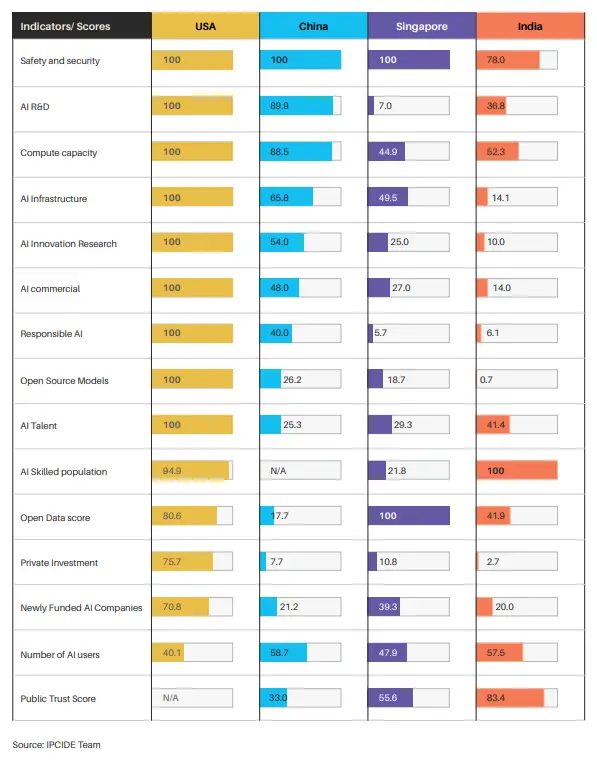
India scores 100 on AI skilled population, and 0.7 on open-source models. The same table tells both stories. Source credit: IPCIDE Team, State of India's Digital Economy 2026
The capital problem
The AI investment numbers are stark. India attracted USD 1,160 million in private AI startup investment. The United States attracted USD 109,080 million. China attracted USD 9,290 million. India's figure is lower than South Korea, Canada, France, Germany, the United Kingdom, Sweden, and the UAE.
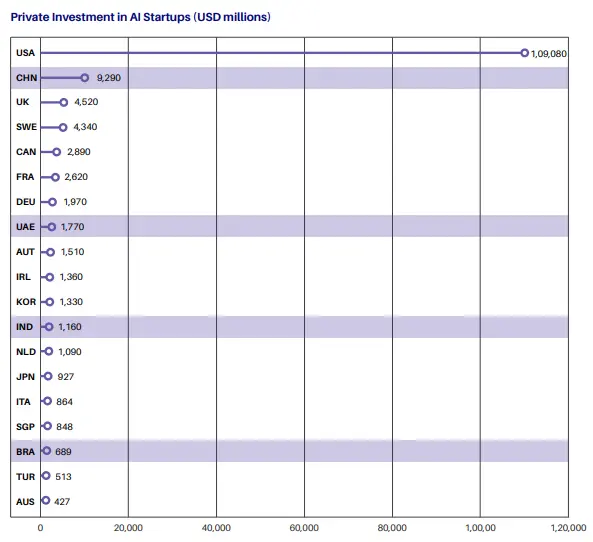
The US attracted USD 109 billion in AI investment. India attracted USD 1.1 billion. This bar chart is the capital gap made visible. Source credit: IPCIDE Team, State of India's Digital Economy 2026
The report places India squarely in what it calls the "limited start-up capital, but strong talent base" quadrant, a position that has strategic implications. The AI supply chain, as the report describes it, is a five-layer stack: energy, infrastructure, compute, models, and applications. The first four layers are capital-intensive. India's comparative advantage sits almost entirely in the fifth, applications, and in the talent that feeds it.
That is not without value. The report argues that the next wave of AI, driven by applications and agents rather than frontier model development, should play to India's strengths. But talent without capital, compute access, and strong university-to-startup pipelines produces exactly the kind of structural stagnation that the data already hints at; world-class engineers building products funded largely by foreign capital, on foreign infrastructure, using foreign models. WION earlier reported on India’s AI infrastructure reality in a separate report in February this year.
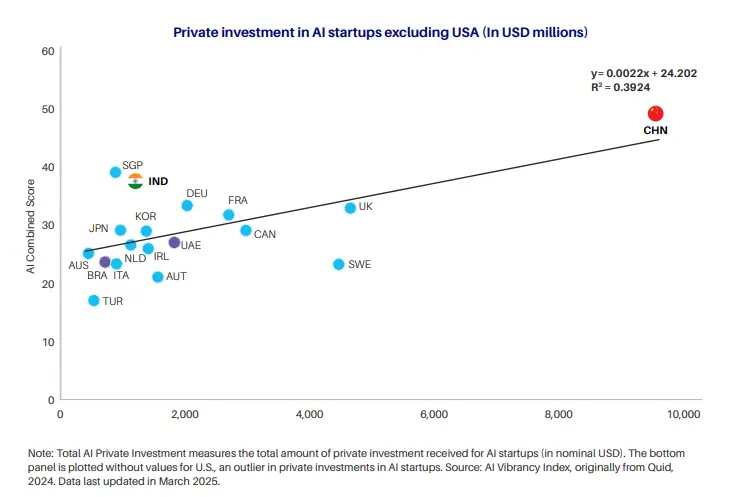
Source credit: IPCIDE Team, State of India's Digital Economy 2026
The broader picture
The report frames the global digital order as increasingly tripolar: the United States, a cluster of Indo-Pacific economies led by China and Singapore, and a declining North Atlantic bloc. India's fifth-place ranking places it inside that emerging bloc. Three of the world's top five digital economies, China, Singapore, and India, are now from the Indo-Pacific.
That is a genuine structural shift and India's position within it reflects real gains in connectivity, digital public infrastructure, and AI adoption. The USD 328 billion in digitally delivered trade is not a benchmark number; it is the output of decades of institutional capability-building that no other developing economy has replicated at comparable scale.
But the report is unambiguous on what comes next. Expanded compute access, mobilised risk capital, stronger university-startup linkages, shared datasets, and clearer commercialisation pathways are not aspirational additions to the India growth story. Without them, the gap between where India ranks and what India captures from the AI economy will continue to widen.
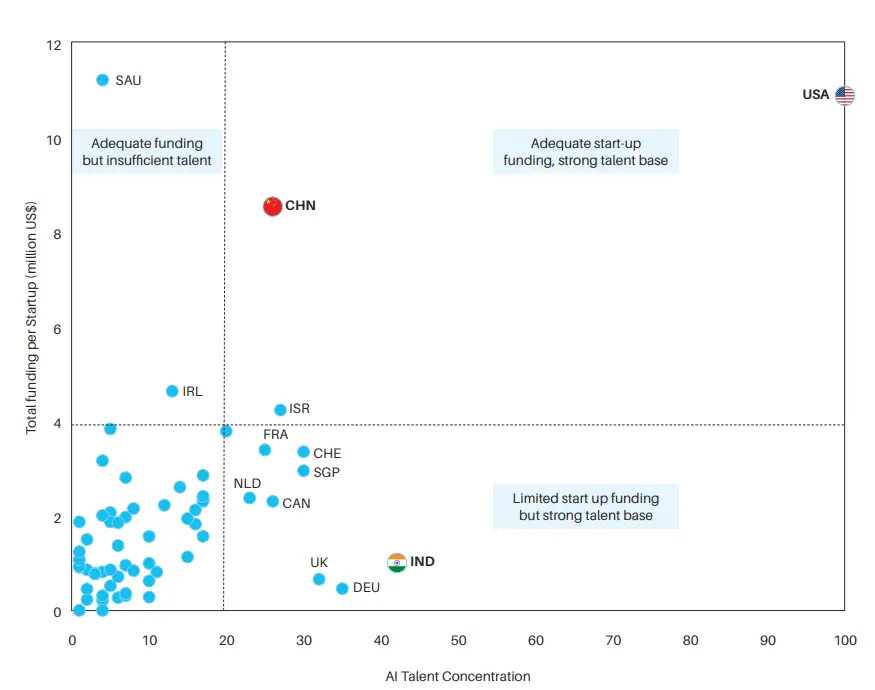
World-class talent, barely any startup capital, India's AI positioning in one scatter plot. Source credit: IPCIDE Team, State of India's Digital Economy 2026
The rankings are a reason to take stock but the 1 percent investment share is a reason to worry.
