

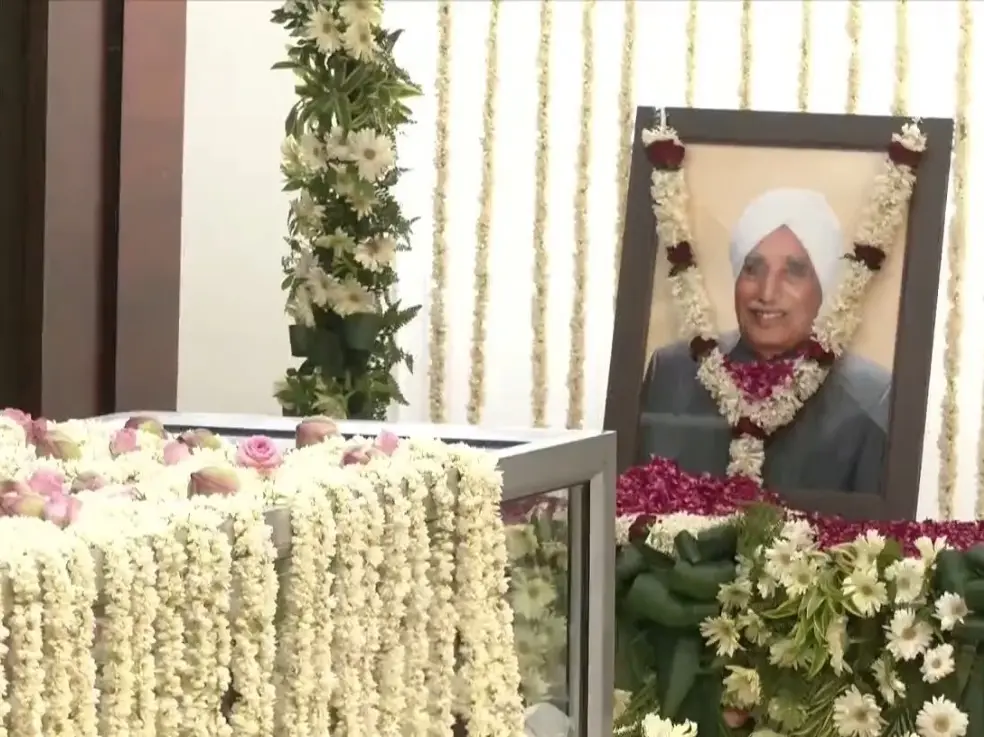
&imwidth=800&imheight=600&format=webp&quality=medium "Dr Subhash Chandra performs last rites of father Nand Kishore Goenka, announces Rs 100-cr university in his memory")
Essel Group Chairman Dr Subhash Chandra on Wednesday (July 15, 2026) performed the mukhagni (funeral rite) for his father, veteran industrialist and philanthropist Nand Kishore Goenka, who died in Mumbai on July 13. Goenka's last rites were performed at Goenka Udyan in Agroha Dham, located in the Hisar district of Haryana.
Addressing people at Goenka Park, after the funeral rites, Dr Chandra announced that a university named after Nand Kishore Goenka will be established to carry forward his legacy. He said the university will be built on 32 acres of land at an estimated cost of Rs 100 crore.
"We have decided to build a university in Goenka Ji's name on 32 acres of land. It will cost around Rs 100 crore. To ensure that his legacy continues, we will introduce courses focused on social service and contributing to society," Dr Chandra said.
Social service and giving back at the heart of the university's vision
Dr Chandra outlined the vision for the upcoming university, saying it will carry forward his father's lifelong commitment to philanthropy through a dedicated academic programme.
Trending Stories
The university will introduce a specialised course on "Social Service and Giving Back to Society", aimed at encouraging students to contribute to community welfare and uphold the values that guided Shri Goenka's life.
He also said the institution will be established in collaboration with the Entrepreneurship Development Institute of India (EDII), Ahmedabad, under a strategic agreement signed by both sides.
"Our entire family is blessed to have been born to such a noble soul. Agroha is not only a sacred land for the entire Agrawal and Vaishya communities, but it has also sent powerful messages of inspiration across India and the world.
Because this region is deeply connected with business, my brothers and I decided to channel resources here. We have signed a strategic agreement with the Entrepreneurship Development Institute of India (EDII), Ahmedabad, to establish this university. It will sit on 32 acres of our family land and will cost around ₹100 crore. Additionally, to carry forward Shri Goenka's legacy of service, we will introduce a dedicated course focused on social service and community welfare."
What is the history of Agroha Dham?
Construction of Agroha Dham began in 1976 and was completed in 1984, and it is dedicated to Goddess Mahalakshmi and Maharaja Agrasen. The site extends across nearly 300 bighas, housing the Shakti Sarovar and magnificent temples. Over the years, it has developed into a centre for education, healthcare and cultural advancement.
Nand Kishore Goenka has played a key role in the construction and development of Agroha Dham, the historic town associated with Maharaja Agrasen, and is widely credited for his invaluable contribution. His last rites were also performed at Goenka Udyan within Agroha Dham.
Bajrang Das Garg, a leader of the Vaishya community and a close associate of the Goenka family, told the media, "Shri Nand Kishore Goenka was one of the principal founders of Agroha Dham. As a patron of the Vaishya community, he made historic contributions to the development of several social and religious institutions in Hisar as well as across the state of Haryana."
Goenka was among the key individuals associated with the establishment and expansion of this religious site. Through his efforts, Agroha Dham gained recognition not only across India but also among the Agrawal community living abroad. He also made notable contributions in the fields of education and social development in Hisar. He also served as the patron of the Shri Devi Bhawan Mandir Gaushala Trust and held the responsibilities of President and Patron of the Shri Vaishnav Agrasen Gaushala.
Agroha, which was established as the capital of Maharaja Agrasen, had been a centre of trade and prosperity since ancient times. Following the invasion by Muhammad Ghori in 1194, Agroha Dham became deserted. Efforts to rebuild and redevelop the site began again in 1907. In 1907, Saint Brahmanand Brahmachari arrived in Agroha, and in 1908, he inspired the Agrawal community to establish the "Agrawal Darbar." Later, in 1976, a resolution for the revival of Agroha was passed at the All India Agrawal Representatives Conference.

