
&imwidth=800&imheight=600&format=webp&quality=medium "What’s inside the $34 billion India–UK free trade deal?")
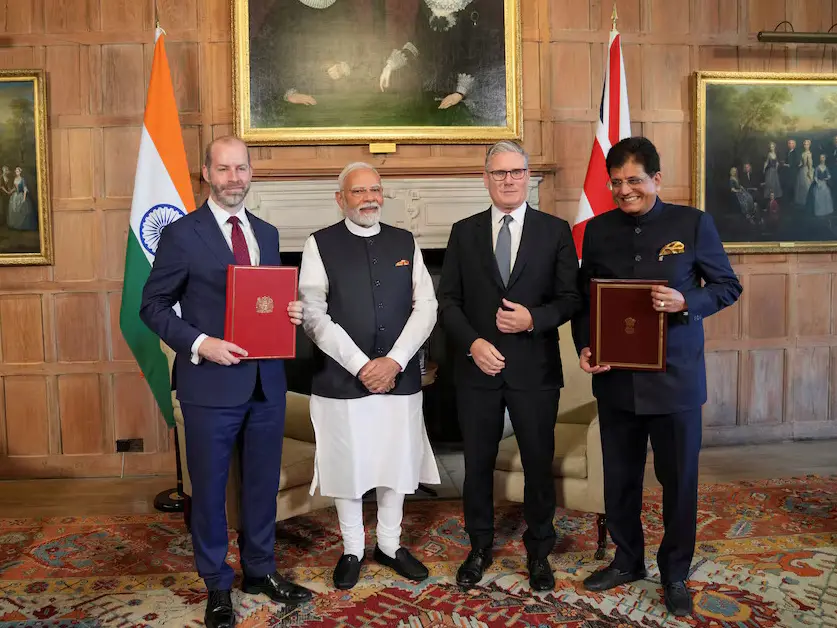
In a major diplomatic show off, India and the United Kingdom have finalised their long-awaited Free Trade Agreement (FTA), marking a historic shift in both nations’ post-pandemic economic strategy. The deal which was signed in London by Indian Commerce Minister Piyush Goyal and UK Business Secretary Jonathan Reynolds, is being touted as the UK’s largest post-Brexit trade pact and India’s most significant bilateral trade agreement in over a decade.
So, what exactly is in the deal? Who stands to benefit the most? And why is this agreement being described as a strategic milestone beyond just trade?
All about $34 billion deal

At the heart of the deal lies a sharp ambition, first is to add over ₹2.86 lakh crore ($34.3 billion) to annual bilateral trade. British officials estimate it could inject up to £4.8 billion ($6.2 billion) into the UK’s GDP. For India, the agreement opens up new gateways for goods, services, and labour mobility in one of Europe’s richest markets. Both governments are framing this FTA as a partnership of equals, one designed to fuel growth, investment, and political trust.
Prime Minister Narendra Modi hailed the agreement as a “defining moment” for India’s global trade strategy. “This deal reflects India’s commitment to rules-based international trade and deepens our economic partnership with a trusted democratic partner,” he said while addressing the press after signing the historic deal.
On the other hand, UK Prime Minister Keir Starmer called it a “major win for British jobs, exports, and future growth,” adding that the agreement “symbolises a new era of collaboration with India, rooted in fairness and opportunity.”
Trending Stories
)
Woman removes all her clothes on American Airlines flight, performs 'indecent acts'; arrested
)
Turkish Airlines plane flies through a storm three times, triggering severe turbulence
)
'Huge destructive power': North Korea calls its latest missile launches 'live-fire drill' even as US dismisses 'immediate threat'
)
‘Let’s go’: Newly declassified videos show dramatic rescue of US Air Force officers downed in Iran
)
Natural caffeine sources gain popularity; matcha & botanicals offer calm energy
)
Veteran Bollywood actress Nafisa Ali shares health update as Stage 4 cancer progresses, starts targeted therapy
&im=FitAndFill=(700,400))
New OTT releases this week (September 14-20, 2026): Lust Stories 3, Waiting Hai, Irumudi- 5 new titles coming on Netflix, Prime Video and more
)
NEET-UG to move to computer-based test soon, NTA DG says ‘CBT is the future’
)
Did India risk its US trade deal despite softer stance at BRICS?
)
Ganesh Chaturthi 2026: Devotees throng the iconic Lalbaugcha Raja pandal in Mumbai
)
Practical Magic 2 breaks Spidey spell over North American box office
)
Did China give Iran intel before US base strike that killed 3 troops? Trump says, 'You’re right...'
)
China discovers vast gold and silver 'mine' in the Pacific with unheard-of deposits
)
Plane carrying prominent figure crashes at Libya’s Misrata airport: Report
)
'Nobody knows if it can be in control': ‘Godfather’ of AI, China spy chief back AI slowdown calls, flags political threat
)
800 million years old - Scientists discover 'fingerprints' of supercontinent Gondwana in ancient rocks
)
Orlando Bloom addresses Pirates of the Caribbean comeback and reunion with Johnny Depp
)
Russian drone hits Warsaw-bound train near Polish border, Zelensky accuses Moscow of ‘deliberate’ targeting
)
China thinned Himalayan troop presence in 2025, India defence report says; terms border situation 'stable'
)
Women's Asia Cup 2026: India denied trophy once again despite winning the title
)
Pakistan puts Pak Rs 70 lakh bounty on UN terrorist Masood Azhar; move draws skepticism in Delhi
)
Israeli minister calls to strip Gaza film directors of citizenship
)
Liam Neeson sparks romance rumours after holding hands with Stella Stocker at TIFF 2026
&im=FitAndFill=(700,400))
Why European Meteor missiles use ramjet engines compared to standard US solid rockets
)
‘Want to reset ties with India, have engagement based on mutual interests,’ says Bangladesh minister
)
Trump says Canada eager to reach a deal, it could come ‘fairly soon’ if Ottawa treats US farmers better
)
Indian importers urge Bangladesh to lift export ban on 'Hilsa' fish ahead of Durga Puja
)
Video of Pakistani lawmaker struggling to read English tribute to Jinnah goes viral - WATCH
&im=FitAndFill=(700,400))
Why Chinese PL-15 air-to-air missiles use dual-pulse motors compared to European interceptors
)
Russia proposes to build 360 kmph Ivolga FG trains in India: What happened on sidelines of BRICS
)
Iran, India agree to deepen humanitarian and political ties, President Pezeshkian says
)
First naval drone battle? Ukraine says Sargan 3000 sank Russian unmanned boat
)
Humans may lose control of AI: Anthropic CEO calls for slowdown, Altman, Musk back him
)
Delhi’s balancing act: BRICS serves as a stage for West Asia diplomacy
What does India gain?
Indian exporters are arguably the biggest immediate winners. The agreement provides tariff-free access for 99 per cent of Indian goods entering the UK. This particularly benefiting sectors such as textiles, engineering products, jewellery, pharmaceuticals, and electric vehicles. As many of these categories earlier faced high duties in the UK previously, making them less competitive. With those barriers gone, Indian producers now have a cost advantage over rivals.
Moreover, Indian service providers, especially in Information Technology, legal, telecom, and finance, will be able to tap into Britain’s competitive services market with fewer regulatory hurdles. The deal also includes a social security agreement to prevent Indian professionals on short-term UK assignments from paying into Britain’s pension system, reducing the cost of cross-border work.
What does the UK gain?
On the other hand, Britain has secured significant tariff reductions on its iconic exports. The most high-profile win is whisky. India’s steep 150 per cent import duty on Scotch will be cut to 75 per cent immediately and gradually lowered to 40 per cent over the next ten years. UK-made electric vehicles and luxury cars which are currently facing 100–110 per cent import duties will see those tariffs come down to 10 per cent, though under a strict quota system.
Sectors like aerospace, medical equipment, and packaged food products will also benefit from greater access to Indian markets. The UK has also pushed for digital trade norms and intellectual property protections that align with its broader global trade agenda.
What does the trade data shows?
The UK has long run a trade deficit with India, it imports more from India than it exports to it. While Britain has seen rising exports of services to India, the goods trade has tilted heavily in India’s favour in recent years. The new FTA seeks to balance that by creating better access for UK goods and increasing the services pie for both countries.
| Year | UK Goods Exports | UK Services Exports | UK Goods Imports | UK Services Imports | UK Trade Deficit |
| 2015 | £3.5 bn ($4.6 bn) | £3.5 bn ($4.6 bn) | £5 bn ($6.5 bn) | £3.5 bn ($4.6 bn) | -£2.5 bn ($3.2 bn) |
| 2020 | £4 bn ($5.2 bn) | £4 bn ($5.2 bn) | £7 bn ($9.1 bn) | £5 bn ($6.5 bn) | -£4 bn ($5.2 bn) |
| 2023 | £6.5 bn ($8.4 bn) | £5.5 bn ($7.1 bn) | £9 bn ($11.7 bn) | £7 bn ($9.1 bn) | -£5 bn ($6.5 bn) |
| 2024 | £7.5 bn ($9.8 bn) | £6 bn ($7.8 bn) | £10.5 bn ($13.7 bn) | £8 bn ($10.4 bn) | -£5.5 bn ($7.2 bn) |
Source: Office for National Statistics, UK (2024), via Bloomberg,
This persistent trade imbalance of about £5.5 billion ($7.2 billion) in 2024. It further reinforces that why the UK is keen to rebalance flows. India, meanwhile, benefits from consistent export growth, especially in technology and pharmaceuticals.
Despite strong diplomatic ties, India still accounts for a relatively small portion of the UK’s overall trade volumes. A second data snapshot helps illustrate the scope of the opportunity.
| Rank | Exports Share | Imports Share |
| 1. EU | 47.7% | 53.1% |
| 2. US | 16.2% | 9.7% |
| 3. Germany | 8.8% | 12.1% |
| 4. Netherlands | 7.6% | 8.3% |
| 5. Ireland | 6.5% | — |
| 6. India | 1.9% | 1.8% |
Source: Office for National Statistics, UK (2024).
This data underscores how India ranks far behind the UK’s top trade partners, a gap that this FTA hopes to narrow. By easing tariffs, expanding service access, and encouraging labour mobility, the deal is expected to help India climb these rankings over time.
A deeper play in a divided world
Beyond the numbers, the timing of the deal is geopolitically significant. Both nations are responding to rising global protectionism and trade fragmentation. India is trying to diversify its export markets beyond China and the US, while the UK is looking to prove that post-Brexit trade diplomacy can work.
This agreement is also symbolic as it positions India as a central partner in Britain’s Indo-Pacific tilt and reinforces the idea of “trusted democracies” building long-term trade resilience. Labour mobility, sustainable supply chains, and green tech collaboration are all expected to grow under the FTA’s framework.
What happens next?
The deal must now be ratified by both countries’ parliaments. Officials say the agreement could come into effect by early 2026. Meanwhile, parallel discussions on investment protection, carbon border tax alignment, and digital tax policy are still ongoing.
Once implemented, this pact could become a blueprint for future India–EU and India–US trade deals, particularly in how it balances tariffs, services, and labour flows while respecting national policy space.
(With inputs from the agencies)