Aviation sector hits turbulence: West Asian conflict fuels flight delays and rising fares

&imwidth=600&imheight=450&format=webp&quality=medium "Aviation sector hits turbulence: West Asian conflict fuels flight delays and rising fares")
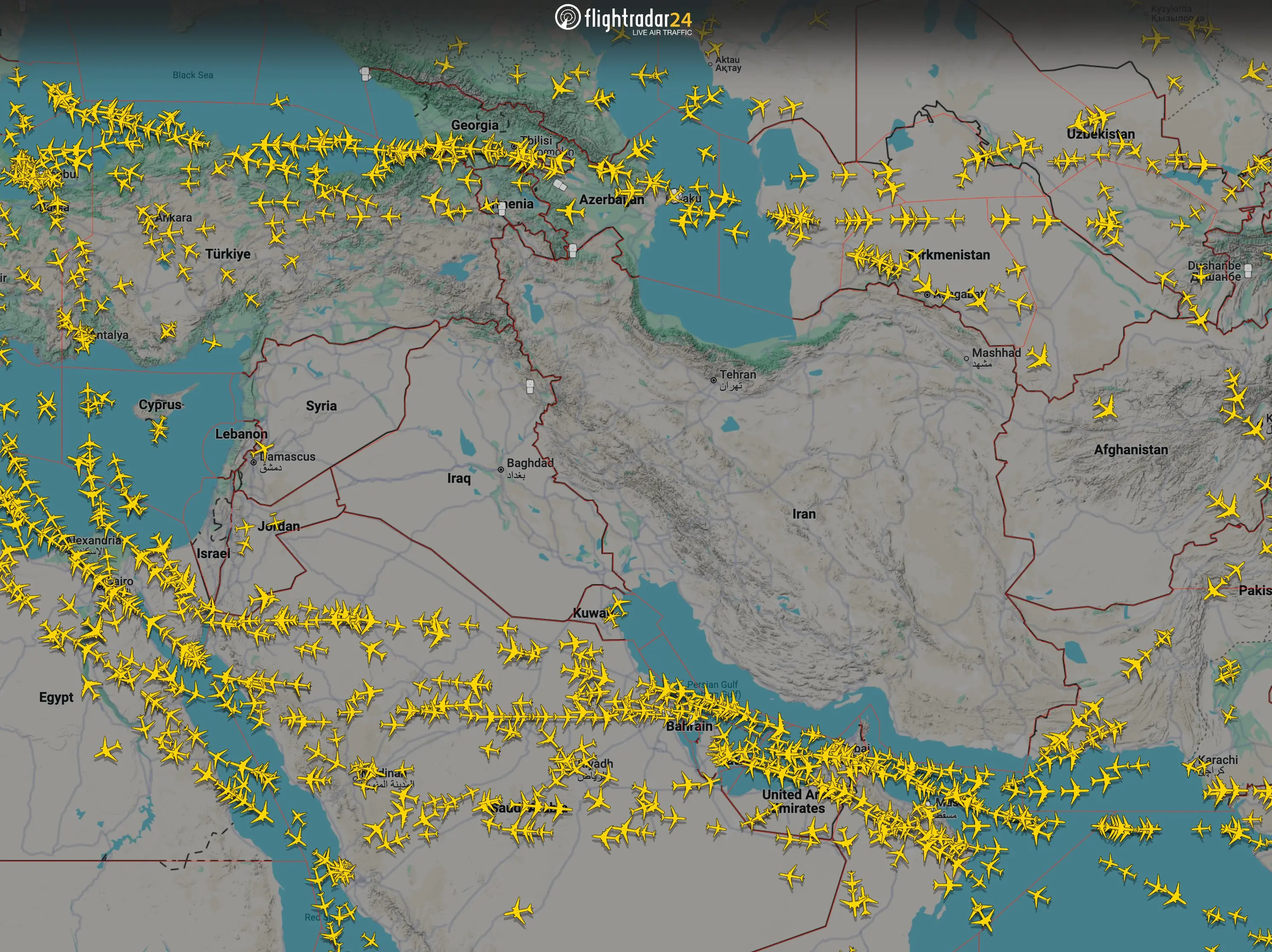
Flight tracking website FlightRadar24 showed airlines avoiding the airspace of Iran, Iraq, Syria and Israel. Photograph: (Image courtesy: X- @flightradar24)
Global aviation reels as airlines cancel flights, reroute journeys, and grapple with economic fallout.
The recent US strikes on Iranian nuclear facilities have plunged the global aviation industry into disarray, as commercial airlines scramble to avoid increasingly volatile West Asian airspace.
The strikes, which targeted three nuclear sites in Iran, have prompted widespread cancellations and rerouting of flights, exacerbating an already strained air travel sector still adjusting to older conflict zones like Russia and Ukraine.
Airlines including British Airways, Singapore Airlines, and Air France-KLM swiftly suspended flights to key West Asian hubs like Dubai, Doha, and Riyadh. American carriers like United Airlines and American Airlines had preemptively halted operations to Qatar and Dubai days before the strikes.
According to real-time data from FlightRadar24, commercial traffic has nearly vanished from the skies over Iran, Iraq, Syria, and Israel, with aircraft rerouted through longer paths via the Caspian Sea in the north or Egypt and Saudi Arabia in the south.
This rerouting is not merely a precautionary measure; it has become an operational necessity. The region, which has grown in importance as a flight corridor between Europe and Asia after Russian and Ukrainian airspace became inaccessible, is now largely restricted.
Airlines are navigating around the conflict zones at the cost of increased fuel consumption, extended flight durations, and heavier crew workloads.
Trending Stories
)
)
)
)
)
&im=FitAndFill=(700,400))
)
)
)
&im=FitAndFill=(700,400))
)
)
)
)
)
)
)
)
)
)
)
)
)
)
)
)
)
)
)
)
)
)
)
)
)
)
)
Airline ops and economics take a hit
The ripple effects on operations are extensive. Airlines face mounting pressure from fuel expenses, which already constitute up to 40 per cent of their operating costs.
As flights detour for safety, they require extra fuel—the cost of which is already on the rise and is expected to hit $100 per barrel if the situation is not controlled—which is pushing margins thinner and leaving carriers with little option but to pass on the cost to consumers.
Industry estimates suggest that airfares could increase by 10-20 per cent in the coming weeks, especially for long-haul routes that are now significantly longer due to rerouting.
The longer flight times are also affecting airline logistics and crew rotations. Aircraft availability is being stretched as round-trip schedules lengthen, placing greater strain on maintenance windows and crew duty rosters.
Delays and cancellations are expected to rise further as carriers adjust to the evolving security landscape. Analysts warn that this will not only disrupt commercial passenger flights but may also have serious implications for the aviation supply chain, affecting cargo movement and the availability of aircraft parts and personnel.
Consumers are already feeling the pinch. Apart from potential fare hikes, passengers are experiencing travel delays, extended layovers, and reduced flight availability. Routes that once took four to five hours are now clocking in at eight hours or more. This means that vacationers and business travellers alike will be paying more for longer flights.
Meanwhile, the impact on the broader travel and tourism sector is becoming increasingly evident. With war-related uncertainty looming large, demand for international travel is expected to dip, particularly to and via West Asia.
Historically, tourism is among the first sectors to suffer when geopolitical conflicts arise, and this episode appears no different. Tour operators, hotels, and regional tourism boards are already bracing for a slowdown in bookings and a potential slump in revenues.
Insurance costs are likely to rise as well, as travellers seek enhanced protection amid heightened risks. Enhanced policies that include trip cancellation and emergency evacuation coverage are expected to become more common.
India’s lane gets narrower
For India the situation becomes particularly tricky as the recent developments further shrink its already restricted air routes, as Pakistan's airspace remains closed for India.
Indian airlines have implemented contingency plans, with alternative routes mapped through Central Asia or Africa, depending on how the situation unfolds. The flights flying to and from India are also expected to add more stops for fuelling.
Air India alone has reportedly diverted or returned 17 flights due to the security situation, operating under strict guidance from international aviation regulators.
As the global aviation industry adapts to this fresh wave of instability, the economic costs are likely to mount, and recovery may be slow and uneven. With summer travel demand peaking and fuel markets on edge over a possible oil price rally, passengers and airlines alike face a turbulent season ahead.