

&imwidth=800&imheight=600&format=webp&quality=medium "Strait of Hormuz 'control map' by Iran creates a major sovereignty dispute")
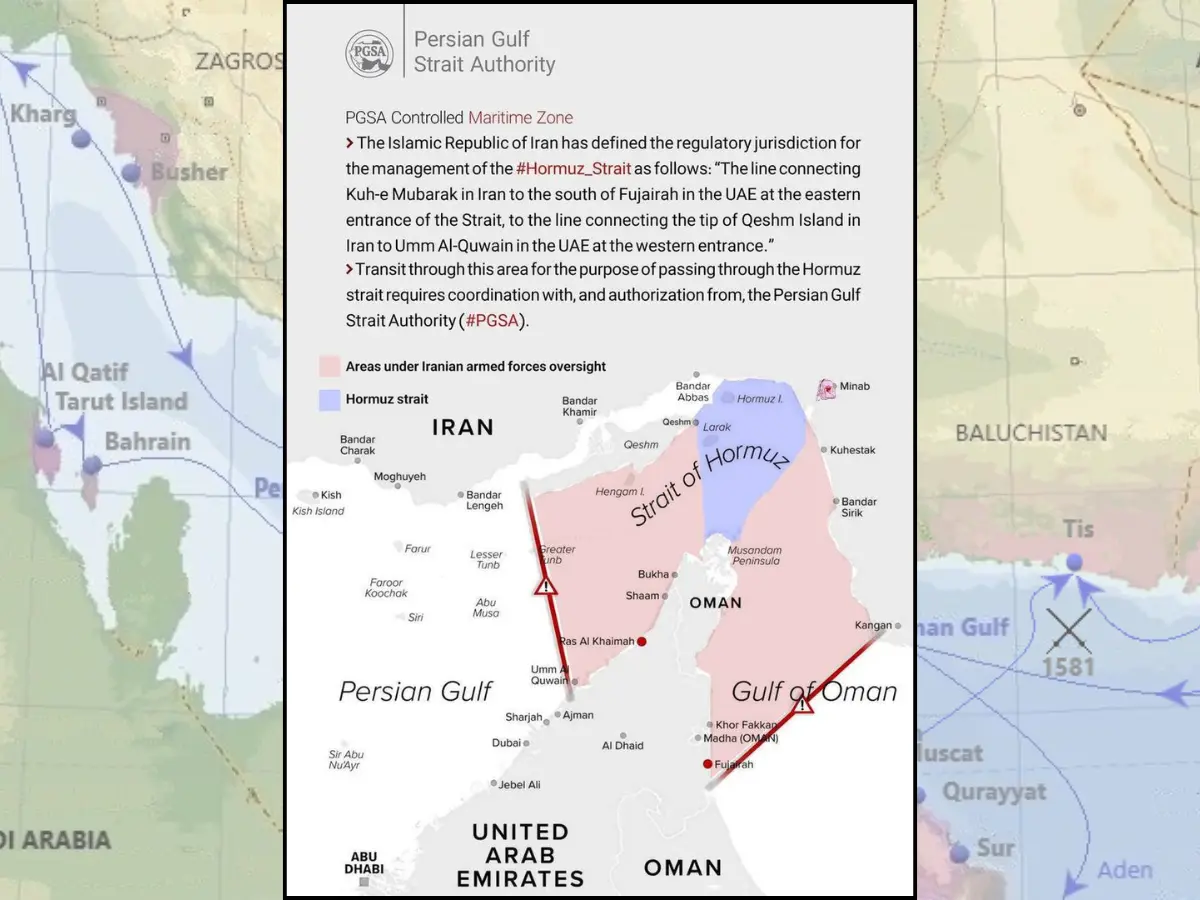
Iran released a new map showing the Strait of Hormuz under its control. The Persian Gulf Strait Authority (PGSA), which was set up earlier this month to control marine traffic in and out of Hormuz, announced that the region was being placed under the "oversight" of its armed forces. It spans more than 22,000 square kilometres, extending into the territorial waters of Oman and the UAE. The eastern line runs from Kuh-e Mubarak to just south of Fujairah in the UAE, while the western line runs from the western tip of Iran's Qeshm island to Umm Al Quwain, also in the UAE. The Emirates has described the said lines made by Iran as "nothing but fragments of dreams." According to the PGSA, "transit through this area for the purpose of passing through the Hormuz Strait requires coordination with, and authorisation" from the body.
Why the Hormuz "control map" matters
The "control map" represents a major political shift as it means that the Strait of Hormuz has gone from being a heavily contested war zone to a state-administered permit and toll regime. This change leads to a sovereignty dispute as the PGSA map claims regulatory jurisdiction over the international shipping lanes that legally fall within the territorial waters of Oman and the United Arab Emirates (UAE). While Oman is a United Nations Convention on the Law of the Sea (UNCLOS) signatory and guarantees "transit passage", Iran has never ratified UNCLOS and asserts that all transit through this zone now requires formal PGSA authorisation.
How does the Strait of Hormuz crisis affect the world?
The Strait of Hormuz has become a major pain point for the world ever since Iran closed it following the first strikes by the US and Israel. This has led to an upheaval in the global oil market, with prices skyrocketing. The waterway acts as the transit point for the transport of one-fifth of the world's oil supply. US secretary of State Marco Rubio slammed Iran for trying to control the Strait and accused it of trying to levy tolls and persuade Oman to join it. Calling the idea "unacceptable", Rubio said that no country should accept it. "If that were to happen in the Straits of Hormuz, it will happen in five other places around the world," Rubio added.
Trending Stories
&imwidth=180&imheight=135&format=webp&quality=medium)
Other Mommy leads North American box Office as Verity, Resident Evil round out top four
&im=FitAndFill=(700,400)&imwidth=180&imheight=135&format=webp&quality=medium)
Navratri 2026: 9 days, 9 forms of Goddess Durga and 9 colours- Check the complete list
&imwidth=180&imheight=135&format=webp&quality=medium)
Anti-SIR protest in Mumbai: Protestors wear black masks & ribbons in Mumbai
&imwidth=180&imheight=135&format=webp&quality=medium)
BCCI rejects venue shift reports, India vs Sri Lanka 1st ODI to remain in Delhi
&imwidth=180&imheight=135&format=webp&quality=medium)
Diljit Dosanjh’s Delhi concert gets a new date: When and where to catch the singer
&im=FitAndFill=(700,400)&imwidth=180&imheight=135&format=webp&quality=medium)
Is sending robots to Mars easier than sending humans?
&imwidth=180&imheight=135&format=webp&quality=medium)
A watchdog rated 'ChatGPT for Teens' an unacceptable risk and says keep under-18s off it
&imwidth=180&imheight=135&format=webp&quality=medium)
1,500 drones illuminate Mumbai sky as Cordelia Cruises unveils second ship, Cordelia Sky
&imwidth=180&imheight=135&format=webp&quality=medium)
'Just coincidence': Police mistakes protester as AISA chief Neha Bora, arrests her from site
&imwidth=180&imheight=135&format=webp&quality=medium)
Anthropic's AI invented a murder witness and sent the fake tip to Philadelphia police
&imwidth=180&imheight=135&format=webp&quality=medium)
Congress demands action against chief election commissioner
&imwidth=180&imheight=135&format=webp&quality=medium)
CJI Surya Kant declines INDIA bloc leaders’ request for meeting ahead of march to SC, asks them to file petition
&imwidth=180&imheight=135&format=webp&quality=medium)
Saif Ali Khan is finally on Instagram! Here's what he shared in his first post
&imwidth=180&imheight=135&format=webp&quality=medium)
'Turn approver, resign, we'll forgive you': Rahul Gandhi claims receiving messages from CEC Gyanesh Kumar
&imwidth=180&imheight=135&format=webp&quality=medium)
One Indian killed in Riyadh airport attack; 11 others injured : MEA
&imwidth=180&imheight=135&format=webp&quality=medium)
Top AI models flunked a test of inventing new AI research, so much for self-improving AI
&imwidth=180&imheight=135&format=webp&quality=medium)
Wasim Jaffer blames Ajit Agarkar-led selection panel for Virat Kohli’s Test retirement
&imwidth=180&imheight=135&format=webp&quality=medium)
'Ouch!!! That must hurt': Kangana Ranaut hails Kamal Haasan's sharp reply to Elon Musk over Starlink row
&imwidth=180&imheight=135&format=webp&quality=medium)
Sidhu Moose Wala’s younger brother wins hearts by recreating late singer’s signature move at Toronto Hologram Show
&imwidth=180&imheight=135&format=webp&quality=medium)
UK school ditches technology, shifts from screen to pen and paper for learning
&imwidth=180&imheight=135&format=webp&quality=medium)
Telangana ATM heist: Thieves in nighties arrive in ambulance, break into SBI ATM in Kamareddy - VIDEO
&imwidth=180&imheight=135&format=webp&quality=medium)
Houthis claim Riyadh airport attacks, Aramco strikes; issue fresh warning to airlines, travellers and workers
&imwidth=180&imheight=135&format=webp&quality=medium)
Portugal Federation confirms Cristiano Ronaldo’s return to national team despite suspension
&imwidth=180&imheight=135&format=webp&quality=medium)
Delhi protests: 'Court should not be dragged into political activity', says CJI Surya Kant
&im=FitAndFill=(700,400)&imwidth=180&imheight=135&format=webp&quality=medium)
New OTT releases this week (October 12-18, 2026): Sacrifice, Koffee with Karan S9, Roadies Rebirth- 6 titles coming on Netflix, JioHotstar and more
&imwidth=180&imheight=135&format=webp&quality=medium)
Microsoft's Nadella says treat every AI model as already hacked, and build an 'emergency brake'
&imwidth=180&imheight=135&format=webp&quality=medium)
Delhi protest: CJI Surya Kant declines to meet India Bloc leaders
&imwidth=180&imheight=135&format=webp&quality=medium)
Telangana man allegedly recruited into Russian military dies near Ukraine border
&imwidth=180&imheight=135&format=webp&quality=medium)
China imposes first-ever sanctions on ministers from Taiwan allies: What this means
&imwidth=180&imheight=135&format=webp&quality=medium)
McSweeney reveals how studying Virat Kohli’s YouTube clips helped Australia A conquer India
&imwidth=180&imheight=135&format=webp&quality=medium)
Maharashtra appoints FDA commissioner Tukaram Mundhe as secretary of committee for MPSC overhaul amid stir
&imwidth=180&imheight=135&format=webp&quality=medium)
Iran: US accepted some conditions, Clarity needed on others
&imwidth=180&imheight=135&format=webp&quality=medium)
Nana Patekar's cause of death confirmed; here's what his postmortem report says
&imwidth=180&imheight=135&format=webp&quality=medium)
iPhone Duo price index: Tracking Apple’s latest pricing trends
&imwidth=180&imheight=135&format=webp&quality=medium)
'Say no to Muse': Meta has no control over its own moderation AI while it forces a security nightmare on everyone
Iran-US deal
Rubio also claimed that "there has been some slight progress" in the matter. Iran and the US are reportedly on the verge of reaching a deal. Trump said on Saturday that a deal with Iran had been "largely negotiated", and the reopening of the Strait of Hormuz is a crucial point in it. Iranian officials also confirmed negotiations are happening and some progress has been made. Iran’s semi-official Tasnim news agency reported that the deal also carries a roadmap to end the war on all fronts. The US has reportedly waived sanctions on Iranian oil during negotiations. However, other reports suggest that things are stuck on two crucial issues - "the mechanism for unfreezing Iranian assets, and the scope of a ceasefire in Lebanon”.

