Research indicates airborne coronavirus remains actively infectious beyond 2 metres

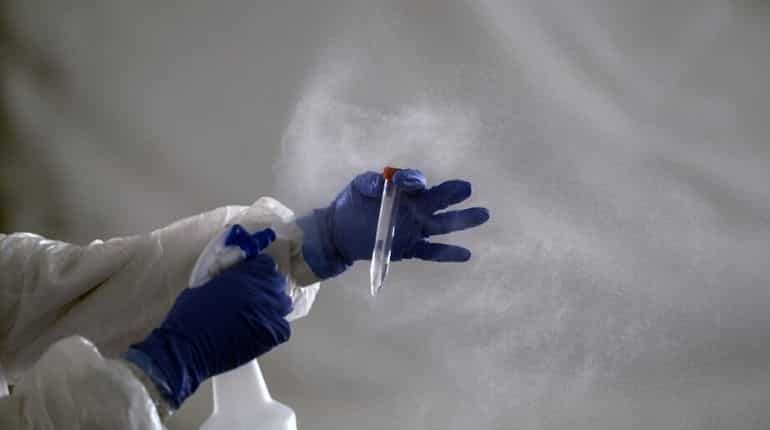
Laboratory test
There is a lot aboutcoronavirus that scientists still don't know. Every month, new information about the virus keeps coming in, making it a frustrating scientific pursuit.
Recently, a group of scientists had claimed that coronavirus is actually airborne, meaning it can be passed through the air, as opposed to what what earlier posited.
Ever since the beginning of the pandemic, scientists have been sure of the fact that COVID-19 is transmitted through the micodroplets released by patients when they're speaking or breathing. However, no proof existed until now of whether these particles were infectious

Replicated quickly!
A study undertaken at the University of Nebraska and released this week, for the first time showed how coronavirus derived from microdroplets (defined as under five microns) can spread even in lab conditions.
This gives credence to the notion that simply speaking and breathingas opposed to coughing and sneezing can spread the virus from one person to another. Additionally, this nullifies the scientific value of the two metres distancing role adopted worldwide, for the infectious virus can travel beyond it.
Also read:Is the airborne route a major source of coronavirus transmission?
Even though the research has not been peer-reviewed, it is a revelation in a series of many such shocking details that have come regarding the virus recently.
Published on medrxiv.org, the research was done by scientists who in March showed that the virus remained airborne in the hospital rooms of coronavirus patients. This study will soon be published in a journal.
Joshua Santarpia, an associate professor at the University of Nebraska Medical Center told AFP,"It is actually fairly difficult" to collect the samples.
Also read:Hundreds of scientists say coronavirus is airborne, ask WHO to revise recommendations, says report
Infectious microdroplets
The device used to understand the virus was the size of cellular phone, however "theconcentrations are typically very low, your chances of recovering material are small".
As part of their research, the scientists took samples of air from five rooms of coronavirus patients. The height at which the results were recorded was about 30 centimetres or a foot.
These recorded "aerosol", or what remains of us after talking, ie, microdroplets, while some were coughing.The researchers were able to collect droplets as small as one micron in diameter.
These samples were placed into a culture to see if they'd grow. They found that out of the 18 samples, three were able to replicate.
This, for the researchers, implies that microdroplets are indeed capable of infecting people.
"It is replicated in cell culture and therefore infectious," he said.