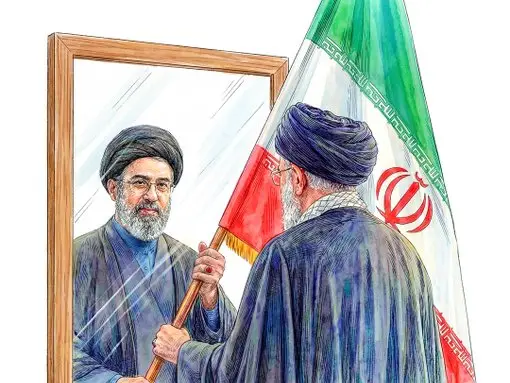
Mirror of power: Will Mojtaba Khamenei follow his father Ali Khamenei’s path or build a harder line for Iran?

&imwidth=600&imheight=450&format=webp&quality=medium "Mirror of power: Will Mojtaba Khamenei follow his father Ali Khamenei’s path or build a harder line for Iran?")
Mojtaba Khamenei has been appointed as the new Supreme leader of Iran Photograph: (X (@fr_Khamenei))
As Iran faces a leadership transition, the rise of Mojtaba Khamenei raises an important question: Will he mirror his father’s rule or reshape Iran’s future?
Iran has entered a new and an uncertain chapter. After the death of Ali Khamenei in an airstrike on February 28, Iran’s clerical leadership has moved to appoint his son, Mojtaba Khamenei, as the country’s next Supreme leader. The sudden leadership change comes at a time of intense regional tension and political uncertainty. Mojtaba Khamenei now becomes the third Supreme leader since the Iranian Revolution, and the first to follow his father in the role. His appointment has immediately sparked debate about the future direction of Iran. Many observers are asking whether he will continue his father’s policies or move the country toward a tougher and more security-focused approach.
What is Mojtaba's ideology?
Most experts believe Mojtaba Khamenei will largely continue the ideological path set by his father. The Islamic Republic was built on principles such as resistance to Western influence, strong religious authority in governance, and maintaining Iran’s strategic power in the region. These foundations are unlikely to change quickly.
However, Mojtaba is often described as having particularly close ties to Iran’s security institutions, especially the Islamic Revolutionary Guard Corps. The Revolutionary Guard already plays a central role in Iran’s military operations, economic activities, and political influence. If Mojtaba relies more heavily on this institution, the balance of power inside the system could tilt further toward security and military leadership. In practical terms, the structure of the Islamic Republic may remain the same, but security institutions could gain influence in shaping national decisions.
What is Mojtaba's leadership style?
For more than three decades, Ali Khamenei led Iran by balancing different centers of power inside the country. His leadership required managing relationships between religious scholars, political leaders, government institutions, and the Revolutionary Guard. This balancing act helped maintain stability within Iran’s complex political system.
Trending Stories
&im=FitAndFill=(700,400)&imwidth=280&imheight=210&format=webp&quality=medium)
&imwidth=280&imheight=210&format=webp&quality=medium)
&imwidth=280&imheight=210&format=webp&quality=medium)
&imwidth=280&imheight=210&format=webp&quality=medium)
&imwidth=280&imheight=210&format=webp&quality=medium)
&imwidth=280&imheight=210&format=webp&quality=medium)
&imwidth=280&imheight=210&format=webp&quality=medium)
&imwidth=280&imheight=210&format=webp&quality=medium)
&imwidth=280&imheight=210&format=webp&quality=medium)
&imwidth=280&imheight=210&format=webp&quality=medium)
&imwidth=280&imheight=210&format=webp&quality=medium)
&imwidth=280&imheight=210&format=webp&quality=medium)
&imwidth=280&imheight=210&format=webp&quality=medium)
&imwidth=280&imheight=210&format=webp&quality=medium)
&imwidth=280&imheight=210&format=webp&quality=medium)
&imwidth=280&imheight=210&format=webp&quality=medium)
&imwidth=280&imheight=210&format=webp&quality=medium)
&imwidth=280&imheight=210&format=webp&quality=medium)
&imwidth=280&imheight=210&format=webp&quality=medium)
&imwidth=280&imheight=210&format=webp&quality=medium)
&imwidth=280&imheight=210&format=webp&quality=medium)
&imwidth=280&imheight=210&format=webp&quality=medium)
&imwidth=280&imheight=210&format=webp&quality=medium)
&imwidth=280&imheight=210&format=webp&quality=medium)
&imwidth=280&imheight=210&format=webp&quality=medium)
&imwidth=280&imheight=210&format=webp&quality=medium)
&imwidth=280&imheight=210&format=webp&quality=medium)
&imwidth=280&imheight=210&format=webp&quality=medium)
&im=FitAndFill=(700,400)&imwidth=280&imheight=210&format=webp&quality=medium)
&im=FitAndFill=(700,400)&imwidth=280&imheight=210&format=webp&quality=medium)
&imwidth=280&imheight=210&format=webp&quality=medium)
&imwidth=280&imheight=210&format=webp&quality=medium)
&imwidth=280&imheight=210&format=webp&quality=medium)
&imwidth=280&imheight=210&format=webp&quality=medium)
&im=FitAndFill=(700,400)&imwidth=280&imheight=210&format=webp&quality=medium)
&imwidth=280&imheight=210&format=webp&quality=medium)
Mojtaba Khamenei, however, has a very different public profile.
Unlike many senior Iranian leaders, he has largely stayed away from public speeches and official government roles. Much of his influence has developed quietly through networks within religious institutions and political circles. Because of this background, observers believe his leadership style could be: more discreet and behind the scenes, more connected to security and intelligence networks and less focused on public political visibility. If this approach continues, Iran’s leadership could gradually become more security-centered rather than primarily clerical-political.
War and regional conflict: Leadership in a tense moment
Mojtaba Khamenei takes power during one of the most sensitive periods in Iran’s modern history. The country is already involved in major regional tensions involving the United States, Israel, and several neighbouring states. These conflicts have shaped Iran’s foreign policy for years and will likely remain central to its strategy. Analysts often describe three possible paths under the new leadership.
- Scenario one: Hardline escalation: One possibility is that Iran strengthens its current strategy of resistance and confrontation. This could include expanding regional influence through allied groups, increasing military responses to threats, and slowing diplomatic engagement with Western governments. In this scenario, the Revolutionary Guard would play an even larger role in shaping Iran’s regional policies.
- Scenario two: Strategic pragmatism: Another possibility is a more calculated and pragmatic approach. Iran could maintain strong political rhetoric against its rivals while quietly pursuing negotiations aimed at stabilizing its economy and easing international pressure. This strategy would allow the leadership to maintain its ideological stance while avoiding further escalation.
- Scenario three: Internal political tensions: Leadership transitions can also bring uncertainty within political systems. Although Mojtaba Khamenei has support among key institutions, different factions within Iran’s political elite may still compete for influence. Economic challenges, foreign policy debates, and political rivalries could shape the early years of his leadership. How these internal dynamics unfold may be just as important as Iran’s external relations.
Dynasty or evolution?
Beyond policy and strategy, Mojtaba Khamenei’s rise raises a deeper symbolic question. The Islamic Republic was created after a revolution that ended the monarchy of Mohammad Reza Pahlavi, rejecting hereditary rule and establishing a new political system based on religious leadership. Now, for the first time in the country’s modern history, the position of Supreme Leader has effectively passed from father to son. For critics, this development raises concerns that Iran could be moving toward a form of dynastic leadership. Supporters argue that the appointment still took place through the country’s formal institutions and constitutional process.
A new chapter for Iran
For now, most observers agree that Mojtaba Khamenei is unlikely to dramatically change Iran’s political system in the short term. Instead, his leadership is expected to continue the framework built over the past four decades. Yet the balance within that system may shift. If security institutions gain greater influence under the new Supreme leader, it could reshape how Iran governs itself and how it approaches regional conflicts. As Iran begins this new chapter, the central question remains: Will Mojtaba Khamenei simply reflect his father’s legacy, or will his leadership gradually redefine the future of the Islamic Republic?
Disclaimer: WION takes utmost care to accurately and responsibly report ongoing conflicts in West Asia involving Israel, Iran, US, Gulf nations and non-state actors like Hezbollah, Hamas, Houthis, Islamic State, and others. Claims and counterclaims, disinformation and misinformation are being made online and offline. Given this context, WION cannot independently verify the authenticity of all statements, social media posts, photos and videos.

