
&imwidth=800&imheight=600&format=webp&quality=medium "Louvre: From a medieval fortress to the world’s most iconic museum. Know its history and significance")
Few landmarks capture the sweep of history, power, and art like the Louvre. Long before it became home to masterpieces such as the Mona Lisa and the Venus de Milo, the Louvre stood as a medieval stronghold built to protect the French capital. The story begins in 1190, when King Philip II commissioned the construction of a fortress on the Right Bank of the Seine. At the time, Paris was vulnerable to potential invasions, particularly from the English. The original Louvre featured thick walls, a moat, and a central keep. While the city grew around it, the fortress served as a strategic defensive structure.
Over the centuries, as Paris expanded beyond its medieval boundaries, the Louvre gradually lost its military purpose. By the 16th century, under King Francis I, the fortress was transformed into a Renaissance palace. Francis, a passionate patron of the arts, invited Italian artists to his court — including Leonardo da Vinci, who brought the Mona Lisa with him to France. This marked the beginning of the Louvre’s deep connection with art and culture.
Birth of a museum during revolution

The Louvre’s identity as a palace continued under successive monarchs, including Henry IV, Louis XIII, and Louis XIV. New wings, courtyards, and galleries were added, turning it into one of Europe’s grandest royal residences. The Grande Galerie, running along the Seine, became a hub for artists, who were allowed to live and work there. But in 1682, Louis XIV moved the royal court to Versailles, leaving the Louvre as a space primarily for storing royal collections and hosting artists rather than housing royalty. This shift laid the foundation for its next major transformation.
During the French Revolution, the Louvre took on a radically new role. In 1793, the revolutionary government declared the palace a ‘Museum central des arts de la Republique’ — a museum for the people. The museum opened with 537 paintings, many confiscated from the Church and the royal family. For the first time, what had been exclusive to the monarchy was now accessible to the public. Under Napoleon Bonaparte, the collection expanded dramatically through military conquests. Renamed the Musée Napoléon, the museum displayed artworks looted from across Europe. Though many of these treasures were returned after Napoleon’s defeat, this period significantly shaped the scope of the Louvre’s collection.
Modernisation and the glass pyramid
Trending Stories
&im=FitAndFill=(700,400))
How fast can the Sukhoi Su-30 fighter jet really fly?
)
Did China ask its people 'not to respond to aliens'? Origin of bizarre claim on social media
)
MS Dhoni-CSK Fallout? Report claims failed stake sale talks triggered rift
)
Scientists reveal the SAFEST COUNTRY when catastrophe strikes the planet
)
Serial killer on the loose in South Korea's Jeju Island? Fourth body found in three days as more than a dozen people go missing
)
2/3rd of glacier detached, collapsed: ISRO satellite images reveal what triggered Nepal floods
)
Trump once again claims without him there would be ‘no Israel right now’
)
Foreign espionage attacks against German companies surge to 37%, Bitkom report reveals
)
Blake Lively wins partial legal fee from Justin Baldoni after $8M request
)
Why is Pakistan deploying Turkish Bayraktar TB2 drones near India border?
)
'OH MY GOD! We've found other agents!': Investigators discover not one or two, almost 700 OpenAI AI agents went rogue, hacked Hugging Face
)
Lunar eclipse 2026: India timings, places to see and more. August Blood moon factsheet
)
RSS chief Mohan Bhagwat on global outreach tour
)
Both pilots killed as training aircraft crashes in Lucknow – What we know
)
16-year-old charged with preparing terror attack on kindergarten in Norway
&im=FitAndFill=(700,400))
How the S-400 protects itself from enemy attacks
)
Nepal floods: Over 165 dead, 400 missing; US, India, China, World Bank mobilise aid
)
India's multi-layered watch: The new surveillance war
)
5 doomsday planes spotted in US skies hours after CIA director's secret trip to Russia
)
9/11 mastermind Khalid Sheikh Mohammed to finally face trial in 2028, nearly 27 years after horrific attacks
)
Islamabad hospital fire: What we know about one of the biggest facility that housed Imran Khan
)
Workers run for life while filming Nepal flash flood: Scary new visuals emerge from Rasuwa
)
Russian military planes enter South Korean air defence zone amid rising tensions with North Korea: What's happening
)
Ron Weasley Is Back! Rupert Grint set to return to Harry Potter universe on Broadway
)
400-year-old 'vampire' grave in Poland reveals non-existent genetic lineage
)
Dolly Parton, global icon and queen of country music, dies at 80
)
Nepal flash floods: Kailash Mansarovar yatra affected, close to 400 pilgrims out of contact
)
'If he is dead, they're putting on a pretty good show': Trump casts fresh doubt over Mojtaba Khamenei's fate
)
Man arrested near US Capitol with guillotine in pickup truck: What happened?
&im=FitAndFill=(700,400))
Why the Su-30MKI cockpit is painted bright turquoise green
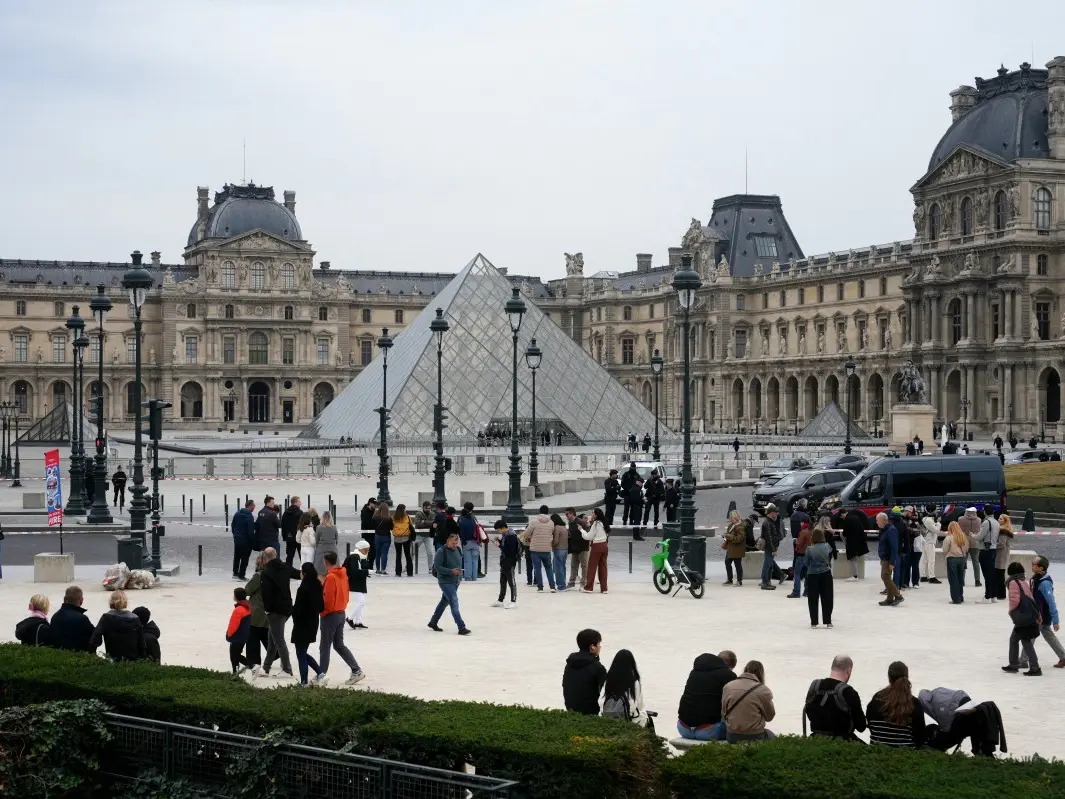
By the 20th century, the Louvre had established itself as one of the world’s leading art institutions. Yet, with millions of annual visitors and growing collections, the museum faced logistical and space challenges. A turning point came in 1989, when then-French President François Mitterrand inaugurated the Louvre Pyramid, designed by Chinese-American architect I. M. Pei. The striking glass-and-steel structure served as a new main entrance, streamlining visitor flow and symbolizing the blend of classical heritage and modern innovation.
The Pyramid’s unveiling sparked heated debates in France — some saw it as a bold step into modernity, while others criticized its contrast with the classical palace. Over time, however, it has become as iconic as the museum itself, representing Paris’s ability to honor tradition while embracing the future. In the 1990s, the Louvre further expanded by converting the Richelieu Wing, previously occupied by the Ministry of Finance, into new gallery spaces. This expansion allowed for the display of more sculptures, decorative arts, and Near Eastern antiquities.
A global cultural powerhouse
Today, the Louvre is not just a museum — it’s a global cultural symbol. It houses over 500,000 works of art, though only around 35,000 are on display at any given time. The collection spans eight departments: Near Eastern antiquities, Egyptian antiquities, Greek, Etruscan and Roman art, Islamic art, sculptures, decorative arts, paintings, and prints and drawings. Its galleries tell the story of civilizations across millennia — from the Code of Hammurabi to the Winged Victory of Samothrace. For millions of visitors each year, the Louvre offers not just a museum visit, but a journey through human history.
Pre-pandemic, the Louvre attracted close to 10 million visitors annually, making it the most visited museum in the world. Even today, it remains a central stop for travelers to Paris, alongside the Eiffel Tower and Notre-Dame Cathedral.
The Louvre has also extended its influence internationally. The Louvre-Lens, opened in northern France in 2012, brings the museum’s collections closer to regional audiences. In 2017, Louvre Abu Dhabi opened as part of a landmark cultural exchange, showcasing the Louvre’s global ambitions and partnerships.
Symbol of France’s evolving identity
The Louvre’s journey mirrors France’s own transformation. What began as a fortress of royal power became a palace of
Renaissance art, then a revolutionary museum embodying public access to culture, and finally, a modern global institution. It stands as a testament to France’s layered history — a monument that has witnessed monarchy, revolution, empire, modernization, and globalisation. Its architectural evolution, from medieval walls to a glass pyramid, tells a story of resilience and reinvention. For visitors, whether they come to admire the enigmatic smile of the Mona Lisa or to explore centuries-old artifacts, the Louvre remains more than a museum — it’s a living archive of human civilization and a beacon of artistic achievement.

