
&imwidth=800&imheight=600&format=webp&quality=medium "Keir Starmer faces growing calls to quit as Prime Minister amid political turmoil")
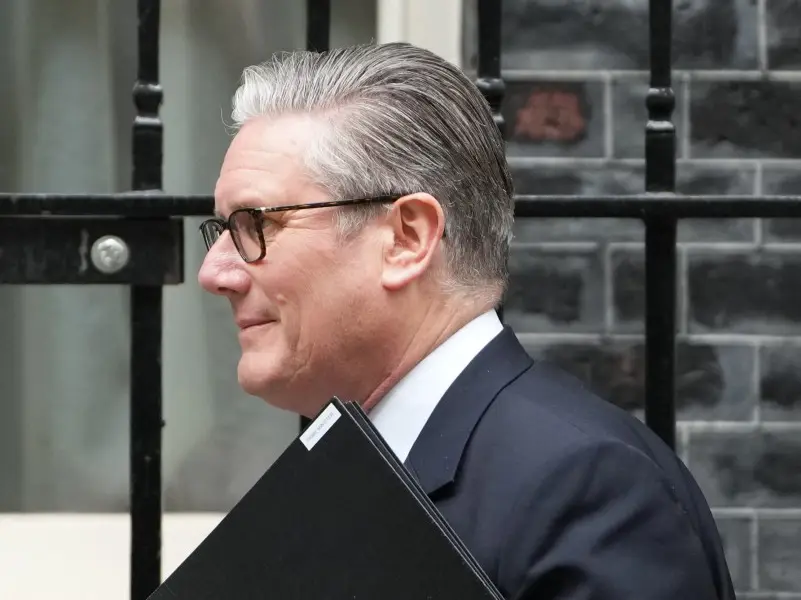
Pressure intensified on Keir Starmer late on Monday (May 11) as growing numbers of Labour MPs urged him to resign following devastating local and regional election losses for the ruling Labour Party. Despite Starmer’s promise to restore public confidence and push forward with stronger reforms, more than 70 Labour MPs reportedly want him to step down, arguing that voters no longer trust his leadership. Under Labour Party rules, a leadership contest can only be triggered if at least 81 MPs, 20 per cent of Labour lawmakers in Parliament, formally support a challenge.
Among those publicly calling for Starmer’s resignation are four government aides who have already quit their roles. British media reports also suggested that Foreign Secretary Yvette Cooper and Interior Minister Shabana Mahmood advised Starmer to oversee an orderly transition of power. Joe Morris, who served as parliamentary private secretary to Health Secretary Wes Streeting, wrote on X that it was "now clear that the prime minister no longer has the trust or confidence of the public to lead this change". Another departing aide, Tom Rutland, claimed Starmer had "lost authority" among Labour MPs and "will not be able to regain it". Melanie Ward, an aide to Deputy Prime Minister David Lammy, also demanded change at the top.

"Keir Starmer did important work to change the Labour Party," she said, but added: “The message from last week’s elections was clear; the Prime Minister has lost the confidence of the public to lead this change.” Cabinet Office aide Naushabah Khan, who also resigned, echoed those concerns. "I am calling for new leadership so that we can rebuild trust and deliver the better future that the British people voted for."
Starmer, 63, became prime minister in July 2024 after Labour’s landslide victory ended 14 years of Conservative rule. However, his government has struggled with policy setbacks, weak economic growth, and controversies surrounding senior appointments, including the short-lived posting of Peter Mandelson as Britain’s ambassador to Washington over links to convicted sex offender Jeffrey Epstein. Although Starmer earned praise for resisting pressure from Donald Trump over Iran policy, public frustration has continued to grow due to the rising cost of living and economic concerns.
Labour’s poor performance in recent elections deepened the crisis. The party suffered heavy losses to the right-wing Reform UK and the Green Party, while also losing control of the Welsh Parliament to Plaid Cymru for the first time since 1999. Labour also failed to gain ground against the Scottish National Party in Scotland. In a major speech on Monday, Starmer admitted voters were frustrated with politics and his leadership but insisted he would continue fighting. "I know I have my doubters, and I know I need to prove them wrong, and I will," he said.
Trending Stories
&im=FitAndFill=(700,400))
How fast can the Sukhoi Su-30 fighter jet really fly?
)
Did China ask its people 'not to respond to aliens'? Origin of bizarre claim on social media
)
MS Dhoni-CSK Fallout? Report claims failed stake sale talks triggered rift
)
Scientists reveal the SAFEST COUNTRY when catastrophe strikes the planet
)
Serial killer on the loose in South Korea's Jeju Island? Fourth body found in three days as more than a dozen people go missing
)
2/3rd of glacier detached, collapsed: ISRO satellite images reveal what triggered Nepal floods
)
Trump once again claims without him there would be ‘no Israel right now’
)
Foreign espionage attacks against German companies surge to 37%, Bitkom report reveals
)
Blake Lively wins partial legal fee from Justin Baldoni after $8M request
)
Why is Pakistan deploying Turkish Bayraktar TB2 drones near India border?
)
'OH MY GOD! We've found other agents!': Investigators discover not one or two, almost 700 OpenAI AI agents went rogue, hacked Hugging Face
)
Lunar eclipse 2026: India timings, places to see and more. August Blood moon factsheet
)
RSS chief Mohan Bhagwat on global outreach tour
)
Both pilots killed as training aircraft crashes in Lucknow – What we know
)
16-year-old charged with preparing terror attack on kindergarten in Norway
&im=FitAndFill=(700,400))
How the S-400 protects itself from enemy attacks
)
Nepal floods: Over 165 dead, 400 missing; US, India, China, World Bank mobilise aid
)
India's multi-layered watch: The new surveillance war
)
5 doomsday planes spotted in US skies hours after CIA director's secret trip to Russia
)
9/11 mastermind Khalid Sheikh Mohammed to finally face trial in 2028, nearly 27 years after horrific attacks
)
Islamabad hospital fire: What we know about one of the biggest facility that housed Imran Khan
)
Workers run for life while filming Nepal flash flood: Scary new visuals emerge from Rasuwa
)
Russian military planes enter South Korean air defence zone amid rising tensions with North Korea: What's happening
)
Ron Weasley Is Back! Rupert Grint set to return to Harry Potter universe on Broadway
)
400-year-old 'vampire' grave in Poland reveals non-existent genetic lineage
)
Dolly Parton, global icon and queen of country music, dies at 80
)
Nepal flash floods: Kailash Mansarovar yatra affected, close to 400 pilgrims out of contact
)
'If he is dead, they're putting on a pretty good show': Trump casts fresh doubt over Mojtaba Khamenei's fate
)
Man arrested near US Capitol with guillotine in pickup truck: What happened?
&im=FitAndFill=(700,400))
Why the Su-30MKI cockpit is painted bright turquoise green
Starmer promised "a bigger response" rather than "incremental change" on key issues, including economic growth, energy policy, and rebuilding ties with Europe. He also vowed to fully nationalise British Steel and strongly criticized Brexit, saying Britain’s departure from the European Union had made the country poorer, weaker, and less secure. After the speech, Labour MP Catherine West said she would begin gathering support among MPs for Starmer to announce a timetable for a leadership election in September instead of launching an immediate challenge.
Starmer has vowed to fight any attempt to remove him and warned that Labour would "never be forgiven" if it repeated the political instability seen under recent Conservative governments. Speculation continues to grow that Wes Streeting and former deputy prime minister Angela Rayner could emerge as potential challengers, although neither commands universal support inside Labour.

