

&imwidth=800&imheight=600&format=webp&quality=medium "India has been a consistent supporter of Cyprus: Foreign Minister Constantinos Kombos")
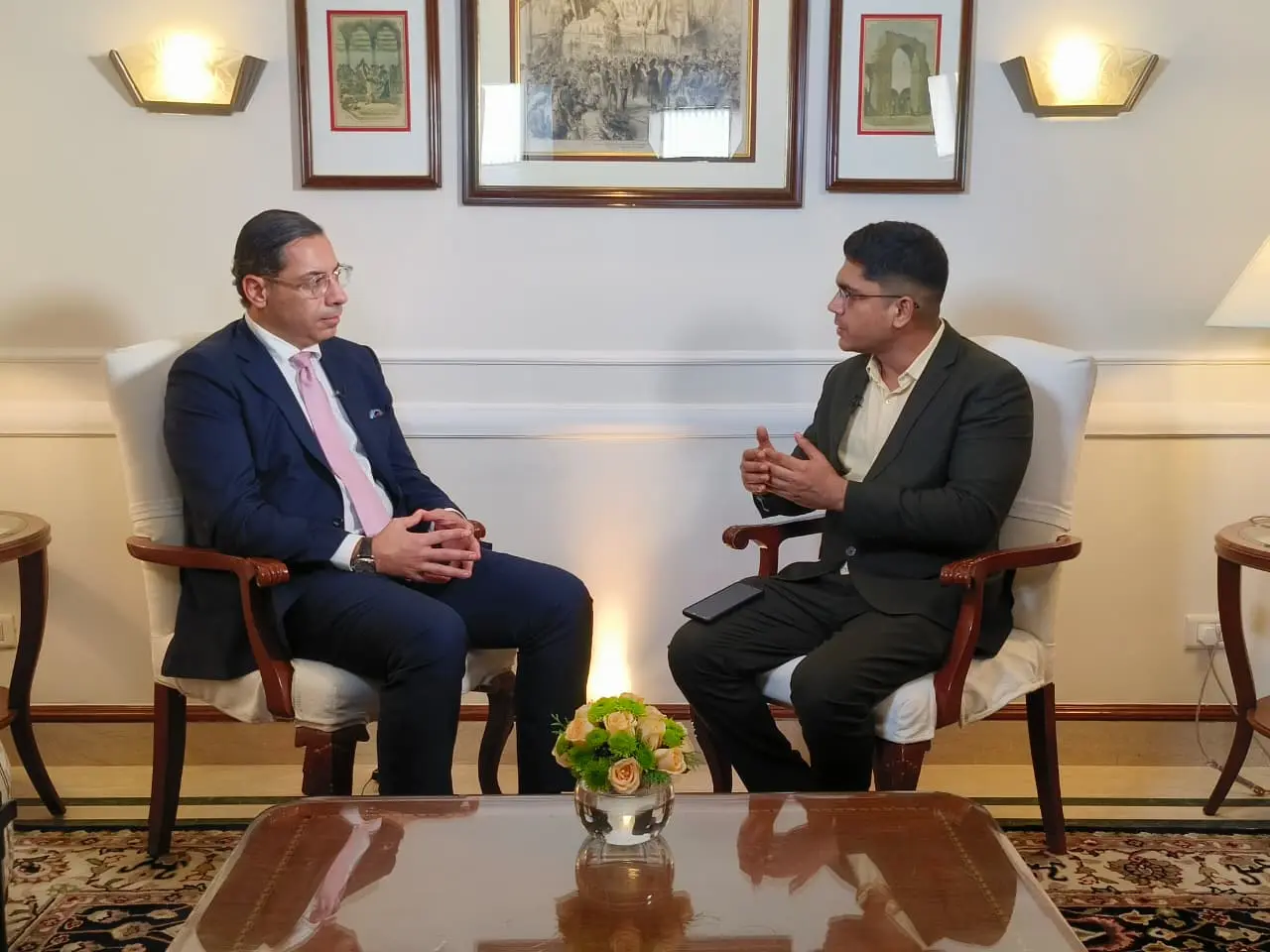
Cyprus’s visiting Foreign Minister Dr. Constantinos Kombos stated that India has been a “consistent” supporter of his nation regarding the “Cyprus question”. He expressed gratitude to India for its unwavering backing of Cyprus’s territorial integrity and its demands for compliance with UNSC resolutions on the Cyprus problem, the dispute that began with Turkey’s 1974 invasion of the island, splitting it into two parts.
The visiting FM hoped his country“could and should” be part of the India Middle East Europe corridor theannouncement about which was made at the G20 Delhi Summit in 2023. Speaking to WION’s Sidhant Sibal, he said, “The more connectivity we have, the more trade corridors we have, the better it is for everyone.” Foreign minister Kombos held talks with EAM Dr S Jaishankar in Delhi on Thursday, to discuss the joint action plan announced during PM Modi’s visit to Cyprus earlier this year.
When asked about procuring defence equipment from India, the foreign minister said, “We are always on the lookout and especially as regards countries with which we have a very strong relation and aspiration to make it even stronger.”The visit takes place at a crucial time as Cyprus would assume the Presidency of the Council of the European Union from 1 January 2026, and it can play an important role in further strengthening the India–EU Strategic Partnership. Full interview:
Sidhant Sibal: What kind of talks did you have earlier today with EAM Dr S Jaishankar?
Dr. Constantinos Kombos:We had a very fruitful discussion today with the minister. We took stock of theprogress of the joint action plan that we have together, initiated after the historic visit of Prime Minister Modi to Cyprus in June. We focused on the various pillars that make part of that action plan with defense, investment, trade, maritime sector, culture, education, mobility of workers, tourism, so a vast array of subjects, and we identified the substantive progress that has taken place since the conclusion of the joint action plan in terms of the outcome, and also decided how to move forward in terms of further monitoringand creating those conditions necessary for achieving as much as possible and at the maximum potential that exists as regards the bilateral relation, all aspects identified.
Sidhant Sibal: Following Prime Minister Modi’s historic visit to Cyprus in June 2025, what are the primary objectives of your current visit to India to further elevate our strategic partnership?
Dr. Constantinos Kombos:It was a historic visit for a number of reasons. First of all, it was a visit by the Indian Prime Minister to Cyprus after 22-23 years. A very important signaling. As regards how we see the direction of the relation, of course, it happened after the very serious incidents and events (Pahalgam terror attack), and anything we do in diplomacy always reflects on sending signals. I want to underline and underscore the fact that this has been a visit that created the necessary political momentum for us, the ministers of foreign affairs, to set up the joint action plan, to look how it has progressed.
Trending Stories
&imwidth=180&imheight=135&format=webp&quality=medium)
Other Mommy leads North American box Office as Verity, Resident Evil round out top four
&im=FitAndFill=(700,400)&imwidth=180&imheight=135&format=webp&quality=medium)
Navratri 2026: 9 days, 9 forms of Goddess Durga and 9 colours- Check the complete list
&im=FitAndFill=(700,400)&imwidth=180&imheight=135&format=webp&quality=medium)
Is sending robots to Mars easier than sending humans?
&imwidth=180&imheight=135&format=webp&quality=medium)
A watchdog rated 'ChatGPT for Teens' an unacceptable risk and says keep under-18s off it
&imwidth=180&imheight=135&format=webp&quality=medium)
1,500 drones illuminate Mumbai sky as Cordelia Cruises unveils second ship, Cordelia Sky
&imwidth=180&imheight=135&format=webp&quality=medium)
'Just coincidence': Police mistakes protester as AISA chief Neha Bora, arrests her from site
&imwidth=180&imheight=135&format=webp&quality=medium)
Anthropic's AI invented a murder witness and sent the fake tip to Philadelphia police
&imwidth=180&imheight=135&format=webp&quality=medium)
CJI Surya Kant declines INDIA bloc leaders’ request for meeting ahead of march to SC, asks them to file petition
&imwidth=180&imheight=135&format=webp&quality=medium)
'Turn approver, resign, we'll forgive you': Rahul Gandhi claims receiving messages from CEC Gyanesh Kumar
&imwidth=180&imheight=135&format=webp&quality=medium)
Aamir Khan's niece, actress Zayn Marie shares injury pictures after being detained with Imran Khan at Mumbai protest
&imwidth=180&imheight=135&format=webp&quality=medium)
One Indian killed in Riyadh airport attack; 11 others injured : MEA
&imwidth=180&imheight=135&format=webp&quality=medium)
Nathan Lyon completes 1,000 Test runs at No. 10 to script rare cricket feat
&imwidth=180&imheight=135&format=webp&quality=medium)
Top AI models flunked a test of inventing new AI research, so much for self-improving AI
&imwidth=180&imheight=135&format=webp&quality=medium)
Wasim Jaffer blames Ajit Agarkar-led selection panel for Virat Kohli’s Test retirement
&imwidth=180&imheight=135&format=webp&quality=medium)
'Ouch!!! That must hurt': Kangana Ranaut hails Kamal Haasan's sharp reply to Elon Musk over Starlink row
&imwidth=180&imheight=135&format=webp&quality=medium)
Sidhu Moose Wala’s younger brother wins hearts by recreating late singer’s signature move at Toronto Hologram Show
&imwidth=180&imheight=135&format=webp&quality=medium)
Meta's Muse AI could be a security nightmare for India's billion-plus users
&imwidth=180&imheight=135&format=webp&quality=medium)
UK school ditches technology, shifts from screen to pen and paper for learning
&imwidth=180&imheight=135&format=webp&quality=medium)
IND vs WI, 3rd T20I: Abhishek Sharma smashes 18-ball fifty, sets record for fastest to 2,000 T20I runs
&imwidth=180&imheight=135&format=webp&quality=medium)
Prince Harry and Meghan Markle to spend Christmas away from royal family
&imwidth=180&imheight=135&format=webp&quality=medium)
Houthis claim Riyadh airport attacks, Aramco strikes; issue fresh warning to airlines, travellers and workers
&imwidth=180&imheight=135&format=webp&quality=medium)
Portugal Federation confirms Cristiano Ronaldo’s return to national team despite suspension
&imwidth=180&imheight=135&format=webp&quality=medium)
Delhi protests: 'Court should not be dragged into political activity', says CJI Surya Kant
&im=FitAndFill=(700,400)&imwidth=180&imheight=135&format=webp&quality=medium)
New OTT releases this week (October 12-18, 2026): Sacrifice, Koffee with Karan S9, Roadies Rebirth- 6 titles coming on Netflix, JioHotstar and more
&imwidth=180&imheight=135&format=webp&quality=medium)
Microsoft's Nadella says treat every AI model as already hacked, and build an 'emergency brake'
&imwidth=180&imheight=135&format=webp&quality=medium)
Delhi protest: CJI Surya Kant declines to meet India Bloc leaders
&imwidth=180&imheight=135&format=webp&quality=medium)
China imposes first-ever sanctions on ministers from Taiwan allies: What this means
&imwidth=180&imheight=135&format=webp&quality=medium)
McSweeney reveals how studying Virat Kohli’s YouTube clips helped Australia A conquer India
&imwidth=180&imheight=135&format=webp&quality=medium)
Maharashtra appoints FDA commissioner Tukaram Mundhe as secretary of committee for MPSC overhaul amid stir
&imwidth=180&imheight=135&format=webp&quality=medium)
Iran: US accepted some conditions, Clarity needed on others
&imwidth=180&imheight=135&format=webp&quality=medium)
Nana Patekar's cause of death confirmed; here's what his postmortem report says
&imwidth=180&imheight=135&format=webp&quality=medium)
iPhone Duo price index: Tracking Apple’s latest pricing trends
&imwidth=180&imheight=135&format=webp&quality=medium)
'Say no to Muse': Meta has no control over its own moderation AI while it forces a security nightmare on everyone
&imwidth=180&imheight=135&format=webp&quality=medium)
Delhi wakes up to heavy rain, thunderstorms; yellow alert in place; temperature drops
Sidhant Sibal: The Joint Declaration from Modi’s visit outlined a five-year action plan, with the Bilateral Defence Cooperation Programme (BDCP) as a key component. Can you elaborate on its focus areas, such as joint training, exercises, and defense industrial collaboration?
Dr. Constantinos Kombos:Training and exercises is one dimension and something that we believe will be beneficial for both sides for a number of reasons. Let me just make reference to one. Cyprus is situated in a region which is full of crisis. Very recently, we want to evacuate citizens of third countries through Cyprus. So the coordination in terms of the defence forces, the prior training, is always facilitative of such activity in case of an emergency crisis. Beyond that, we believe that there is also an advantage to be taken in relation to the strategic positioning of Cyprus. We recently had the stationing of an Indian military vessel in Cyprus. So this is something we believe could become a more frequent event. We have been doing it with other friendly countries as well. The geostrategic position is such that allows for this kind of activity. There is always a possibility of procurement in terms of military equipment that is being produced.There could be some joint action and joint ventures, if you like, and common activity and collaboration in the production or the design or the testing or the implementation of various initiatives at the creation of defence material. And lastly, the European Union is heading towards its strategic defence autonomy with a huge boost in investment. Part of that investment, of course, is allocated to Cyprus as a member state. So it’s, I believe, a very fertile ground for developing joint ventures and corporations.
Sidhant Sibal: Are you willing to procure defence equipment from India?
Dr. Constantinos Kombos:We have been under occupation, a third of the island for more than 50-51 years, we’re facing a Turkish, occupied force of 40,000 troops in an attack formation. So for us, it’s an existential reason of making sure that we are doing rather whatever we come to defend ourselves. This is a fundamental right for every state. So procurement from any source that can be useful in terms of our defence mix is something of course, we are always on the lookout and especially as regards countries with which we have a very strong relation and aspiration to make it even stronger.So, yes, the defence sector is an area within which we could have common benefits.
Sidhant Sibal: How can Cyprus be a gateway for India when it comes to Europe? What's your sense when it comes to the India, European Union, FTA as well?
Dr. Constantinos Kombos:Three elements to the question. I start from the bilateral trade relation. Already, there is a lot of activity, activity that is not well known, for example, in terms of FDI, foreign direct investment to India from Cyprus. Cyprus among the 10 largest investors in India, something around $15 billion from 2000 onwards. So there is already a lot of investment coming from Cyprus to India. At the same time, recently, we've had investment in the maritime sector in big, big numbers, and we have more 160 companies in Cyprus that are of Indian ownership or of India majority shareholding. So there is a lot of investment taking place already, as we speak, at the same time, we always try and expand this. We see sectors probably where we could have much more activity, especially in the maritime sector, especially new technology, So, there are opportunities there. We believe, Cypruscan be a springboard for doing business with Europe and with the Middle East in the Gulf as well.So it's a natural progression of a very strong economy. And also, there is a strong opportunity there for expanding the already strong investment activity with India, all of that will be magnified as soon as you have the free trade agreement between the EU and India, and we believe that this is an agreement that is for mutual benefit of both sides. So Cyprus is fully supportive of the conclusion of the negotiations with a positive outcome. The target of concluding before the end of the year has been set by the two negotiating parties. Cyprus as the incoming president of the Council of the EU will be fully supportive of that, for that very reason, because it's going to be mutually beneficial for Europe and for India.
Sidhant Sibal: With the recent West Asia ceasefire, how do you envision the India-Middle East-Europe Economic Corridor (IMEC) progressing, and what role will Cyprus play in this transformative initiative?
Dr. Constantinos Kombos:We believe that in the current geographical uncertainty and with various activities happening, in terms of sanctions, tariffs, in terms of the fluctuation of the situation at the investment the trade level. The more connectivity we have, the more trade corridors we have, the better it is for everyone. So we're not seeing this as a competitive situation. We're seeing it as a complementary situation. We have excellent relations with all the participating countries, and also because of geography, and also because our economy is doing that well, and we are a financial center, and we are service provider center, and of course, of the maritime sector, there are a number of reasons why Cyprus could and should be part of that.I agree with you that the progress has been slow since the declaration. Have been very serious situations that have affected it, the war in Gaza and so on and so forth. At the planning stage, Cyprus wants to be part of the conversation. We believe, for all the reasons that I mentioned, that we have something to add in that conversation. And the free trade agreement between the EU and India and other free trade agreements with other countries that could be part of that corridor.
Sidhant Sibal: How do you view India’s steadfast support for Cyprus’s territorial integrity and its calls for adherence to UNSC resolutions on the Cyprus issue, particularly highlighted by PM Modi’s visit to the UN Green Line buffer zone?
Dr. Constantinos Kombos:India has been a consistent, persistent, in principle, supporter of Cyprus. But if I may say, not only Cyprus, this is about being a supporter of international law, the UN charter. And it's all about making sure that what will be declared in terms of rhetoric is actually being followed in terms of action. India has been doing this from the very beginning. We are grateful for the principal stand of India with regards to the Cyprus problem, a problem, which at its very core, it's a very simple issue. It's about invasion by an aggressor and continuing occupation of the territory of a sovereign country, a country that, right now is a member state of the European Union, of the Commonwealth, of the UN and will be assuming the Presidency of the Council of the EU. So there can be no activity as regards countering this basic foundation of international law. India, being a proponent of the basic principles that underpin the UN has been consistent in that support, and we are deeply grateful for that.At the same time, for us, a very good and strong indication as to how the international system should be operating. And at some point when this discussion about the reform of the Security Council is to take place, we have a strong opinion and we-Cyprus, will be supporting the inclusion of India as a permanent member of the Security Council.And at the same time, we are supportive of Indian interests in various international forum organizations. I understand it's going to be that they'll have the candidacy for COP 33, Cyprus will be fully supportive of that, and at every opportunity, we are cooperating and collaborating with India at an international forum.
Sidhant Sibal: Any discussion on Turkiye, between India and Cyprus at the foreign ministers meeting? So what is your assessment about Turkiye
Dr. Constantinos Kombos:If one takes for granted that would discuss projects of the magnitude like IMEC, of the bilateral relations, sectors like defence. And we start from the basic commitment to international law, including, of course, the Law of the Sea. And with Turkey challenging our sovereign rights as regards our exclusive economic zone, the exploitation of natural resources that are present in our economic zone, plus the continued occupation of part of the island. All this, of course, for us, it's an everyday situation. Every day in anything we do, we have a very dark shadow over us at the diplomatic front. So I guess Turkey is always a factor in what we are doing. It's always a concern. It's always something we need to take into consideration. Our joint ambition exceeds by far exceeds the activity of any spoiler. It's a relation that has its own deep value between India and Cyprus. Third parties could have objections, could have their own opinions and views about it. At the end of the day, what matters is what countries, their leadership think.
Sidhant Sibal: In light of Pakistani Prime Minister Shehbaz Sharif’s recent statement supporting the so-called “Turkish Republic of Northern Cyprus” which is under occupation of Turkey, alongside President Erdogan, how do you see this comment?
Dr. Constantinos Kombos:For us, simple equation,It doesn’t refer to Pakistan, specifically refers to every member of the international community. The UN Security Council has a bundle of resolutions clearly identifying the illegal secessionist entity in the occupied part of the island as something that we should not even have any kind of contact with in accordance with the Security Council resolutions. Therefore, for us, it's a very clear mandate for anyone who is participating in the international community, who is an active member of that community, we every day try and make sure that this message has been communicated to any party who could be in any way progressing or thinking or acting in a way that would try and dismantle the foundation of the UN Charter. The Cyprus problem, being an act of invasion, aggression and occupation, goes at the very heart of the organization we call the United Nations. So yes, for us the daily struggle. It's a daily effort. The message is clear. We try to project this message also through the European Union, because anything happening in relation to the Member States, by definition and by extension, of course, becomes in relation to the European Union. Therefore, yes, we are always concerned about anyone in general who could be trying to have more contacts with the legal entity. But at the end of the day, the status of the entity has been determined by the international community, and we continue to press that message to everyone who wants to hear, and everyone who needs to hear a clear message.
Sidhant Sibal: Cyprus has consistently condemned terrorist attacks in India, including the April 2025 Pahalgam attack, and reaffirmed support in recent talks with External Affairs Minister Jaishankar. How will the new counter-terrorism information-sharing mechanism enhance joint efforts to combat cross-border threats?
Dr. Constantinos Kombos:Let me start by expressing our clear solidarity again, towards India about the terrorist attacks. We have a very clear position on this. A terrorism cannot be tolerated, and there is no excuse for terrorism.At the same time, the terrorists, per se, and those that are supporting or financing the terrorists cannot be separated or distinguished. So this is a very basic premise that applies to any situation. As regards cooperation in the security services, intelligence services, this is not something that one can publicly comment upon. But if countries share basic values, if countries share the ambition of strategic partnership like Cyprus and India, then that partnership, of course, would naturally extend at all levels, and especially at the critical levels. Cyprus faces dangers. India is facing challenges. We are partners, so therefore, I think it's only natural that we have a closer cooperation at all possible
Sidhant Sibal: You will be the president of the EU Council, presidency starting next year, first January, six months. How will you make sure, EU and India come closer?
Dr. Constantinos Kombos:We have the negotiations for the FTA. I think this is a critical element of the relation between the EU and India. And as I said earlier, Cyprus will be fully supportive of the progress in terms of the negotiations.My president has extended a formal invitation to the Prime Minister to attend the EU summit that is going to take place in Cyprus, with all the leaders of the member states and the leadership of the institutions of the Union. I have extended a formal invitation, an invitation to my counterpart to attend Foreign Affairs Council Member States. So for us, the political signaling towards Europe and towards India is very clear. We have the space to select guests for us. India is invited at all levels, not because, not only because you have a very strong bilateral relation, but because we believe that the relation between the EU and India is for the interest, the geopolitical interest, economic interest of both sides.
Dr. Constantinos Kombos: We had a very fruitful discussion today with the minister. We took stock of the progress of the joint action plan that we have together, initiated after the historic visit of Prime Minister Modi to Cyprus in June. We focused on the various pillars that make part of that action plan with defense, investment, trade, maritime sector, culture, education, mobility of workers, tourism, so a vast array of subjects, and we identified the substantive progress that has taken place since the conclusion of the joint action plan in terms of the outcome, and also decided how to move forward in terms of further monitoring and creating those conditions necessary for achieving as much as possible and at the maximum potential that exists as regards the bilateral relation, all aspects identified.
Sidhant Sibal: Following Prime Minister Modi’s historic visit to Cyprus in June 2025, what are the primary objectives of your current visit to India to further elevate our strategic partnership?
Dr. Constantinos Kombos: It was a historic visit for a number of reasons. First of all, it was a visit by the Indian Prime Minister to Cyprus after 22-23 years. A very important signaling. As regards how we see the direction of the relation, of course, it happened after the very serious incidents and events (Pahalgam terror attack), and anything we do in diplomacy always reflects on sending signals. I want to underline and underscore the fact that this has been a visit that created the necessary political momentum for us, the ministers of foreign affairs, to set up the joint action plan, to look how it has progressed.
Sidhant Sibal: The Joint Declaration from Modi’s visit outlined a five-year action plan, with the Bilateral Defence Cooperation Programme (BDCP) as a key component. Can you elaborate on its focus areas, such as joint training, exercises, and defense industrial collaboration?
Dr. Constantinos Kombos: Training and exercises is one dimension and something that we believe will be beneficial for both sides for a number of reasons. Let me just make reference to one. Cyprus is situated in a region which is full of crisis. Very recently, we want to evacuate citizens of third countries through Cyprus. So the coordination in terms of the defence forces, the prior training, is always facilitative of such activity in case of an emergency crisis. Beyond that, we believe that there is also an advantage to be taken in relation to the strategic positioning of Cyprus. We recently had the stationing of an Indian military vessel in Cyprus. So this is something we believe could become a more frequent event. We have been doing it with other friendly countries as well. The geostrategic position is such that allows for this kind of activity. There is always a possibility of procurement in terms of military equipment that is being produced. There could be some joint action and joint ventures, if you like, and common activity and collaboration in the production or the design or the testing or the implementation of various initiatives at the creation of defence material. And lastly, the European Union is heading towards its strategic defence autonomy with a huge boost in investment. Part of that investment, of course, is allocated to Cyprus as a member state. So it’s, I believe, a very fertile ground for developing joint ventures and corporations.
Sidhant Sibal: Are you willing to procure defence equipment from India?
Dr. Constantinos Kombos: We have been under occupation, a third of the island for more than 50-51 years, we’re facing a Turkish, occupied force of 40,000 troops in an attack formation. So for us, it’s an existential reason of making sure that we are doing rather whatever we come to defend ourselves. This is a fundamental right for every state. So procurement from any source that can be useful in terms of our defence mix is something of course, we are always on the lookout and especially as regards countries with which we have a very strong relation and aspiration to make it even stronger. So, yes, the defence sector is an area within which we could have common benefits.
Sidhant Sibal: How can Cyprus be a gateway for India when it comes to Europe? What's your sense when it comes to the India, European Union, FTA as well?
Dr. Constantinos Kombos: Three elements to the question. I start from the bilateral trade relation. Already, there is a lot of activity, activity that is not well known, for example, in terms of FDI, foreign direct investment to India from Cyprus. Cyprus among the 10 largest investors in India, something around $15 billion from 2000 onwards. So there is already a lot of investment coming from Cyprus to India. At the same time, recently, we've had investment in the maritime sector in big, big numbers, and we have more 160 companies in Cyprus that are of Indian ownership or of India majority shareholding. So there is a lot of investment taking place already, as we speak, at the same time, we always try and expand this. We see sectors probably where we could have much more activity, especially in the maritime sector, especially new technology, So, there are opportunities there. We believe, Cyprus can be a springboard for doing business with Europe and with the Middle East in the Gulf as well. So it's a natural progression of a very strong economy. And also, there is a strong opportunity there for expanding the already strong investment activity with India, all of that will be magnified as soon as you have the free trade agreement between the EU and India, and we believe that this is an agreement that is for mutual benefit of both sides. So Cyprus is fully supportive of the conclusion of the negotiations with a positive outcome. The target of concluding before the end of the year has been set by the two negotiating parties. Cyprus as the incoming president of the Council of the EU will be fully supportive of that, for that very reason, because it's going to be mutually beneficial for Europe and for India.
Sidhant Sibal: With the recent West Asia ceasefire, how do you envision the India-Middle East-Europe Economic Corridor (IMEC) progressing, and what role will Cyprus play in this transformative initiative?
Dr. Constantinos Kombos: We believe that in the current geographical uncertainty and with various activities happening, in terms of sanctions, tariffs, in terms of the fluctuation of the situation at the investment the trade level. The more connectivity we have, the more trade corridors we have, the better it is for everyone. So we're not seeing this as a competitive situation. We're seeing it as a complementary situation. We have excellent relations with all the participating countries, and also because of geography, and also because our economy is doing that well, and we are a financial center, and we are service provider center, and of course, of the maritime sector, there are a number of reasons why Cyprus could and should be part of that. I agree with you that the progress has been slow since the declaration. Have been very serious situations that have affected it, the war in Gaza and so on and so forth. At the planning stage, Cyprus wants to be part of the conversation. We believe, for all the reasons that I mentioned, that we have something to add in that conversation. And the free trade agreement between the EU and India and other free trade agreements with other countries that could be part of that corridor.
Sidhant Sibal: How do you view India’s steadfast support for Cyprus’s territorial integrity and its calls for adherence to UNSC resolutions on the Cyprus issue, particularly highlighted by PM Modi’s visit to the UN Green Line buffer zone?
Dr. Constantinos Kombos: India has been a consistent, persistent, in principle, supporter of Cyprus. But if I may say, not only Cyprus, this is about being a supporter of international law, the UN charter. And it's all about making sure that what will be declared in terms of rhetoric is actually being followed in terms of action. India has been doing this from the very beginning. We are grateful for the principal stand of India with regards to the Cyprus problem, a problem, which at its very core, it's a very simple issue. It's about invasion by an aggressor and continuing occupation of the territory of a sovereign country, a country that, right now is a member state of the European Union, of the Commonwealth, of the UN and will be assuming the Presidency of the Council of the EU. So there can be no activity as regards countering this basic foundation of international law. India, being a proponent of the basic principles that underpin the UN has been consistent in that support, and we are deeply grateful for that. At the same time, for us, a very good and strong indication as to how the international system should be operating. And at some point when this discussion about the reform of the Security Council is to take place, we have a strong opinion and we-Cyprus, will be supporting the inclusion of India as a permanent member of the Security Council. And at the same time, we are supportive of Indian interests in various international forum organizations. I understand it's going to be that they'll have the candidacy for COP 33, Cyprus will be fully supportive of that, and at every opportunity, we are cooperating and collaborating with India at an international forum.
Sidhant Sibal: Any discussion on Turkiye, between India and Cyprus at the foreign ministers meeting? So what is your assessment about Turkiye
Dr. Constantinos Kombos: If one takes for granted that would discuss projects of the magnitude like IMEC, of the bilateral relations, sectors like defence. And we start from the basic commitment to international law, including, of course, the Law of the Sea. And with Turkey challenging our sovereign rights as regards our exclusive economic zone, the exploitation of natural resources that are present in our economic zone, plus the continued occupation of part of the island. All this, of course, for us, it's an everyday situation. Every day in anything we do, we have a very dark shadow over us at the diplomatic front. So I guess Turkey is always a factor in what we are doing. It's always a concern. It's always something we need to take into consideration. Our joint ambition exceeds by far exceeds the activity of any spoiler. It's a relation that has its own deep value between India and Cyprus. Third parties could have objections, could have their own opinions and views about it. At the end of the day, what matters is what countries, their leadership think.
Sidhant Sibal: In light of Pakistani Prime Minister Shehbaz Sharif’s recent statement supporting the so-called “Turkish Republic of Northern Cyprus” which is under occupation of Turkey, alongside President Erdogan, how do you see this comment?
Dr. Constantinos Kombos: For us, simple equation, It doesn’t refer to Pakistan. specifically refers to every member of the international community. The UN Security Council has a bundle of resolutions clearly identifying the legal secessionist entity in the occupied part of the island as something that we should not even have any kind of contact with in accordance with the Security Council resolutions. Therefore, for us, it's a very clear mandate for anyone who is participating in the international community, who is an active member of that community, we every day try and make sure that this message has been communicated to any party who could be in any way progressing or thinking or acting in a way that would try and dismantle the foundation of the UN Charter. The Cyprus problem, being an act of invasion, aggression and occupation, goes at the very heart of the organization we call the United Nations. So yes, for us the daily struggle. It's a daily effort. The message is clear. We try to project this message also through the European Union, because anything happening in relation to the Member States, by definition and by extension, of course, becomes in relation to the European Union. Therefore, yes, we are always concerned about anyone in general who could be trying to have more contacts with the legal entity. But at the end of the day, the status of the entity has been determined by the international community, and we continue to press that message to everyone who wants to hear, and everyone who needs to hear a clear message.
Sidhant Sibal: Cyprus has consistently condemned terrorist attacks in India, including the April 2025 Pahalgam attack, and reaffirmed support in recent talks with External Affairs Minister Jaishankar. How will the new counter-terrorism information-sharing mechanism enhance joint efforts to combat cross-border threats?
Dr. Constantinos Kombos: Let me start by expressing our clear solidarity again, towards India about the terrorist attacks. We have a very clear position on this. A terrorism cannot be tolerated, and there is no excuse for terrorism. At the same time, the terrorists, per se, and those that are supporting or financing the terrorists cannot be separated or distinguished. So this is a very basic premise that applies to any situation. As regards cooperation in the security services, intelligence services, this is not something that one can publicly comment upon. But if countries share basic values, if countries share the ambition of strategic partnership like Cyprus and India, then that partnership, of course, would naturally extend at all levels, and especially at the critical levels. Cyprus faces dangers. India is facing challenges. We are partners, so therefore, I think it's only natural that we have a closer cooperation at all possible
Sidhant Sibal: You will be the president of the EU Council, presidency starting next year, first January, six months. How will you make sure, EU and India come closer?
Dr. Constantinos Kombos: We have the negotiations for the FTA. I think this is a critical element of the relation between the EU and India. And as I said earlier, Cyprus will be fully supportive of the progress in terms of the negotiations. My president has extended a formal invitation to the Prime Minister to attend the EU summit that is going to take place in Cyprus, with all the leaders of the member states and the leadership of the institutions of the Union. I have extended a formal invitation, an invitation to my counterpart to attend Foreign Affairs Council Member States. So for us, the political signaling towards Europe and towards India is very clear. We have the space to select guests for us. India is invited at all levels, not because, not only because you have a very strong bilateral relation, but because we believe that the relation between the EU and India is for the interest, the geopolitical interest, economic interest of both sides.
