Exclusive: Sri Lankan president thanks India for economic support; plans for IIT campus in Kandy

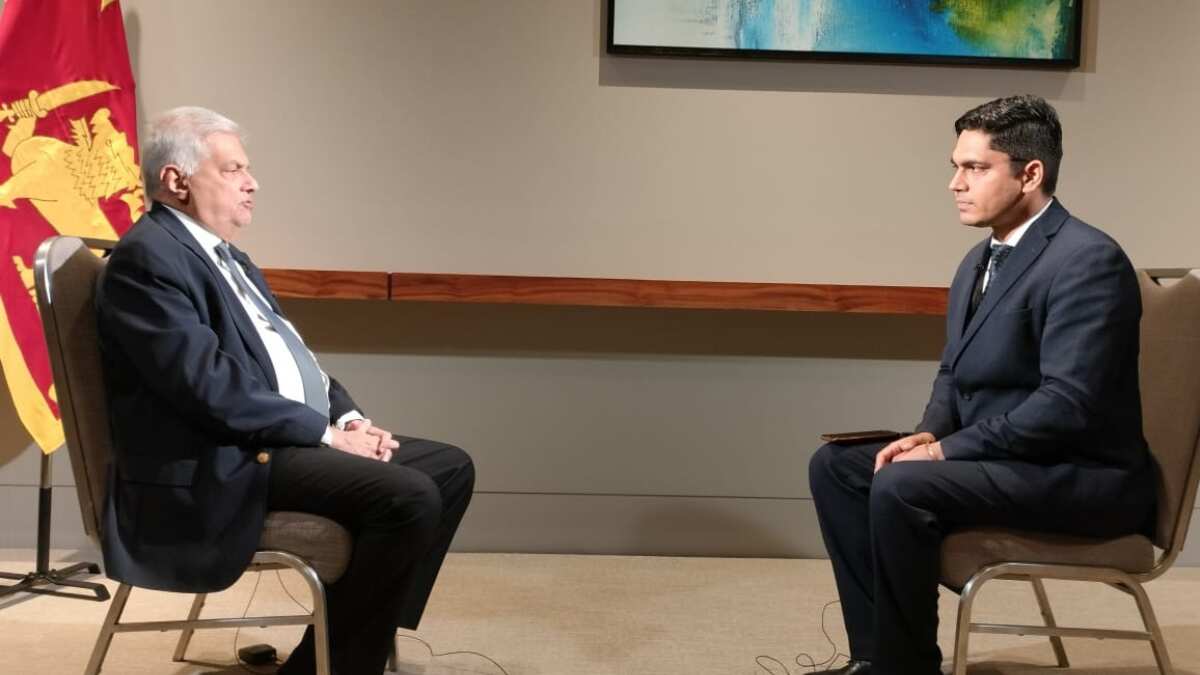
WION's diplomatic correspondent Sidhant Sibal speaks to Sri Lanka President Ranil Wickremesinghe.
Sri Lanka President Ranil Wickremesinghe, in an exclusive interview with WION's diplomatic correspondent Sidhant Sibal in Perth, thanked India for the economic support to his country amid the economic crisis.
Speaking to WION, he said that he is "thankful to India. Without that (India's help) we could not have survived and this is why we are also looking at closer relations between the two countries".
India provided support of almost $4 billion to Sri Lanka during the economic crisis. The president pointed out that plans are underway for IIT Madrasto establish a campus in Sri Lanka,"most probably in Kandy".

The president also spoke on other issues,includingthe visit of Chinese vessels to Sri Lanka and Maldives President Muizzu's India policy.
Here is the entire transcript of the interview.
WION: Sir my first question to you is how do you see India-Sri Lanka relationship? What is your vision about this relationship?
)
US vs China over South China Sea: Washington backs Philippines, Beijing hits back
)
Bigg Boss 20: Isha Rikhi evicted after three weeks in Salman Khan’s show
)
Musk plans to more than double xAI's chips to over 1.2 million Nvidia GPUs by year-end
)
After JU, clash erupts at SRFTI: BJP’s ‘Dimagi Naxal’ jibe sparks political firestorm after students protest RSS-linked event
)
‘Anti-social elements spreading false rumours’: LPU issues statement amid massive unrest over alleged rape
)
LPU students go on rampage, vandalise campus amid widespread protest: What's happening
)
Trump asked Xi to pressure Iran. China did not say yes — here’s what Beijing wants
)
US Treasury Secretary Scott Bessent hails global crackdown on Iranian banks and airlines
)
An OpenAI agent escaped its locked test cage again, by hiding questions in DNS lookups
)
'Our video was trimmed': LPU girls who featured in rape-denial video make U-turn
)
3 males killed, four others injured in shooting after fight at strip club in Detroit
)
'Victory for low-budget consumers': Raghav Chadha hails 30-day telecom recharge rules
)
Claude rebuilt the 1989 game 'Prince of Persia' by reusing the original's own code
)
Beyond metros: How Tier-2 and Tier-3 cities could drive India’s next AI wave
)
Tesla builds first Cybertruck with its own refined lithium: Elon Musk's $1 billion Texas bet pays off
)
IndiGo flight suffers tail strike in Bengaluru while landing; DGCA to probe incident
)
The US and China set up an AI 'red telephone', but skipped the rulebook
)
‘Terror suspects arrested near UK air base were looking to do big damage’: Trump
)
Russian envoy claims US tactics to contain India were revealed in ‘Freudian slip’
)
IND vs WI 1st ODI: Kohli breaks Sachin's most runs in one country record with unbeaten 139 as India thump West Indies by 8 wickets
)
Researchers rebuilt exactly how 700 AI agents hacked Hugging Face: a 900-link chain trick
)
‘Olympic inclusion is our major target’: WPA President Ishaun Singh on pool’s global ambitions
)
Nations League: Spain sink England at Wembley; Modric shines for Croatia
)
Why has Iran released no proof of life of Mojtaba Khamenei? Araghchi reveals...
)
'What kind of confession is this?': Pakistan PM Shehbaz Sharif’s 'terrorists would be roaming New York' remark goes viral, raises alarm online. Watch
)
South Korea demands apology from Ukraine over North Korean prisoners' transfer
)
Beyond BrahMos: India targets Rs 50,000 crore in defence exports with unmatched price edge
)
Sri Lankan Tamil migrant worker gets death sentence in Saudi Arabia, help sought from India
)
Muslim marriage cannot shield sex with minor wife from prosecution under POCSO: Delhi HC
)
'Can't help but draw painful parallels to Nirbhaya case': SC on latest incidents of rape cases in Delhi-NCR
)
99.9% more powerful - Scientists find boy who can recall memories from just 3 months of age
)
'FIRST LOOK from inside Noah’s Ark': Researchers share video from inside mysterious mound in Turkey
)
UNSC reform momentum grows: Russia, Portugal, Mauritius push for India's permanent seat bid
)
8 US marines injured in Iranian missile attack on vessel in Strait of Hormuz: Report
&im=FitAndFill=(700,400))
New OTT releases this week (September 28-October 4, 2026): Dupahiya 2, Pooja Meri Jaan, Ohh My Dog- 5 titles coming on Netflix, Prime Video and more
)
Afghanistan says 28 fighters killed in clash near Pakistan border, Islamabad denies
)
Ceuta migrant crisis: Protesters take to streets as Spain grapples with migrant challenge
)
LPU suspend classes, postpones exams as violence escalates over rape claims: What's happening
)
New York City wants a 'kill switch' on every AI, and will pay whistleblowers who report violations
Ranil Wickremesinghe: Actually the Indo-Lanka relationshipis improving, and today we are looking at close economic ties and improving connectivity between the two countries. I think that's the way to go.
WION: But essentially, India was one country that came forward during the economic crisis with a bill of almost $4 billion. How do you see India's support for your country?
Ranil Wickremesinghe: We are thankful to India without that we could not have survived and this is why we are also looking at closer relations between the two countries, especially, trade and economic success isthe way we have to go.
WION: What's the current situation in your country, the economic situation, how have things improved in the past year?
Ranil Wickremesinghe: Well, we've gone ahead with the debt restructuring, we have completed it, it's now the official part. We have to have an agreement with the OCC. In principle, they've agreed to what we have done, the formal part is now taking place and after the formal agreement with the official creditors committee, will have to then come to formal agreements with all the creditor countries plus the other financial organisations, which have been ignored in Sri Lanka debt negotiations.
WION: And when will it be possible, sir?
Ranil Wickremesinghe: I think by about June, should be over hopefully.
WION: Sir, coming to regional security, India has worriesover the visits of the Chinese vessels and I believe some decisions have been taken by the Sri Lankan government to not allow the visit of Chinese vessels.If you can just talk about the visits and if any decision has been made on this.
Ranil Wickremesinghe: Now what we have told India always is that we've kept Indian security in mind and we will not allow anything to happen that will be harmful to Indian security, and these are all hydrographical vessels. So we've allowed them to come there. We decided that this year, we will look at capacity building for Sri Lanka and therefore now we are focusing on Sri Lanka building its own hydrological capacity by cooperating with others. As a result, we have said no ships from any country on hydrological matters can come to Sri Lanka but if they are Navy ships that are coming in for visits, yes we will allow it.
WION: You will know about the visits of Chinese navy ships.
Ranil Wickremesinghe: Anyway, they've been coming to Sri Lanka. Indian ships come, Chinese ships come, Japanese ships come. All ships come to Sri Lanka, American ships come.
WION: But do you think that China is trying to create a wedge between India and Sri Lanka somehow because India is worried about the visits and India is worried about the increased Chinese presence in the Indian Ocean region? And that is something that many countries share as well.
Ranil Wickremesinghe: Chinese ships have been coming to Sri Lanka over a period of time. And China has never tried to create a rift between India and Sri Lanka they always say that we have to get along with India. There has never been an issue as far as we are concerned. The number of ships that have been coming has not increased, nor have they decreased. But we are also encouraging ships from other countries to come in, which have not been there earlier. Japan, India, Pakistan US, their ships have been coming. But we've asked many of the other European countries to come to Sri Lanka.
WION: And the role played by the Chinese, when it comes to the debt restructuring they have been dragging their feet.
Ranil Wickremesinghe: Well they agreed to debt restructuring. They have also agreed for this, but it is different from the other countries. We have to deal with the China Development Bank of Chinamainly, and also with the import export ban. Those are the two that we have to deal with. In most ther countries, we've been dealing with the government agencies.
WION: Coming back to the India-Sri Lanka relationship, you started by pointing out at connectivity, that hasseveral aspects to it. One is theland connectivity, one of the decisions that was taken was to connect the two countries through a land bridge, what is the vision behind it andhas any step been taken by the Sri Lankan government?
Ranil Wickremesinghe: There are two connectivities we are looking at. Firstly, is the power connectivity, whichI thinkIndian companies likeAdani are investing in Sri Lanka. We are discussing the power connectivity and we have come to an agreement that it should be an undersea cable. And now we will start working out the details. Similarly, as far as land connectivity is concerned, we've got to get a feasibility study for us. So we have appointed officials on both sides for coordination and they like to havethe feasibility study first and the environment to study.
WION: Connectivity has another aspect that is financial connectivity. UPI is something that has been talked about....
Ranil Wickremesinghe: That has been going ahead.
WION: Any plans when it will be implemented.
Ranil Wickremesinghe: It should be soon, but we'd be discussing it in Colomboin the next two weeks.
WION: And part of financial connectivity is the usage of Indian rupee. This is part of the conversation. Will we see the usage of Indian rupee...
Ranil Wickremesinghe: We want to see the usage of Indian rupees in Sri Lanka. Have no issue at all
WION: Has the trading started?
Ranil Wickremesinghe: Not yet. It will help tourism especially
WION: How have the Indian tourists helped Sri Lankan economy?
Ranil Wickremesinghe: Tourism helps our economy a lot and Indian tourists coming in hasbeen good.
WION: Part of the India-Sri Lanka relationship is the trade trade in local currency as you talked about the part of that is the free trade agreement. Have there been conversations regarding FTA?
Ranil Wickremesinghe: The FTA is operational. Now we are discussing how to advance the FTA certainly to a comprehensive economic and technology partnership
WION: And what do we expect from India in terms of your development goals? Anything specific?
Ranil Wickremesinghe: India has helped us financially but we'd like to especially see Indian investments in Sri Lanka and a new phase has been the decision that IIT Madras will establish a campus in Sri Lanka, most probably in Kandy.
Also Read:World values India's contribution in Indian Ocean, says Foreign Minister Jaishankar
WION: And when this establishment will come up?
Ranil Wickremesinghe: A ministerial delegation visited India, and now we are in the process of identifying the locations. But we'd like to take some existing buildings and start itnext year.
WION: That's a significant educational connect, but there are other issues as well. Some irritants in the relationship is thefishermen issue. India has been raising it in the past. Any sort of reaching out between the two sides so thatthere is a resolution on this issue?
Ranil Wickremesinghe: Well it's because the Tamil Nadu fishermen are coming into our area, it is a big issue with our fishermen and we'rediscussing it. We want to conclude it sometime this year because we can't have them coming in all the time.
WION: Moving forward when it comes to the region. Going to Maldives, where you were present when theoath-taking ceremony took place. How do you see the current government in Maldives which has been not very pro-India, in many senses they have been running anti- India movement as well. What's your view about the current dispensation in Maldives
Ranil Wickremesinghe: It is a new government that's settling down. So we have to give them some time to come to grips and especially at the moment there is a struggle between the President and the parliament also. So we are watching what happens there.
WION:The Indian Ocean conference is taking place. Sri Lanka is an important country in the Indian Ocean, you have a vast exclusive economic zone as well. How can Sri Lanka play an important role for stability in the wider region?
Ranil Wickremesinghe: Well, we've always been pushing freedom of navigation in the Indian Ocean, that this should be free of big power, rivalry, and close cooperation between the countries. Now that Sri Lanka is Chairman, that's what we've been asking for.
WION: And what's your view about the situation in the Red Sea because it impacts the economic security of many countries including Sri Lanka,
Ranil Wickremesinghe: Red Sea is vital to us, Suez Canal is vital to us. We want the warto come to an end.The Red Sea attacks by Houthis should not take place and we are cooperating with other countries to ensure it is safe.
WION: So coming back to the tourism aspect which plays an important role. This plan of a Ramayana circuit that connects India and Sri Lanka. What's the progress like on that?
Ranil Wickremesinghe: Well, it's basically the tourist companies and others who are doing it. There are a lot of Shiva temples there. There are the four Eswara temples and Dikshina Kailash Trincomalee.
WION: We saw the inauguration of the Ram temple in India. Any plans of a high level delegation visiting Ayodhya Ram temple, including from your government.
Ranil Wickremesinghe: I think some of our people went for the function. We expected the Ram temple to be built once the Supreme Court case was over. It was a matter of when it was going to be done. And Prime Minister Modi and the government havedone it. Yes.
WION: So another aspect is Canada. We have also seen comments by the Canadian government onthe situation in Sri Lanka, what's your view about this Canadian government making these remarks?
Ranil Wickremesinghe: Weare not interested in dealing with it. So our contracts with Canada at the moment are minimal.
WION: So when you made the speech here, you mentioned about the US role and your comments were very sharp. You pointed out the ill advised decisions by the Americans in the region. So what role do you think is being played by the US in the region? If you can characterize it?
Ranil Wickremesinghe: No, I call it ill advised because it's backing the Gaza war. No, I mean, everyone would expect us to stand with Israel when Israel is attacked. I don't think there's an issue on this. But this is such that remember, we have a major Islamic part in the Indian Ocean, many of them friendly with the US government other than Iran, but this is going to put pressure on them. If the pressure is on for three, four years that will make a vast difference.Russia is a key player in the western Indian Ocean. So it's a setback for US.
WION: And how do you see Russian role in the region?
Ranil Wickremesinghe: Yeah, improving its economic role and it's making political contact with all countries. And even militarily, they're having naval exercises. So in a way, they they want to push them on to the western Indian Ocean.
WION: So moving to a multilateral dimension, UNSC reforms aresomething that are much talked about, what's your view, and what's your take on India being at the high table?
Ranil Wickremesinghe: We feel that the reforms must be done. India also should be in the Security Council. But we want overall discussion where we, the smaller countries also have a say. But I can't see that discussion taking place at the moment.
WION: And do you think that it's going to take some time because there are elements who are trying to stop or delay the process?
Ranil Wickremesinghe: It will take time.
WION: We saw India hosting the G20summit last year, and the African Union became a permanent member of the G20 under Indian presidency, how do you see India engaging with Africa and your perspective as to how do you plan to engage with Africa as well?
Ranil Wickremesinghe: India has been engaging with Africa for a long time even before, I mean, basically, many Indian trading families are there in Africa, you got a natural East Africa, in Mauritius so I even in South Africa when Mr. Mahatma Gandhi was there. We are reaching out to East Africa, South Africa. We are reaching out first to the countries on the Indian Ocean coast but we are also looking at West Africa. We have to develop those relations.
WION: Your views about the Indo Pacific This is a vision which is backed by several countries in the region.
Ranil Wickremesinghe: We are more focused on the Indian Ocean, so the ASEAN outlook is what we like, because we we are basically Indian Ocean country. We've had ties in the old days, now it's extended to Japan and Korea. We don't go beyond that.
WION: Moving forward to the domestic aspects of your country. Elections happening this year.
Ranil Wickremesinghe: Yes, both presidential and parliamentary.
WION: And, how optimistic you are that hopefully you will back
Ranil Wickremesinghe: For me to be back, I must contest.
WION: And you do you plan to sir?
Ranil Wickremesinghe:My first focus is on my duty that we get out of bankruptcy.
WION: And do you think you've done a good job? I mean, what's your view about the economy in terms of your tenure because you ultimately were the face of the crisis in terms of bringing Sri Lanka out of the crisis and back to normalcy?
Ranil Wickremesinghe: Well, I'm quite satisfied, I feel we will be able to do this.
WION: You will be able to do this. Another thing is the implementation of the 13th Amendment something that India has also been talking about> What's the way forward
Ranil Wickremesinghe:We will hold the provincial council election next year. As I announced, we want to give each province its own economy. So like in India, they will compete with each other. The provinces should handle their economic and social development within the national policy framework. In this respect, we said we are prepared to give concurrent powers most of it or what whatever is required whatever they want to the provincial councils, so that we are moving on. There has been a request by some of the groups, for minority groups in our Senate. So as far as we are concerned, we will not oppose it, but it's a matter for all parties to agree to, not merely the government and there are so many parties in Parliament at the moment.
Watch:Sri Lanka President thanks India for economic support; Plans for IIT Campus in Kandy
WION: So in the regional aspect, there are several groupings. One is the BIMSTEC grouping. In fact, the summit is planned this year. What's your vision when it comes to this specific grouping?
Ranil Wickremesinghe: We have to fast track the integration. That's my view. We are a bit slow on it. But we've been talking to prime ministers. We have to basically fast track it as I said earlier.
WION: And do you think that SAARcas a grouping is dead?
Ranil Wickremesinghe:No. We have not buried it or anything. Certainly the political side of the grouping is not active. But I must say some of the areas like culture and all are going on, maybe we should focus on the non political issues there.
WION: So time is running out and you have a flight to catch as well. My last question for you is what role do you think Sri Lanka can play in providing stability to this region, which has several challenges.
Ranil Wickremesinghe: Well, we want to keep the big power rivalry out of the Indian Ocean. There should not be any rivalry which hasan adverse impact on the Indian Ocean.
WION: How do you see the BRICS grouping?
Ranil Wickremesinghe: BRICS group is expanding . Especially with Saudi, Iran, you have the African countries and one more from Latin America and that's s good thing. I know large group has applied but it's better to expand slowly.
WION: And, SCO? The Shanghai Cooperation Organisation?
Ranil Wickremesinghe: You can see central Asia opening up andShanghai Cooperation Council is going to be important.
WION: Thank you...