World values India's contribution in Indian Ocean, says Foreign Minister Jaishankar

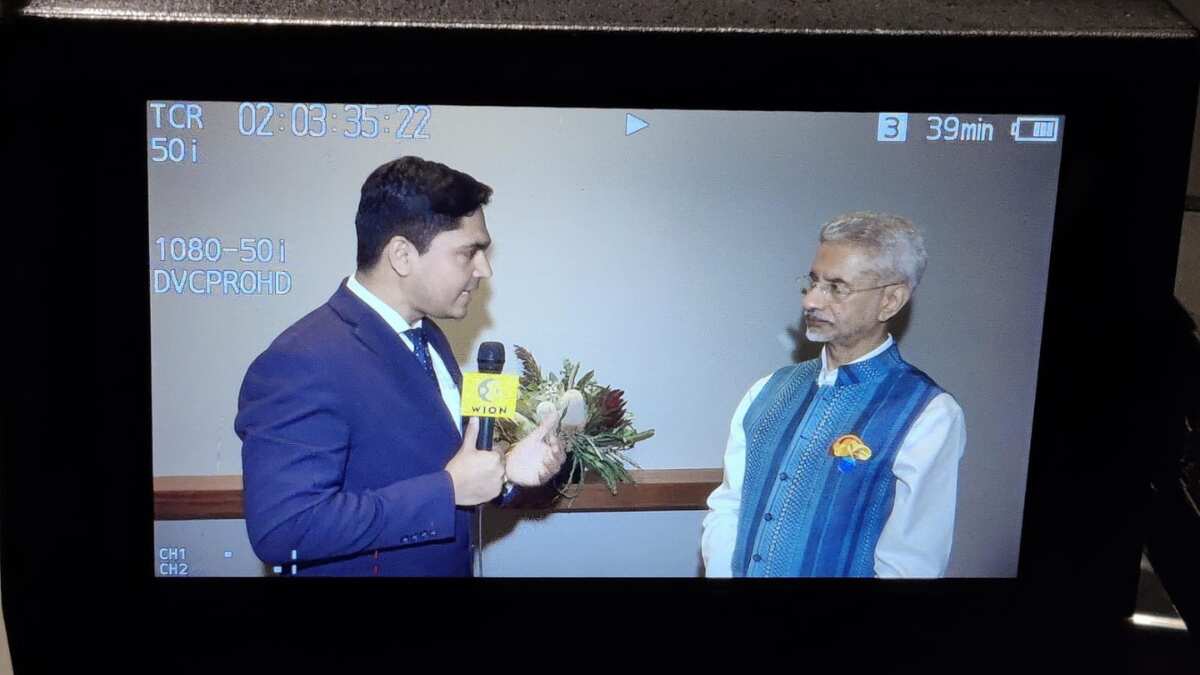
File photo.
India's External Affairs Minister (EAM) Dr S Jaishankar has said that the world "values" India's contributions to the Indian Ocean region. Speaking to our diplomatic correspondent Sidhant Sibal in Perth, on the sidelines of the Indian Ocean conference, he said, "Expectation is that India would make a greater contribution, frankly, from our own perspective, you know, our interests today are so much greater and so much of our trade, for example, goes through the Red Sea."
He pointed to India's "strong shipping presence in that whole western Indian Ocean area". He also spoke on the India-Australia relationship, and how it has been strengthened under the Modi government.
Siddhant Sibbal: We're here in Perth at the Indian Ocean conference with me is External Affairs Minister Dr S Jaishankar. Sir welcome to WION. This conference is something that has grown in each passing year starting from Singapore. This year we have seen so many foreign ministers coming and the role played by this conference in bringing together other countries of the region.

Dr S Jaishankar: Well, I've been attending this conference, I think barring one since it started. This is the seventh conference. Where this is useful is that you know, in the Indian Ocean there are different platform mechanisms, there isn't a single occasion where everybody gathers. So what it does is partly it has a broader, broader reach. It also supplements because there are official gatherings but some of this brings together you know, ministers diplomats, think tankers, business people. So often these kinds of international cooperation efforts are strengthened when you have this track to sort of activities side by side, and I think that's really been the value that it has brought and that value has grown with those seven conferences.
Also read |Exclusive: Sri Lankan president thanks India for economic support; plans for IIT campus in Kandy
Siddhant Sibbal: Sir India is a net security provider in the Indian Ocean region, if you can talk about that. I'm asking this given that there are challenges emerging in the region including the crisis in the Red Sea.
Dr S Jaishankar: Well, what has happened, two things have happened one, internationally. Many others who in the past bore that responsibility today may not have the same willingness or capability. some who have greater capability may not have the willingness. So there is a kind of, in the global commons, there's a deficit okay. So if you have international waters, let us say piracy, we are seeing that we've seen that in the Gulf of Aden. We are having, you know, attacks on maritime shipping. Now, whose responsibility is it because it's not, it's not within most of it is not within us. So here countries need to step forward. I think the expectation is that India would make a greater contribution, frankly, from our own perspective, you know, our interests today are so much greater and so much of our trade, for example, goes through the Red Sea. We have such a strong shipping presence in that whole western Indian Ocean area. So it's, I would say self-interest, but it's also in a sense of global good that we are doing and it's something which the world values.
Siddhant Sibbal: And so how is India helping in building capacity in the region?
Dr S Jaishankar: It varies, you know, there are countries where we have actually done a lot of training, capacity building. We have given equipment I mean, if you look, even in our own region, Sri Lanka, Maldives, Mauritius, Seychelles, and Mozambique, these are all countries where in the maritime sphere, we've been we've actually given equipment we have built capacities on the go east of India, Vietnam, to some degree. So this is something which is I would say, part of how to build a larger Indian Ocean community and it's, it's a it's a very important aspect of the SAGAR outlook that we have.
Siddhant Sibbal: Sir, moving on to the bilateral aspect, India, the Australia relationship, you pointed out in the speech at the dinner, that it's one of the most consequential relationships, what's your vision about this relationship? Are the new heights being touched in this relationship?
Dr S Jaishankar: Well, you know, if you look at it by any metrics, we have, we've had more visits. We have more trade. number of students is growing communities growing. The exchanges between us and civil society growing business exchanges are growing, tourism is growing. So there's a lot of and by, if you measure it in numbers, the relationship is really great. But to me, the real change is in the comfort, the greater trust and confidence that we have in each other. The fact that we meet and discuss so many things that we work together. You know, in my remarks, I pointed out we have a strong bilateral relationship we have a trilateral with Indonesia and France, and we have a very important quad relationship we work with the Australians and bodies like the IORA etc. So we really think this is a relationship with great promise. great potential. And, you know, if you look at the last 10 years, this is one if I were to pick one or two relationships, which have really changed in the last 10 years, because before Prime Minister Modi came very frankly, it was a very neglected relationship.
Siddhant Sibbal: And how both countries are working together in the Indian Ocean region, we are here in Perth which is known as the Indian Ocean capital of Australia.
Dr S Jaishankar: Well, in different ways. I mean, you know, we do the Malabar exercise. There are other exercises they have exercises in which we participate as well. I think there's one called Talisman Sabre. We are working now on a HADR- Humanitarian Assistant disaster response efforts including through the quad. bilaterally, we have hosted deployments. So whether it is policy, whether it's exercises, whether it is a, you know, together, we are contributing to a larger effort, it's all coming together.