

&imwidth=800&imheight=600&format=webp&quality=medium "Does hosting Putin help or hurt Xi’s bid to project China as a responsible global power?")
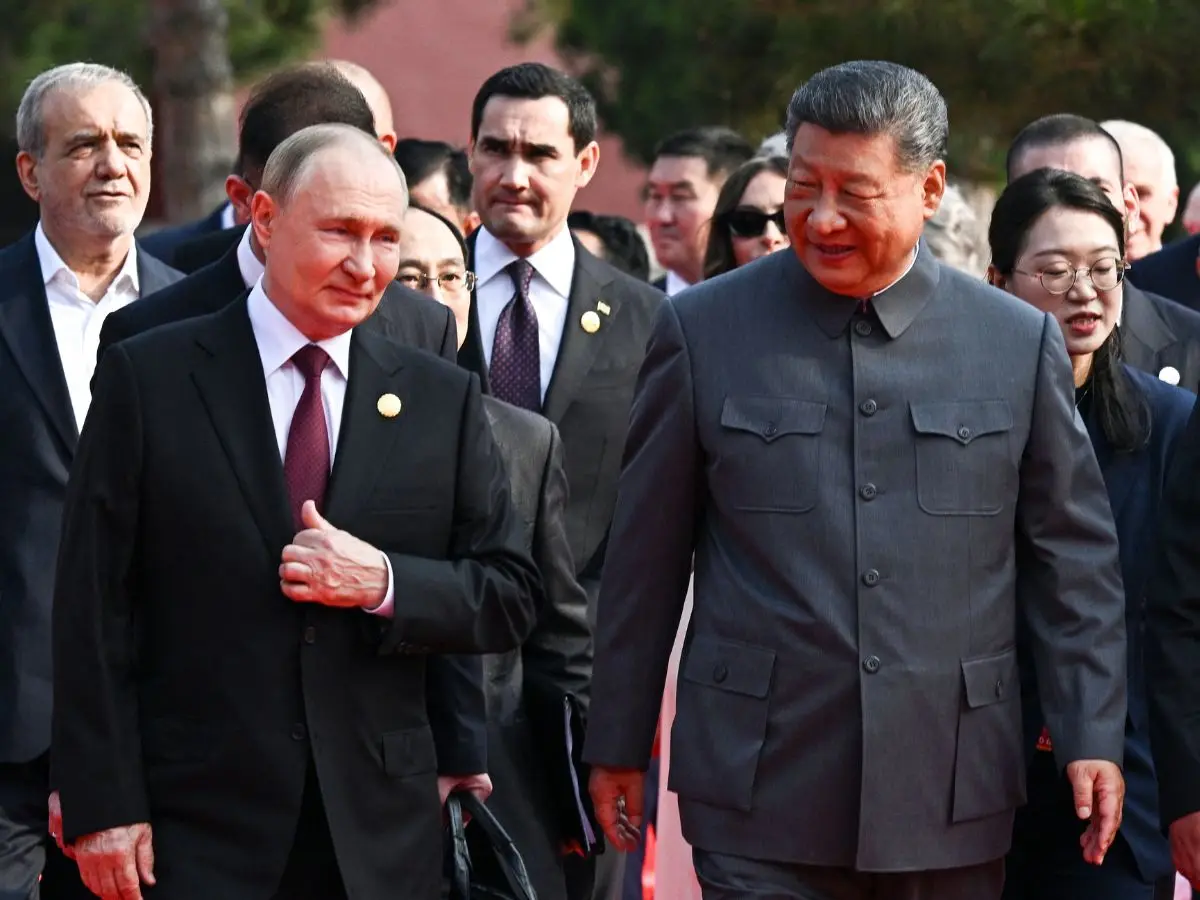
Chinese President Xi Jinping is set to host Russian leader Vladimir Putin in Beijing less than a week after US President Donald Trump’s closely watched visit to China, placing Beijing’s balancing act on full display. As trade tensions, wars and global energy disruptions reshape international politics, China is seeking to project itself as a stable and predictable power. Yet welcoming Putin, while Russia’s war in Ukraine grinds on, also risks renewed scrutiny of Beijing’s increasingly close partnership with Moscow. By rolling out the red carpet for two heavily conflicted global figures within days, Xi seeks to project China as an indispensable, stabilizing superpower capable of managing relations with both Washington and Moscow.
Putin arrives on Tuesday for what Chinese officials describe as his 25th visit to China, underlining the depth of ties between the two countries. China and Russia have repeatedly characterised their relationship as an ‘all-weather’ and ‘ironclad’ partnership, with Xi and Putin maintaining regular contact through meetings, calls and personal exchanges.
A partnership built on strategy and energy
The relationship is underpinned by complementary interests: China’s economic strength and Russia’s vast energy reserves. Moscow has become increasingly reliant on Beijing since Western sanctions cut Russia off from many European markets following the Ukraine conflict. “The Xi-Putin summit will telegraph to the world that the China-Russia strategic partnership remains the cornerstone of both countries’ foreign policies,” Ian Storey of the ISEAS-Yusof Ishak Institute in Singapore, told Reuters, adding that any US attempt to divide the two powers was ‘destined to fail’.
Trade between the two countries has more than doubled since 2020, according to the Mercator Institute for China Studies. More than 70 per cent of China’s imports from Russia are mineral fuels, while Russian oil exports to China have risen sharply since 2022. Energy cooperation is expected to dominate this week’s discussions, particularly the proposed Power of Siberia 2 gas pipeline. During Putin’s last visit in September 2025, both sides agreed to advance the project, although pricing disputes remain unresolved.
Trending Stories
&imwidth=180&imheight=135&format=webp&quality=medium)
Blasts heard in Sanaa as Saudi-led coalition warns civilians to evacuate; Houthis vow retaliation
&imwidth=180&imheight=135&format=webp&quality=medium)
China's counter-surveillance industry booms amid heightened espionage fears | Gravitas
&imwidth=180&imheight=135&format=webp&quality=medium)
Saudi Arabia strikes Yemen oil sites as Houthi missiles target Riyadh; 'limited fire' breaks out at Aramco
&im=FitAndFill=(700,400)&imwidth=180&imheight=135&format=webp&quality=medium)
Navratri 2026: 9 days, 9 forms of Goddess Durga and 9 colours- Check the complete list
&imwidth=180&imheight=135&format=webp&quality=medium)
Trump accuses Houthis of driving up oil prices before US midterms, warns of consequences
&imwidth=180&imheight=135&format=webp&quality=medium)
New Delhi rejects Beijing’s claims and remarks on Ladakh location naming exercise
&imwidth=180&imheight=135&format=webp&quality=medium)
Russian woman and Bihar boy's love story goes viral after she reaches India to marry him
&imwidth=180&imheight=135&format=webp&quality=medium)
US Midterms 2026: In Alaska, cost-of-living anxiety meets strangest ballot in high-stakes Senate race
&imwidth=180&imheight=135&format=webp&quality=medium)
CMs Vijay-Naidu meet in Vijayawada, discuss water sharing, river-linking
&imwidth=180&imheight=135&format=webp&quality=medium)
'Don't ever mess with nature!': Trump’s tiger attack post triggers social media backlash as victim's family issues heartbreaking tribute
&imwidth=180&imheight=135&format=webp&quality=medium)
OpenAI employee arrested by FBI after allegedly hiding recording device in office
&imwidth=180&imheight=135&format=webp&quality=medium)
1,500 drones illuminate Mumbai sky as Cordelia Cruises unveils second ship, Cordelia Sky
&imwidth=180&imheight=135&format=webp&quality=medium)
Delhi Police arrest Cockroach Janta Party's Saurav Das, Ashutosh Ranka, Ajinkya Shinde in Jantar Mantar case, to be produced before court
&imwidth=180&imheight=135&format=webp&quality=medium)
Pope Leo XIV diagnosed with lung cancer after surgery, Vatican says 'successful surgery and recovering'
&imwidth=180&imheight=135&format=webp&quality=medium)
Pakistan to chair UN-backed global Borrowers’ Platform as its own debt burden mounts, triggers sarcastic reactions on social media
&imwidth=180&imheight=135&format=webp&quality=medium)
Robot gropes girl, makes thrusting movements in bizarre crime in Germany
&imwidth=180&imheight=135&format=webp&quality=medium)
France accuses Musk of ‘online harassment’ of European leaders, warns of poll interference
&imwidth=180&imheight=135&format=webp&quality=medium)
MI5 chief warns Russia is UK’s ‘aggressor number one’ as Iran and AI threats grow
&imwidth=180&imheight=135&format=webp&quality=medium)
'Turn approver, resign, we'll forgive you': Rahul Gandhi claims receiving messages from CEC Gyanesh Kumar
&imwidth=180&imheight=135&format=webp&quality=medium)
Trump reconsidering calling off Nidal Hasan's execution livestream. Here's why
&imwidth=180&imheight=135&format=webp&quality=medium)
‘My president, I mean my husband’: Trump's new press secretary Katie Zacharia's first briefing goes off the rails in 14 minutes
&imwidth=180&imheight=135&format=webp&quality=medium)
‘How many people did she illegally bring from Somalia?’ Trump targets Ilhan Omar, questions her net worth
&imwidth=180&imheight=135&format=webp&quality=medium)
Marco Rubio to visit India next week, focus on energy cooperation and strategic ties
&imwidth=180&imheight=135&format=webp&quality=medium)
L Murugan resigns as Union Minister, expresses wish to return to grassroots
&imwidth=180&imheight=135&format=webp&quality=medium)
'Ouch!!! That must hurt': Kangana Ranaut hails Kamal Haasan's sharp reply to Elon Musk over Starlink row
&imwidth=180&imheight=135&format=webp&quality=medium)
Girl 'dead' for 8 hours wakes up at her own funeral, dad insists she wasn't breathing
&imwidth=180&imheight=135&format=webp&quality=medium)
Sidhu Moose Wala’s younger brother wins hearts by recreating late singer’s signature move at Toronto Hologram Show
&imwidth=180&imheight=135&format=webp&quality=medium)
UK school ditches technology, shifts from screen to pen and paper for learning
&im=FitAndFill=(700,400)&imwidth=180&imheight=135&format=webp&quality=medium)
New OTT releases this week (October 12-18, 2026): Sacrifice, Koffee with Karan S9, Roadies Rebirth- 6 titles coming on Netflix, JioHotstar and more
&imwidth=180&imheight=135&format=webp&quality=medium)
Anupam Kher joins Ranbir Kapoor's Ramayana as Jatayu, new poster unveiled
&imwidth=180&imheight=135&format=webp&quality=medium)
Netanyahu wants to join Saudi's war on Houthis, but Crown Prince denies: Report
&imwidth=180&imheight=135&format=webp&quality=medium)
Measles kills again: 6 dead in Pennsylvania as America faces its worst outbreak in decades | Gravitas
&imwidth=180&imheight=135&format=webp&quality=medium)
Ken Paxton's Dubai night out with two US fugitives sparks political storm as Texas Senate race tightens
&imwidth=180&imheight=135&format=webp&quality=medium)
Cornell University suspends fraternity parties over 2024 gang rape allegations
ALSO READ: Iraq oil exports through Strait of Hormuz plunge from 93 million to 10 million barrels in April
Beijing’s global messaging challenge
While Beijing has regularly called for talks to end the war in Ukraine, now over four years long, it has never condemned Russia for sending in troops. Thus, it continues to present itself as neutral on Ukraine and insists it has not supplied lethal weapons to either side. “China says it strictly controls exports of dual-use items,” foreign ministry spokesperson Guo Jiakun said on Monday. At the same time, Beijing appears determined to show that its diplomacy will not be shaped by Western pressure. According to AFP, Natasha Kuhrt of King’s College London described the summit as “a reminder to Washington that this is a solid relationship of 30 years-plus standing”.
For Xi, the optics are carefully calibrated: projecting China as a force for global stability while preserving one of its most strategically important partnerships.

