

&imwidth=800&imheight=600&format=webp&quality=medium "BRICS Summit 2026: How four chairmanships reshaped India’s global strategy")
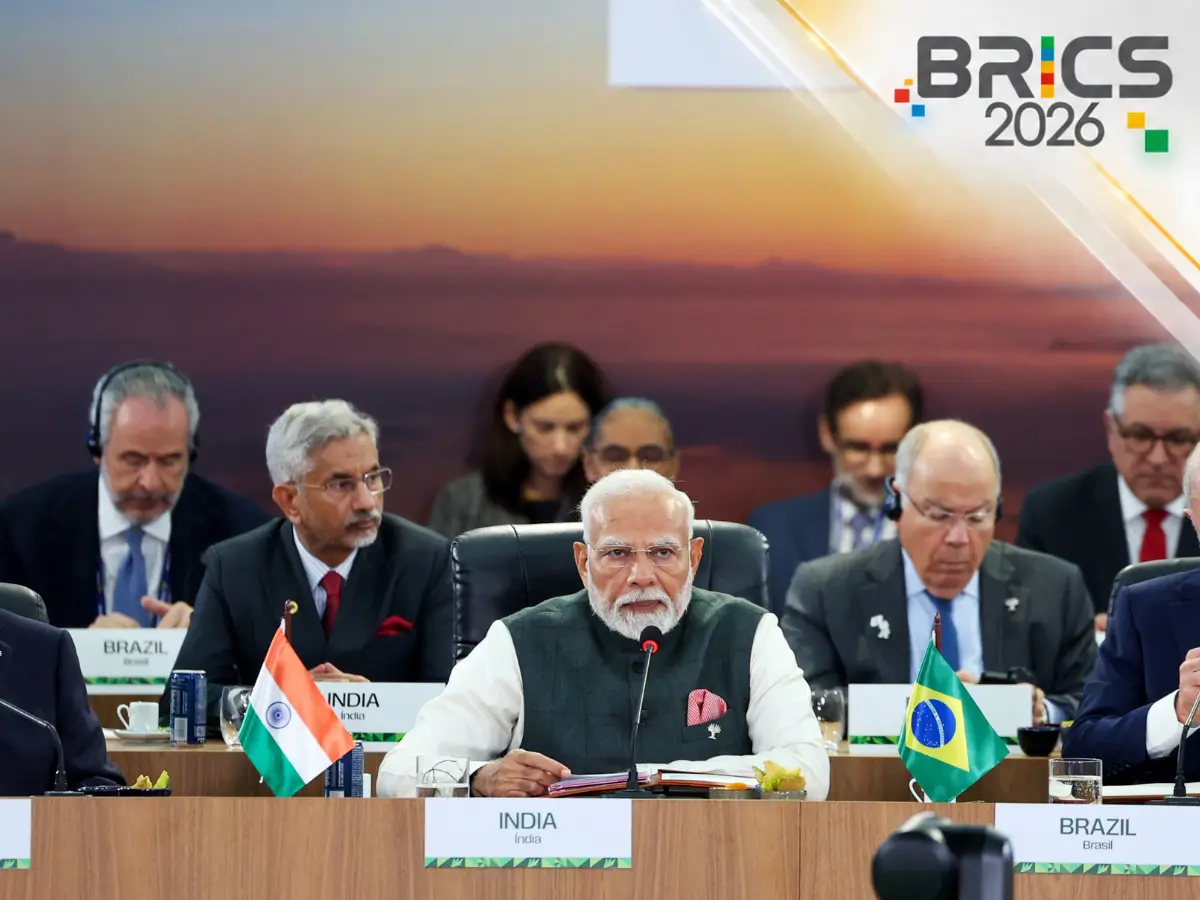
India’s four BRICS chairmanships—in 2012, 2016, 2021 and 2026—reflect the changing priorities of both the grouping and New Delhi’s foreign policy. From strengthening BRICS’ institutional foundations and financial cooperation to pushing counter-terrorism, consensus-building and Global South priorities, India’s role has steadily expanded. In 2026, technology, resilience and global governance reform have emerged as key pillars of its BRICS strategy.
BRICS chairmanship in 2012
During India’s first BRICS chairmanship was in 2012. In that year, New Delhi’s primary objective was to give greater institutional shape and credibility to what was still a relatively informal grouping of emerging economies. India moved the bloc from an informal dialogue forum toward a concrete, institutionalised entity. India put forward the core proposal to create a new multilateral development bank financed by the Global South. This directly resulted in the heads of state instructing their finance ministers to study its feasibility. This Indian initiative laid the direct groundwork for the formal establishment of the New Development Bank (NDB) in 2014.
2016: Using BRICS to highlight terrorism and connectivity
By India’s second BRICS chairmanship in 2016, the grouping had acquired greater political significance, and New Delhi used the Goa Summit to push issues extending beyond economics. The eighth BRICS Summit was held under the theme “Building Responsive, Inclusive and Collective Solutions”, with India seeking to broaden the organisation’s agenda around security, connectivity and development. Terrorism became one of New Delhi’s most important priorities. India sought to bring greater international attention to terrorism and the networks that support it, particularly against the backdrop of growing tensions in South Asia. The summit provided India with a platform to make the case for stronger international cooperation against terrorist organisations and their financing, while also reinforcing its position on cross-border terrorism. At the same time, India promoted regional connectivity and economic integration as important components of the BRICS agenda.
Trending Stories
&imwidth=180&imheight=135&format=webp&quality=medium)
SA vs AUS 2nd Test: Temba Bavuma reveals 'Tendulkar inspiration' behind career-best 179
&imwidth=180&imheight=135&format=webp&quality=medium)
Ilhan Omar breaks silence over alleged marriage to her brother; Trump thinks it's 'really good answer'
&imwidth=180&imheight=135&format=webp&quality=medium)
Koffee With Karan 9: Rashmika Mandanna calls trolling over South Indian accent ‘unreasonable’
&imwidth=180&imheight=135&format=webp&quality=medium)
Watch: India rejects ‘imprecise and unsupported’ references in UN migrant rights report
&imwidth=180&imheight=135&format=webp&quality=medium)
US midterms 2026: US Supreme Court allows New Hampshire to restrict student IDs for voting
&imwidth=180&imheight=135&format=webp&quality=medium)
China's dancing robot turns violent bodyguard, lifts cars and fights intruders - Watch
&imwidth=180&imheight=135&format=webp&quality=medium)
'It's a crime not to see this scene': Tehran puts Trump 'behind bars'
&imwidth=180&imheight=135&format=webp&quality=medium)
'This is despicable': Amy Acton hits back at Vivek Ramaswamy over Ohio campaign ad featuring her estranged mother
&imwidth=180&imheight=135&format=webp&quality=medium)
WATCH: Trump demands Ilhan Omar removal from Congress for 'using fake name to be sworn in'. So what is her real name?
&imwidth=180&imheight=135&format=webp&quality=medium)
Horrific video shows the moment 18-year-old fell to her death from Mexico amusement park ride
&imwidth=180&imheight=135&format=webp&quality=medium)
From Agni-V to Project Kusha: How are India’s indigenous missile systems and defence shield reshaping modern warfare
&imwidth=180&imheight=135&format=webp&quality=medium)
Christa Pike's failed execution: Tennessee team struggled to insert IV lines, lawyer says
&imwidth=180&imheight=135&format=webp&quality=medium)
One man, 8 months of work, and a river dirty again: Why Bittu Tabahi may quit
&imwidth=180&imheight=135&format=webp&quality=medium)
Two BrahMos missiles on Tejas, triple the range and 100% indigenisation, says former BrahMos CEO
&imwidth=180&imheight=135&format=webp&quality=medium)
Saudi Arabia targeted yacht carrying 14 Indians in Red Sea, rescue underway, Houthis claim
&im=FitAndFill=(700,400)&imwidth=180&imheight=135&format=webp&quality=medium)
New Friday OTT releases (October 23, 2026): Gajab Raat, Dorothy, Chaar Yaar- Watch these 6 new movies and TV shows on Netflix, Prime Video and more
&imwidth=180&imheight=135&format=webp&quality=medium)
ENG vs SL: Harry Brook’s 202 goes in vain as Sri Lanka pull off second-highest ODI chase
&imwidth=180&imheight=135&format=webp&quality=medium)
US to get 850 F-35 stealth fighter jets under 10-year Pentagon-Lockheed deal
&imwidth=180&imheight=135&format=webp&quality=medium)
'Vivek should keep it up': Trump defends Ramaswamy's controversial campaign ad targeting Amy Acton
&imwidth=180&imheight=135&format=webp&quality=medium)
US midterms 2026: Elon Musk’s political spending hits $445 million as Republicans battle to retain Senate control
&imwidth=180&imheight=135&format=webp&quality=medium)
GRAVITAS | Putin fires nuclear-capable hypersonic missiles, Zelensky ready to surrender 25% territory
&imwidth=180&imheight=135&format=webp&quality=medium)
Trump ordered to answer questions under oath in BBC defamation lawsuit by December 11
&imwidth=180&imheight=135&format=webp&quality=medium)
France reports first human case of livestock virus Shamonda, patient dies; what we know so far
&im=FitAndFill=(700,400)&imwidth=180&imheight=135&format=webp&quality=medium)
Serbia elections: Nearly 150,000 people take to streets in massive rally against Aleksandar Vucic | In pics
&imwidth=180&imheight=135&format=webp&quality=medium)
Finance influencer dies by suicide in Chennai; father accuses tech CEO, who denies charge
&imwidth=180&imheight=135&format=webp&quality=medium)
Putin says Russia is ready to resume Ukraine-US peace talks but rejects 'short ceasefire' amid deadly attacks
&imwidth=180&imheight=135&format=webp&quality=medium)
Meghan Markle’s father Thomas under investigation over alleged child abuse images: Report
&imwidth=180&imheight=135&format=webp&quality=medium)
Netanyahu dials PM Modi, invites him and Capt Smit Machchhar to light torch on Israel’s Independence Day
&imwidth=180&imheight=135&format=webp&quality=medium)
'That was great, who threw that punch?': Trump asks as protester punched at rally
&imwidth=180&imheight=135&format=webp&quality=medium)
Viral video shows cross falling on Colombia priest, no official confirmation | WATCH
&imwidth=180&imheight=135&format=webp&quality=medium)
ENG vs SL: Harry Brook breaks Shubman Gill’s record for fastest ODI double century
&imwidth=180&imheight=135&format=webp&quality=medium)
What is the ‘heat ray’ weapon? Pete Hegseth reportedly authorises DHS to test it at US-Mexico border
&imwidth=180&imheight=135&format=webp&quality=medium)
India-China face-off continues near Arunachal’s Taksing, reveals ITBP chief in first official confirmation of tensions
&imwidth=180&imheight=135&format=webp&quality=medium)
A secret code, a midnight escape and 300 deaths: The Russian officer who turned on Putin
2021: Maintaining consensus amid the pandemic and China tensions
India assumed the BRICS chairmanship for a third time in 2021, but the circumstances were markedly different from its earlier presidencies. The 13th BRICS Summit was held virtually as countries continued to deal with the COVID-19 pandemic. At the same time, India was confronting an acute military standoff with China along the Line of Actual Control. Against this backdrop, India adopted the theme “BRICS@15: Intra-BRICS Cooperation for Continuity, Consolidation and Consensus.” The emphasis was on maintaining the functioning of the grouping despite the difficult international environment and differences among its members.
The pandemic also pushed health cooperation, economic recovery and resilience higher on the agenda. For India, the challenge was to preserve BRICS as a functioning multilateral platform while simultaneously managing its increasingly complicated relationship with China. This made consensus-building particularly important: New Delhi had to advance its interests without allowing bilateral tensions to completely overshadow the wider BRICS agenda.
2026: From BRICS cooperation to a Global South platform
India’s fourth BRICS chairmanship in 2026 focuses more heavily on institutional development, economic cooperation and specific geopolitical concerns, New Delhi is now seeking to shape the direction of an expanded BRICS+ grouping. India has placed a strong emphasis on a “Humanity First” and people-centric approach, with the 2026 agenda organised around four broad pillars: Resilience, Innovation, Cooperation and Sustainability. The expansion of BRICS has also dramatically increased the geographic and political diversity of the grouping, making consensus-building more complex while simultaneously increasing its potential as a platform representing developing and emerging economies.
For New Delhi, this provides an opportunity to position BRICS as an important vehicle for Global South advocacy. Rather than presenting the grouping simply as an alternative economic bloc, India is seeking to use its chairmanship to push issues such as development, technology, financial reform, climate action and greater representation for developing countries in global institutions.

