Anthony Fauci: The face of America's fight against COVID-19

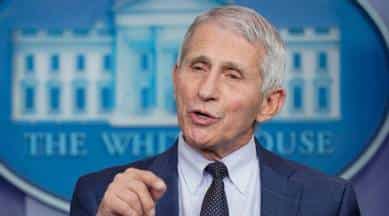
Dr. Anthony S. Fauci
Dr. Anthony Fauci, the leading infectious disease specialist in the United States, announced on Monday that he will depart the federal government in December after more than five decades of service. During the COVID-19 pandemic, he rose to national prominence and was the target of smear campaigns.
Dr. Fauci has worked as a medical researcher for 50 years. During that time, he has witnessed his effigy being burned, had protesters call him a "murderer," and had smoke bombs thrown through his office window.
However, he has also received accolades for being the most well-known physician in America and the person whose compassion and composure allowed the US to make otherwise impossibly large gains in addressing a public health catastrophe.

Dr. Anthony Fauci, 79, was in charge of immunology at the National Institutes of Health during the 1980s HIV/AIDSepidemic and has experience with conflict.
When pandemic was identified in the US six months after the first known case, the Trump White House was focusing on Dr. Fauci briefing media, and highlighting his apparent errors.
Born into a family of medics
"I was delivering prescriptions from the time I was old enough to ride a bike," he told the Holy Cross college alumni magazine in 2002.
Anthony was born on Christmas Eve, 1940, to an immigrant Italian pharmacist family in Brooklyn.
As documented by the BBC, he had contributed to the creation of Cornell Medical School's library as a student working construction jobs to support himself during the summers, and in 1966, he graduated top in his class.

The family pharmacy in Brooklyn run by Dr. Fauci's father, known in the neighbourhood as 'Doc'. Photo credits: BBC
Instead of being enlisted to fight in Vietnam after completing his medical residency, he joined the NIH in 1968 as part of the US war effort. The researchers were given the nickname "Yellow Berets," a play on the name of the military unit Green Berets.
Years later, he claimed, a report that detailed the passing of an otherwise healthy patient from a peculiar case of pneumonia typically observed in cancer patients on June 5, 1981, marked a turning point in his professional life. Another report detailing 26 deaths—all of which were gay men—suddenly appeared.
"I remember reading it very clearly," he later said. "It was the first time in my medical career I actually got goose pimples. I no longer dismissed it as a curiosity. There was something very wrong here. This was really a new microbe of some sort, acting like a sexually transmitted disease."
Called a doctor and a 'murderer'
Dr. Fauci's work as a clinician on immune system control is credited with revealing how the HIV virus undermines the body's defences. The first antiretroviral medication to treat Aids, zidovudine, was the subject of his clinical trials.
However, when the pandemic spread through the US in the 1980s, he came under fire from activists upset with the Reagan administration's lack of action and lack of access to cutting-edge medications.
Outside of government buildings, protesters held posters that read, "Dr. Fauci, you are killing us," and activists lambasted him on television.

Aids activists protesting the government's response to the epidemic in 1988.Photo credits: BBC
Even the antagonist of a play was modelled after him by playwright and homosexual rights activist Larry Kramer.
Dr. Fauci stated in a 2011 interview, "I remember peeking out a window and people on the lawn of the NIH were throwing smoke bombs. "I told the police to hold off as they prepared to arrest them. Bring them up here to my office so we can chat."
His empathy for HIV/AIDS patients was praised, and he was given credit for persuading authorities to relax limits on clinical trials so that patients may test out new medications.
He was referred to as "the government's leading Aids celebrity" by the New York Times, although the newspaper also highlighted that he actually conducted all of his own research, unlike "a lot of folks you see quoted on TV [who have] aides don white coats and do all that tiresome work." In 2008, he received the Presidential Medal of Freedom, the highest civilian honour bestowed by the US.
He was named director of the NIH's division of Allergy and Infectious Diseases in 1984, and he still retains that position today.
Working with Trump
He has been in charge of studies on everything from Aids to Ebola to asthma in his research division.
He has provided advice to six presidents, including George W. Bush, and is currently the public's principal expositor of the Covid-19 outbreak during the Trump administration.
He has established himself as a dependable figure for Americans in front of the podium at White House Covid-19 briefings, where he has provided information regarding the US response, clarified the science, and occasionally corrected President Trump's statements.
He has stated that developing a vaccine will take at least a year and a half, contradicting Mr. Trump's hopeful assumption that one would be available very soon.

Former US president, Donald Trump and National Institute of Allergy and Infectious Diseases Director Anthony Fauci arrive for a briefing on the coronavirus pandemic in the press briefing room of the White House on March 26, 2020 in Washington, DC.Photo credits: Getty
Trump, who is known to dislike being challenged, has even begrudgingly given Dr. Fauci a high compliment. The researcher, Mr Trump has said, is "a major television star" as reported by the BBC.
However, observers claim that his denials of the president's assertions have exposed the conflicts that can arise when working with the White House. The US "could have saved lives" if it had taken action to halt Covid-19, Dr. Fauci said in an interview with CNN, prompting Trump to tweet about dismissing him.
According to Dr. Fauci, when it comes to providing the public with accurate information, "I'm making an effort. I can't accomplish the impossible ".
"I'm not allowed to charge the podium and knock President Trump to the ground. He said it, okay. Let's try to fix it so it doesn't happen again."
However, he promised to keep going and added, "To my knowledge, I haven't been fired."